

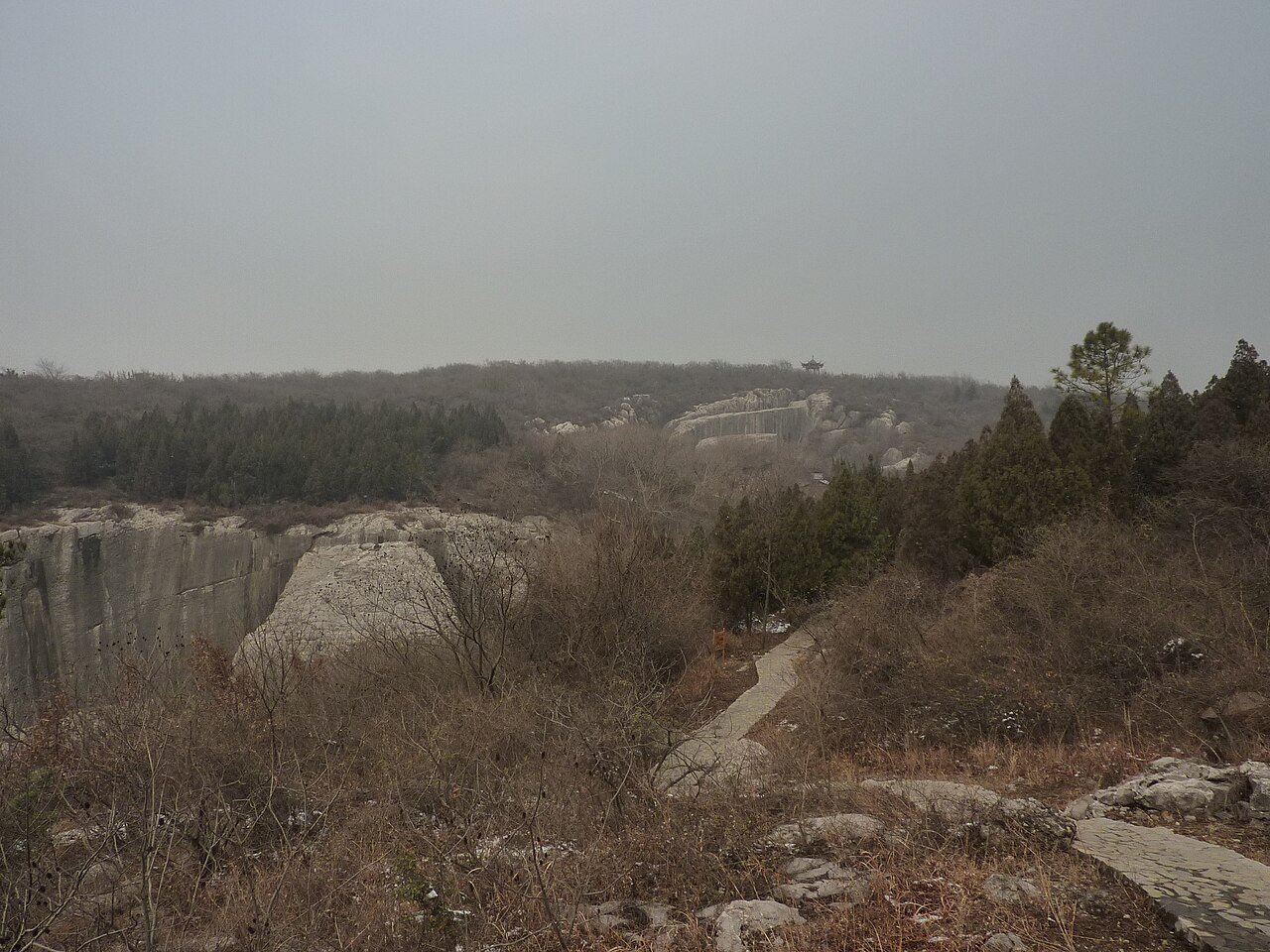
On a wooded hillside 25 kilometres south-east of Nanjing lie the three rough-cut sections of the largest stone object ever quarried by human hands — a stele commissioned by the Yongle Emperor in 1405 that proved too massive to move, and has never left the mountain.
At a glance
Yangshan Quarry is the site of an unfinished Ming Dynasty imperial monument of extraordinary scale. Around 1405, the Yongle Emperor — the same ruler who built the Forbidden City and ordered the extension of the Great Wall — commissioned a giant commemorative stele to honour the tomb of his father, the Hongwu Emperor, founder of the Ming Dynasty. The planned monument would have stood approximately 73 metres tall, taller than the Washington Monument, and weighed an estimated 16,250 tonnes assembled. Quarry workers succeeded in rough-cutting three massive sections from the Yangshan mountain: a cap, a body, and a base. Then the project was silently abandoned. No technology of the early 15th century could move a stone block of that weight even a single kilometre, let alone 25 kilometres to its intended home at the Ming Xiaoling Mausoleum. The three sections remain on the hillside exactly where the workers left them in 1405, with the tool marks of Ming dynasty stone-cutters still visible on their surfaces. The site opened as a public park in the 1990s.
Key facts
- Date quarried: c. 1405 AD, early Ming Dynasty, reign of the Yongle Emperor
- Commissioned by: Emperor Yongle (Zhu Di), to honour his father Emperor Hongwu at Ming Xiaoling Mausoleum
- Planned height: approximately 73 metres assembled — taller than the Washington Monument (55 m)
- Estimated total weight: approximately 16,250 tonnes — three times heavier than any stone successfully moved in history
- Three sections: stele cap (approx. 8.4 m tall, 16 m wide); stele body (approx. 25 m tall, 4 m wide); tortoise-form base (approx. 13 m tall, 30 m wide)
- Material: granite, quarried from Yangshan mountain
- Status: rough-cut, never finished, never moved; each section remains on the slope attached to or resting near the original bedrock
History
The Yongle Emperor (reigned 1402–1424) was one of the most ambitious builders in Chinese history. In a single reign he relocated the imperial capital from Nanjing to Beijing, constructed the Forbidden City, launched the naval expeditions of Zheng He, and extended the Great Wall. His father, the Hongwu Emperor, founded the Ming Dynasty and was buried at the Ming Xiaoling Mausoleum outside Nanjing. Yongle decided to honour this tomb with the largest commemorative stele ever built in China.
The commission was assigned to imperial workshops and quarrying began at Yangshan, a granite mountain approximately 25 kilometres from the mausoleum. The plan called for three sections: a decorative cap, a tall rectangular body bearing an imperial inscription, and a massive base in the form of a bixi — the traditional tortoise-shaped pedestal of Chinese commemorative architecture. Workers cut deep trenches around each block and roughed out the forms. The scale was unprecedented: the base alone, at roughly 13 metres tall and 30 metres wide, would have been the largest single quarried stone object in the world.
At some point the project was abandoned. The historical record is silent on the exact date or decision. Modern engineering analysis concludes that no method available in 1405 could move any of the three sections from the quarry to the mausoleum. The stele body alone, at an estimated 6,300 tonnes, is 75 times heavier than Stonehenge’s largest stone. The workers were stopped by physics. The quarry was later used for smaller objects during the Ming and Qing dynasties, but the three giant sections were left untouched. A public park was established in the 1990s.
What you see
The three sections are arranged across the hillside at intervals of roughly 300 metres, connected by a paved walking path through forested slopes. The stele body is the most dramatic: approximately 25 metres long and 4 metres wide, lying at a slight angle on the slope with its lower end still connected to the bedrock by an uncut slab. The surface was worked to a relatively smooth finish on the upper faces; the lines of the chisels are traceable. The scale is difficult to comprehend until you walk alongside it — the stone is roughly the height of a seven-storey building laid on its side, and there is no fence between you and it.
The base (tortoise pedestal) is the heaviest section, broader and lower, with the rough bixi outline visible from above but detail work never begun. The cap sits on a separate part of the hillside; its cloud-and-dragon decoration was only sketchily roughed in before work stopped. A small museum near the entrance provides models and diagrams of what the assembled monument would have looked like.
Practical information
- Address: Yangshan Quarry Park (阳山碑材), Jiangning District, Nanjing, Jiangsu Province, China
- Opening hours: generally open daily during daylight hours; verify locally as hours vary seasonally
- Admission: nominal fee; check current rates on arrival
- Best time to visit: spring (March–May) and autumn (September–November); summer is hot and humid
- Photography: unrestricted; stele body is most photogenic in early morning or late afternoon light
Getting there
Yangshan Quarry is approximately 25 kilometres south-east of Nanjing city centre in Jiangning District. The most practical access is by taxi or ride-share (approximately 40–50 minutes; roughly 60–80 RMB). The site is not easily reachable by public transport from the city centre. Many visitors combine Yangshan with the Ming Xiaoling Mausoleum on the Purple Mountain, the monument the stele was intended to honour.
Nearby
- Ming Xiaoling Mausoleum — the tomb of Emperor Hongwu, intended destination of the unfinished stele; UNESCO World Heritage Site, approximately 20 km north-west
- Purple Mountain (Zijin Shan) — forested mountain east of Nanjing with Sun Yat-sen Mausoleum, the Nanjing Observatory, and extensive parkland
- Nanjing City Wall — the longest surviving pre-modern city wall in the world, built under the Hongwu Emperor in the 14th century
Sources
- Wikipedia, Yangshan Quarry, en.wikipedia.org
- Paludan, Ann. Chronicle of the Chinese Emperors. Thames & Hudson, 1998.
- Steinhardt, Nancy Shatzman. Chinese Architecture. Yale University Press, 2002.
- Nanjing Municipal Bureau of Culture and Tourism — Yangshan Quarry heritage listing
Find it on the map
See this place and what’s around it →📷 Become a Cultural Heritage Online photographer
Share your photos of places: they stay published under your name as the author. The more they're seen, the more you get noticed — and soon a contest will reward the most appreciated photos.
Log in or sign up free to add a photo