
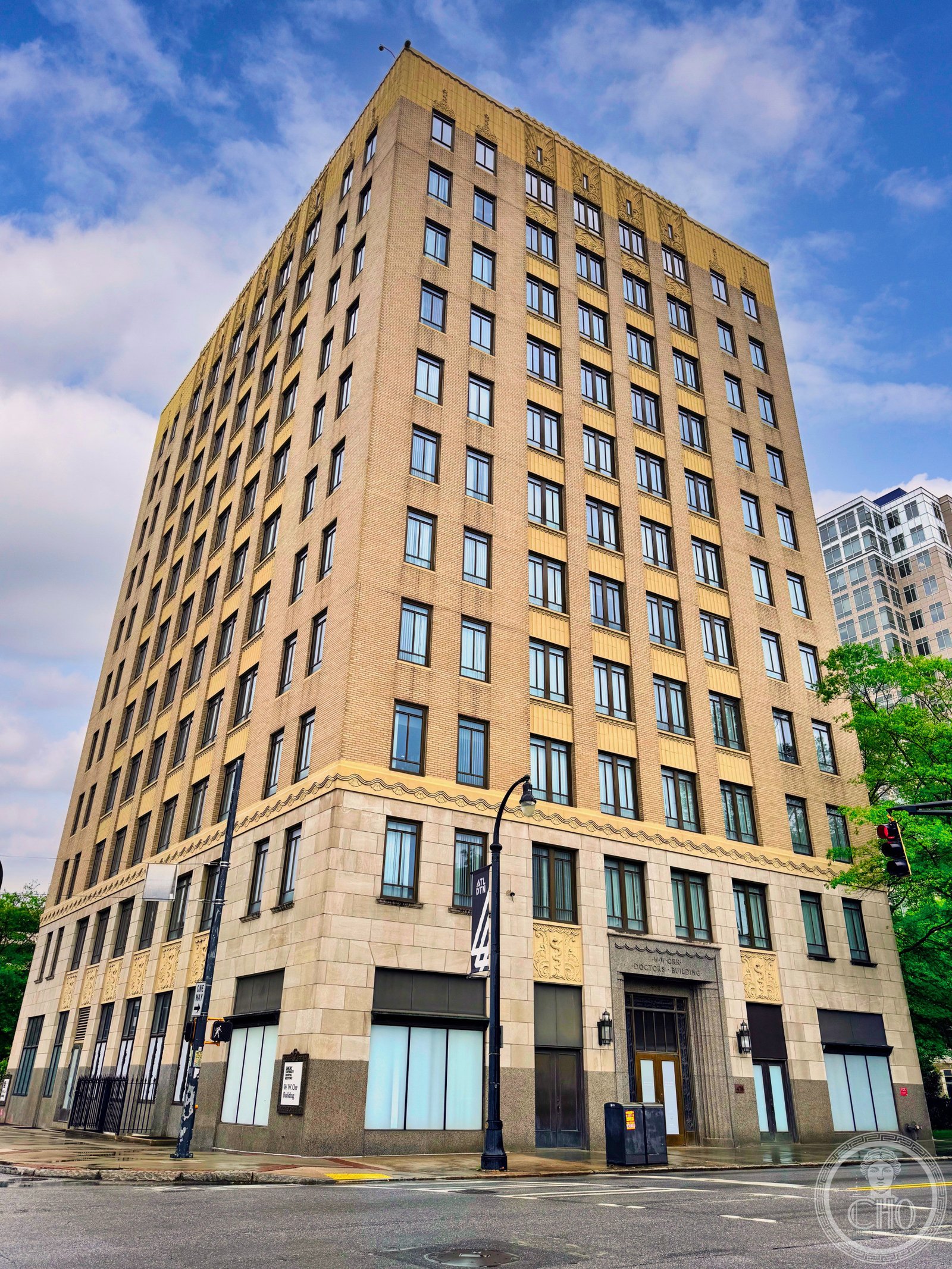
Atlanta’s first Art Deco medical tower, where caducei carved in stone announced a new kind of Peachtree Street.
At a glance
One of Atlanta’s earliest Art Deco landmarks, the W.W. Orr Building rose eleven stories at 478 Peachtree Street NE in 1930, nearly a mile north of the commercial core — a distance that announced the automobile age for Peachtree Street’s northward expansion. Architect Francis Palmer Smith of Pringle and Smith gave the medical tower a facade decorated with serpents and staffs, the caduceus motif declaring the building’s purpose in carved stone. Now part of Emory University Hospital Midtown’s campus, it remains a functioning medical building and a designated City of Atlanta landmark.
Key facts
- Built: 1930
- Architect: Francis Palmer Smith (Pringle and Smith), Atlanta
- Style: Art Deco
- Floors: 11
- Address: 478 Peachtree Street NE, Atlanta, Georgia 30308
- Landmark: City of Atlanta, October 23, 1989
- Current use: Medical offices, Emory University Hospital Midtown complex
History
Wayman W. Orr, president of the Atlanta Retail Merchants’ Association in the 1910s, gave his name to the building that Pringle and Smith designed as one of their first departures from Beaux-Arts convention. The firm had spent two decades producing Neo-Classical and Beaux-Arts buildings across Atlanta; the Orr Building and the William-Oliver Building — completed the same year — marked their pivotal transition to the Art Deco vocabulary then transforming American commercial architecture.
When it opened in 1930, the Orr Building’s location seemed eccentric. The commercial center of Atlanta was clustered closer to Five Points, a mile south. But the city had begun the northward automobile migration that would redefine Peachtree Street as a boulevard rather than a pedestrian commercial strip. The Orr Building was among the first structures built specifically for medical offices so far from downtown — making it both an architectural landmark and a signpost of Atlanta’s expanding urban geography. The site had previously been occupied by the residence of J. Bulow Campbell in the 1890s, before the block was redeveloped.
The building has operated continuously as a medical facility since opening. Its integration into the Emory University Hospital Midtown campus reinforced the purpose already announced in its decorative program. The City of Atlanta recognized it as a local landmark on October 23, 1989. It was the city’s second building constructed specifically for medical offices, after the Medical Arts Building.
What you see
At street level, the entrance draws the eye with caducei carved into the pale stone: serpents wound around staffs, the ancient emblem of medicine rendered in the crisp geometric vocabulary of 1930s Art Deco. The motif recurs at intervals up the facade — a design choice that is not merely ornamental but explicit, declaring the building’s function in the language of classical symbolism while framing it in a resolutely modern idiom.
The vertical lines and setback profile are characteristic of the Pringle and Smith Art Deco interpretation of the early 1930s, applied here to a medical professional tower rather than a mixed commercial block. The eleven-story mass rises with restrained elegance, flanked today by the broader Emory Midtown hospital complex that has grown around it in subsequent decades without obscuring its Peachtree Street frontage.
Practical information
- Active medical offices; entry restricted to patients and staff
- Exterior viewing from Peachtree Street NE unrestricted from the sidewalk
- The Atlanta landmark designation covers the exterior facade
- Best photographed mid-morning from across Peachtree Street, before direct afternoon sun
- Parking in Emory University Hospital Midtown surface lots on adjacent streets
Getting there
478 Peachtree Street NE is in Midtown Atlanta’s SoNo neighborhood, accessible from MARTA’s Arts Center station (Red and Gold lines), approximately eight minutes on foot north on Peachtree. By car, exits from I-75/85 (Downtown Connector) at 10th Street lead to Peachtree Street NE within three minutes. Hartsfield-Jackson Atlanta International Airport is 12 miles south. GPS: 33.7677°N, 84.3856°W.
Nearby
- William-Oliver Building (1930) — companion Pringle and Smith Art Deco building on Auburn Avenue, completed the same year as the Orr Building
- Fox Theatre (1929) — Peachtree Street, Atlanta’s great Moorish-Deco movie palace, a five-minute walk south
- Emory University Hospital Midtown — immediate surroundings; the Orr Building is now part of the campus complex
Sources
- Wikipedia: W. W. Orr Building
- Craig, Robert M. Atlanta Architecture: Art Deco to Modern Classic, 1929–1959 (Pelican Publishing, 1995), p. 32
- Craig, Robert Michael. The Architecture of Francis Palmer Smith, Atlanta’s Scholar-architect (University of Georgia Press, 2012)
- Atlanta Historic Preservation: local landmark designation records, October 23, 1989
Find it on the map
See this place and what’s around it →Record researched and written by Luigi De Marchi for Cultural Heritage Online, 2026.
📷 Become a Cultural Heritage Online photographer
Share your photos of places: they stay published under your name as the author. The more they're seen, the more you get noticed — and soon a contest will reward the most appreciated photos.
Log in or sign up free to add a photoIs this page about you?
This page is read by travellers and heritage enthusiasts who find it on Google. Tell us how you are connected to this place and we will take it from there.