

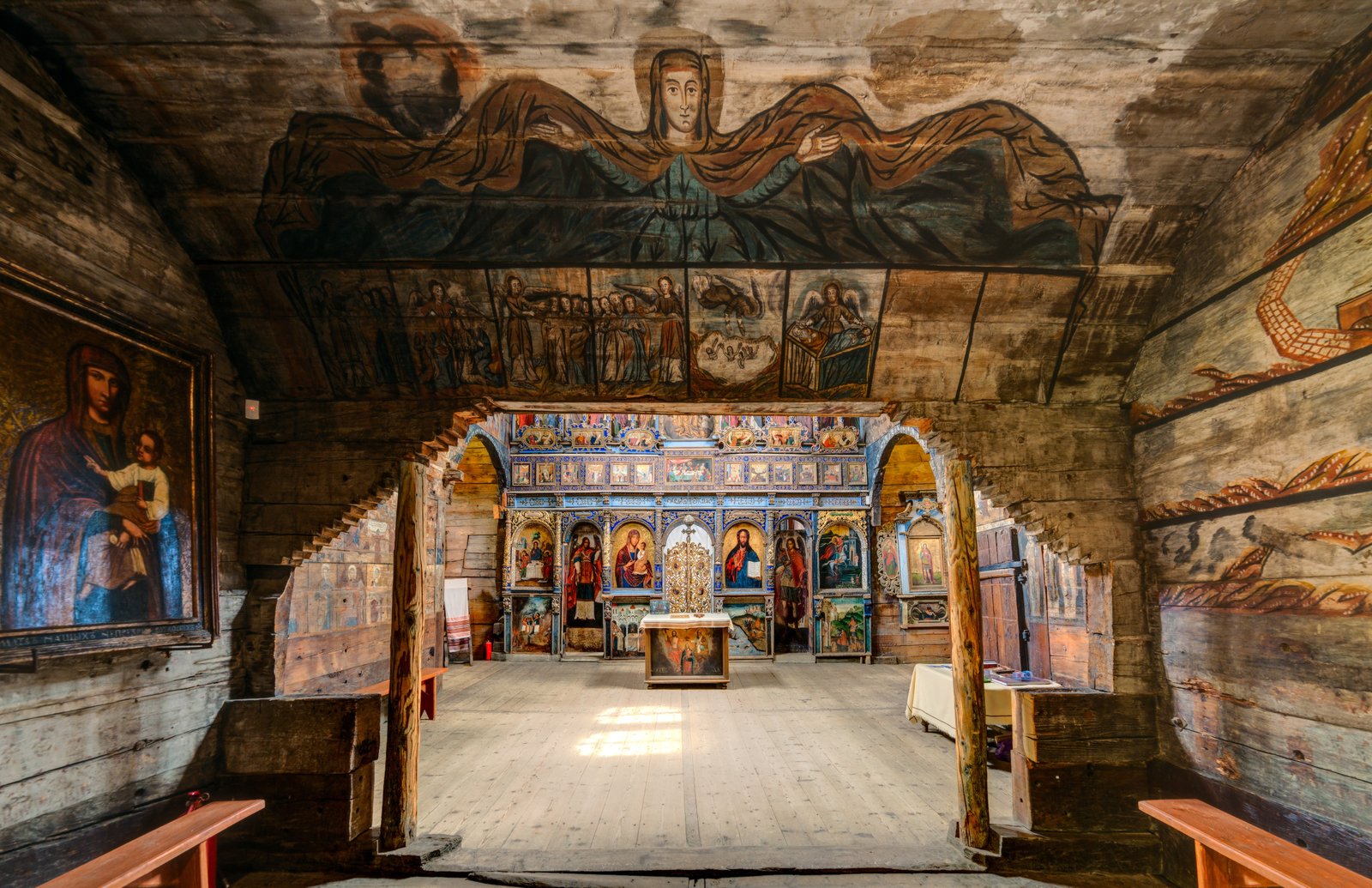
In remote Carpathian villages on both sides of the Polish-Ukrainian border, sixteen wooden churches survive from a vernacular building tradition that maintained a distinct Ruthenian spiritual and architectural identity through centuries of foreign domination: one of the finest achievements of European religious folk architecture.
At a glance
The tserkva (Ukrainian/Ruthenian wooden church) is a distinctive architectural form characterised by log construction, a tripartite east-west plan (narthex, nave, sanctuary), multiple helmet-shaped or onion-shaped domes, and elaborate interior polychrome frescoes. UNESCO inscribed 16 tserkvas across Poland (8) and Ukraine (8) in 2013 as a trans-national serial World Heritage Site, recognising them as outstanding examples of a living vernacular tradition that spans from the late 16th to the early 19th century. The buildings survive because the Carpathian villages in which they stand remain remote and economically marginal, largely bypassed by 20th-century development.
Key facts
- UNESCO inscription: 2013 (List No. 1424rev), trans-national serial site
- Components: 8 tserkvas in Poland (Subcarpathian Voivodeship and Lesser Poland Voivodeship) + 8 in Ukraine (Lviv, Ivano-Frankivsk, Zakarpattia oblasts)
- Date range: 16th-19th century CE; most finest examples from the 17th-18th century
- Construction: horizontal log construction with square timber notching; no nails in the structural frame
- Religious tradition: Greek-Catholic (Ukrainian Byzantine Rite) and Ukrainian Orthodox
- Architectural signature: tripartite plan (narthex-nave-sanctuary), multiple domes, polychrome interior frescoes
- Preservation context: survived because remote villages remained poor and undeveloped through the 20th century
History and significance
The tserkva tradition emerged from the Ruthenian population of the Carpathian mountain region: a community that was neither Polish Catholic nor Russian Orthodox, but adhered to the Greek-Catholic (Uniate) church, which maintained Byzantine liturgical rites while accepting papal authority after the Union of Brest in 1596. The tserkva was the physical expression of this distinct religious and ethnic identity, built in a vernacular style that deliberately differed from both the Latin-rite churches of Poland to the west and the Orthodox churches of Russia to the east.
The buildings were constructed without architects in the formal sense: by local master carpenters who transmitted knowledge of plan, proportion, and structural technique orally across generations. The resulting forms are extraordinarily consistent across a large geographic area, suggesting a shared aesthetic tradition maintained over centuries. The interior frescoes, painted by itinerant artists in the 17th and 18th centuries, depict scenes from the Orthodox liturgical calendar in a style that blends Byzantine iconographic conventions with Carpathian folk art.
The survival of the tserkvas is paradoxical: many were threatened not by neglect but by forced population movements. The post-World War II transfer of the Lemko and Bojko populations from the Polish Carpathians to the Soviet Union and to western Poland left many tserkvas in villages from which their congregations had been expelled. Some were converted to Roman Catholic use; others stood empty for decades. The UNESCO inscription acknowledged not just architectural beauty but the complex history of cultural survival and loss.
What you see
Each tserkva is a unified organic composition: the logs of the walls are squared and notched at the corners without metal fasteners; the domes rise in tapering octagonal tiers from a square base, producing the characteristic silhouette. The roof shingles are of split wood, weathered to silver-grey. The proportions are compact and powerful, the buildings seeming to grow from the hillside landscape rather than being placed upon it.
Inside, the tripartite plan is experienced as a sequence of enclosed spaces of increasing sanctity from the narthex (where worshippers stand) through the nave to the sanctuary (separated by an iconostasis). The iconostasis—the wall of icons separating nave from sanctuary—is the liturgical and artistic centrepiece: in the finest examples (such as the church at Kwiaton in Poland, 1700) it is painted across its full height with a hierarchical programme of saints, prophets, and Pantocrator images in ochre, ultramarine, and crimson. The surrounding wall frescoes extend the programme to scenes of the Last Judgement, the Tree of Jesse, and local saints.
Notable individual components include the church at Kwiaton (Malopolska, Poland, 1700), one of the most complete and accessible examples; the church of the Nativity of Christ at Rohatyn (Ivano-Frankivsk Oblast, Ukraine, 16th century); and the church of St Michael at Uzhok (Zakarpattia Oblast, Ukraine, 1745-1745).
Practical information
- Access: the Polish tserkvas are more accessible by public transport; the Ukrainian components require a car or local tour
- Poland entry: Kwiaton church (Malopolska) is accessible from Nowy Sacz (40 km); Powroznik church is near Krynica-Zdroj resort
- Ukraine entry: Rohatyn and Drohobych churches are near major cities; Zakarpattia components require more travel
- Opening hours: variable; many are active parish churches and open for services; some have designated visiting hours — check locally
- Photography: generally permitted outside; ask permission inside, particularly during services
- Best season: May-October; Carpathian winters close some mountain roads
Getting there
For the Polish components, fly to Krakow (KRK) or Rzeszow (RZE) and travel south toward the Carpathian foothills. Kwiaton (the most visited example) is approximately 40 km south of Nowy Sacz. For the Ukrainian components, fly to Lviv (LWO) or cross from Poland at the Medyka-Shehyni or Krakowiec border crossings; Rohatyn is 65 km southeast of Lviv. A dedicated tserkva tour covering major examples on both sides of the border is feasible in 3-4 days.
Nearby
- Bieszczady National Park, Poland — wild Carpathian mountain landscape adjacent to several Polish tserkva sites; famous for wildlife
- Lviv Old Town, Ukraine (UNESCO WHS) — one of Central Europe’s best-preserved historic city centres, accessible from the Ukrainian components
- Krakow, Poland (UNESCO WHS) — the most practical gateway city for the Polish Carpathian tserkva route
- Skansen Museum of Folk Architecture, Sanok, Poland — open-air museum with relocated Carpathian vernacular buildings including tserkvas
Sources
- UNESCO World Heritage List — Wooden Tserkvas of the Carpathian Region in Poland and Ukraine (No. 1424rev, 2013)
- Wikipedia — Wooden Tserkvas of the Carpathian Region in Poland and Ukraine
- Przybyszewska-Jarminska, B. (2013). Heritage of Carpathian Wooden Churches. Warsaw: NIMOZ.
Find it on the map
See this place and what’s around it →📷 Become a Cultural Heritage Online photographer
Share your photos of places: they stay published under your name as the author. The more they're seen, the more you get noticed — and soon a contest will reward the most appreciated photos.
Log in or sign up free to add a photo