
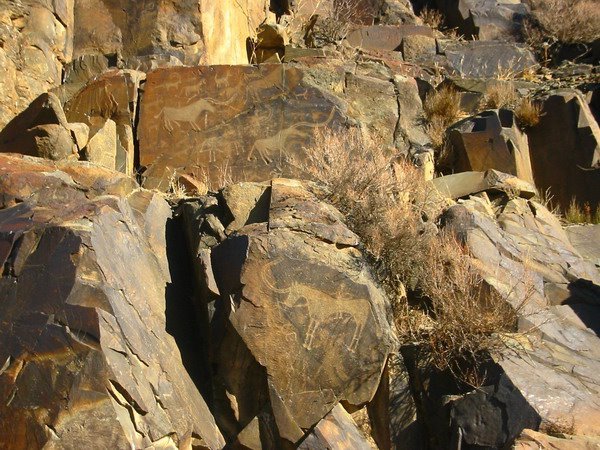
In a remote granite gorge of the Chu-Ili Mountains, approximately 5,000 rock carvings span four millennia of Central Asian sacred art: from extraordinary Bronze Age solar deities found nowhere else in the world, to Saka hunters, Turkic inscriptions, and early modern Kazakh clan marks.
At a glance
The Tamgaly gorge lies about 170 km northwest of Almaty in southeastern Kazakhstan. The desert-varnished granite surfaces of the Chu-Ili Mountains provided an ideal carving medium, and successive peoples of the Eurasian steppe used this sheltered valley for ceremony, burial, and art for approximately 3,500 years. UNESCO inscribed the site in 2004 as an outstanding example of Central Asian rock art, particularly for the Late Bronze Age solar deity figures: large anthropomorphic figures with radiating sun-disc heads that have no precise parallel anywhere else in the world.
Key facts
- UNESCO inscription: 2004 (List No. 1145)
- Petroglyphs: approximately 5,000 individual carvings in more than 40 concentrations
- Chronological span: c. 1500 BCE (Late Bronze Age) to early 20th century CE
- Location: Chu-Ili Mountains, Zhambyl District, Almaty Region; approximately 170 km northwest of Almaty
- Defining feature: solar deity figures with radiating sun-disc heads, unique in Central Asian rock art
- Associated features: Bronze Age burials, offering platforms, and traces of ritual fires near the main panels
- Surface technique: carved into desert varnish (manganese-oxide patina), producing lighter figures against dark rock
History and significance
The earliest petroglyphs at Tamgaly date to c. 1500-1200 BCE, corresponding to the Late Bronze Age Andronovo cultural complex of the Eurasian steppe. The people who carved the main panels chose Tamgaly for its protected microclimate, reliable water, and exceptional rock surface. The concentration of solar deity images in the central panels suggests the gorge functioned as a major ceremonial site, possibly a place of pilgrimage for the wider steppe region.
Later Iron Age additions (c. 800-200 BCE) by Saka (Scythian-related) peoples introduced hunting scenes and the dynamic animal-style characteristic of Central Asian nomadic art. The Turkic period (6th-12th century CE) added inscriptions and tamgas (clan marks). The latest petroglyphs, some with Islamic inscriptions, date to the 19th and early 20th centuries, making Tamgaly a site of unbroken use spanning some 3,500 years.
The Bronze Age solar deity figures are particularly significant because their stylistic parallels with petroglyphs in the Altai Mountains and Minusinsk Basin of southern Siberia suggest a unified religious iconography that may have extended across much of the Eurasian steppe during the 2nd millennium BCE.
What you see
The gorge opens gradually from the surrounding steppe, granite walls rising as the path narrows. Petroglyphs are distributed across more than 40 concentrations; the most important is the central Main Sanctuary where the solar deity figures are densest. The carvings are made into the dark desert varnish, appearing lighter than the surrounding rock surface.
The Bronze Age solar deity figures are the visual centrepiece: large figures (30-50 cm) with human bodies and enormous round radiating heads, some shown in ritual poses or in paired compositions that may represent fertility or marriage ceremonies. Surrounding them are animals carved in various styles: horses, camels, deer, ibex, wild boar, snow leopards, dogs. The Iron Age panels are stylistically distinct: smaller, more dynamic figures in motion rather than the frontal, hieratic Bronze Age style.
At the base of several major panels, Bronze Age burials and offering deposits have been found, confirming that the carvings were the focus of sustained ritual activity. Small stone structures interpreted as offering platforms remain visible near the most significant carving groups.
The solar deity images
The solar deity petroglyphs are the site’s most studied and debated feature. Their radiating head-discs are far larger and more elaborate than sun symbols found at contemporary steppe sites, and the associated iconography suggests a developed theological programme. Some researchers propose connections to proto-Indo-Iranian solar religion; others emphasise the local Bronze Age context. The debate remains open, making Tamgaly a live site of scholarly inquiry as well as a visual wonder.
Practical information
- Getting there: 170 km northwest of Almaty by car; no public transport — hire a driver or join a day tour from Almaty
- Entry: small admission fee; local guides available and recommended
- Best season: April-June and September-October; summers (40°C+) are extreme; winters are harsh
- What to bring: sturdy shoes for rocky terrain; sun protection; water (none available on site)
- Duration: 3-5 hours for main panels; a full day for outer concentrations
- Photography: permitted throughout; morning light from the east illuminates the main panels best
Getting there
The nearest major airport is Almaty International Airport (ALA), approximately 200 km southeast. From Almaty, take the A2 highway northwest toward Zhambyl District; the site is signposted near the village of Karabastau. Most visitors arrange a day trip through Almaty-based tour operators; the final approach road requires a vehicle with good ground clearance. Several operators offer combined Tamgaly and Charyn Canyon day tours.
Nearby
- Charyn Canyon (200 km east of Almaty) — spectacular red sandstone canyon often combined with Tamgaly
- Central State Museum of Kazakhstan, Almaty — important Bronze Age steppe artefacts providing essential context
- Issyk Kurgan (east of Almaty) — burial mound of the Golden Man (Saka warrior, c. 5th century BCE)
- Big Almaty Lake — glacial Tian Shan lake, popular day trip from Almaty
Sources
- UNESCO World Heritage List — Petroglyphs within the Archaeological Landscape of Tamgaly (No. 1145, 2004)
- Wikipedia — Tamgaly
- Maryashev, A.N. & Goryachev, A.A. (2002). Rock Art of the Semirech’e. Almaty: Institute of Archaeology.
Find it on the map
See this place and what’s around it →📷 Become a Cultural Heritage Online photographer
Share your photos of places: they stay published under your name as the author. The more they're seen, the more you get noticed — and soon a contest will reward the most appreciated photos.
Log in or sign up free to add a photo