
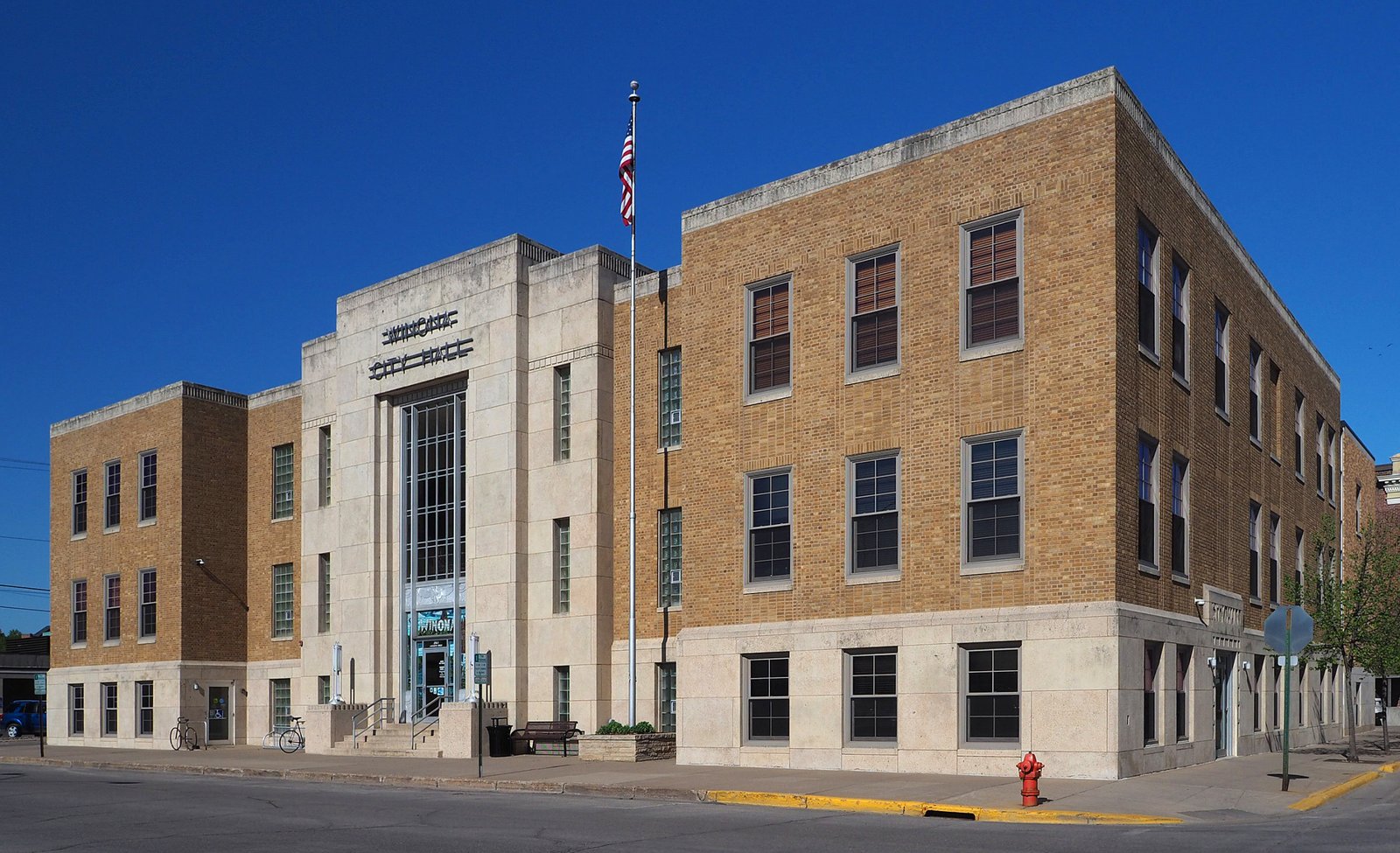
Boyum, Schubert & Sorenson’s 1939 city hall in Winona, Minnesota stands as an outstanding example of the PWA Moderne style—Classical Moderne architecture whose massive civic presence on Lafayette Street embodies the last great expression of New Deal public building in Minnesota before America’s entry into World War II.
At a glance
Winona City Hall at 207 Lafayette Street in Winona, Minnesota was designed by the firm of Boyum, Schubert & Sorenson and completed in 1939. Listed on the National Register of Historic Places on July 8, 1999, under NRHP reference 99000806, the building was recognized as “a local example of the massive federal relief efforts of the New Deal and for its exceptional Classical Moderne architecture.” The architectural style is designated as PWA Moderne (Public Works Administration Moderne) in the building’s NRHP nomination, a variant of Art Deco that the federal government favored for Depression-era civic buildings—combining the stripped classical forms of official governmental architecture with the geometric ornamental vocabulary of the Art Deco period. Winona’s position as an important Mississippi River port city of the upper Midwest gave its city hall a civic significance that the building’s architectural ambition reflects.
Key facts
- Built: 1939
- Architects: Boyum, Schubert & Sorenson
- Style: PWA Moderne / Classical Moderne
- Address: 207 Lafayette Street, Winona, Minnesota 55987
- NRHP: ref. 99000806, listed 8 July 1999
- Significance: Recognized as a local example of New Deal massive civic relief efforts; exceptional Classical Moderne architecture
- Current use: Active Winona City Hall
History
Winona, Minnesota developed as one of the most prosperous cities of the upper Midwest in the nineteenth century, built on the lumber and wheat trade that passed through its Mississippi River port. The city’s prosperity in the 1860s through 1880s produced a built environment of exceptional quality, and the architectural ambitions of the 1939 city hall were a continuation of a civic tradition that had characterized Winona since the Civil War era. By the late 1930s Winona was benefiting from the Public Works Administration’s program of civic building construction, which provided federal funding for public facilities in cities and counties across the country during the Depression.
The PWA Moderne style that the Winona City Hall exemplifies was the architectural language that the federal government preferred for its supported civic buildings in the late New Deal period: a stripped-down classicism that retained the gravitas of traditional institutional architecture while acknowledging the ornamental modernism of Art Deco through geometric detailing and the elimination of applied historical ornament. The style sits at the meeting point of the Beaux-Arts tradition and the Art Deco period, and Winona’s city hall is one of the most accomplished examples of this synthesis in Minnesota.
The building was completed in 1939, just two years before the United States entered World War II, making it one of the last major Depression-era public buildings to be completed in the region before wartime material shortages and construction priorities ended the New Deal building program. The NRHP listing in 1999 recognized the building’s historical significance within this broader civic context.
What you see
The Winona City Hall presents its PWA Moderne character through a massive symmetrical facade whose vertical elements emphasize height and civic authority. The stripped classical composition—with its flat wall surfaces, minimal ornament, and the geometry of the window arrangement—represents the Art Deco era’s transformation of classical civic architecture: the forms of the Beaux-Arts tradition distilled to their essential geometric structure without the applied historical decoration that would have characterized an earlier generation of civic buildings.
Lafayette Street in central Winona provides the building with a civic setting appropriate to its scale and ambition. The surrounding downtown commercial district, largely built in the 1860s–1890s boom years, includes some of the finest Victorian commercial architecture in the upper Midwest, and the 1939 city hall reads as Winona’s generation-spanning commitment to architectural quality in its public buildings.
Practical information
- Status: Active Winona City Hall; open during normal business hours
- Exterior: Freely viewable from Lafayette Street at all times
- Photography: Exterior from public sidewalk freely permitted
- Time needed: 15–20 minutes for exterior; Winona’s compact historic downtown is entirely walkable
Getting there
Winona is on the Mississippi River in southeastern Minnesota, accessible via US Route 61 (the Great River Road) and I-90 (20 miles south at La Crescent). The La Crosse Regional Airport is 25 miles south in Wisconsin. Minneapolis is 110 miles northwest via US 61 and MN 43. The city hall is on Lafayette Street in central Winona, two blocks from the Mississippi River levee. Winona is known for its preserved 19th-century commercial and residential architecture and for the Saint Mary’s University campus.
Nearby
- Winona Armory (1915) — National Guard armory in the historic district; Craftsman-influenced design on Johnson Street
- Julius C. Wilkie Steamboat Center — Mississippi River waterfront museum in a restored 1890s sternwheel steamboat; Levee Park on the river bank
- Great River Road — US Route 61 north and south of Winona follows the Mississippi River through bluff country; one of the most scenic drives in the Midwest
- Garvin Heights Viewpoint — overlook 575 feet above the Mississippi valley, 1 mile south of downtown; panoramic views of the river valley and the city
Sources
- Wikipedia, “Winona City Hall” — primary narrative source
- National Register of Historic Places, ref. 99000806 (8 July 1999)
- Wikimedia Commons, Winona_City_Hall.jpg
Find it on the map
See this place and what’s around it →Record researched and written by Luigi De Marchi for Cultural Heritage Online, 2026.
📷 Become a Cultural Heritage Online photographer
Share your photos of places: they stay published under your name as the author. The more they're seen, the more you get noticed — and soon a contest will reward the most appreciated photos.
Log in or sign up free to add a photoIs this page about you?
This page is read by travellers and heritage enthusiasts who find it on Google. Tell us how you are connected to this place and we will take it from there.