
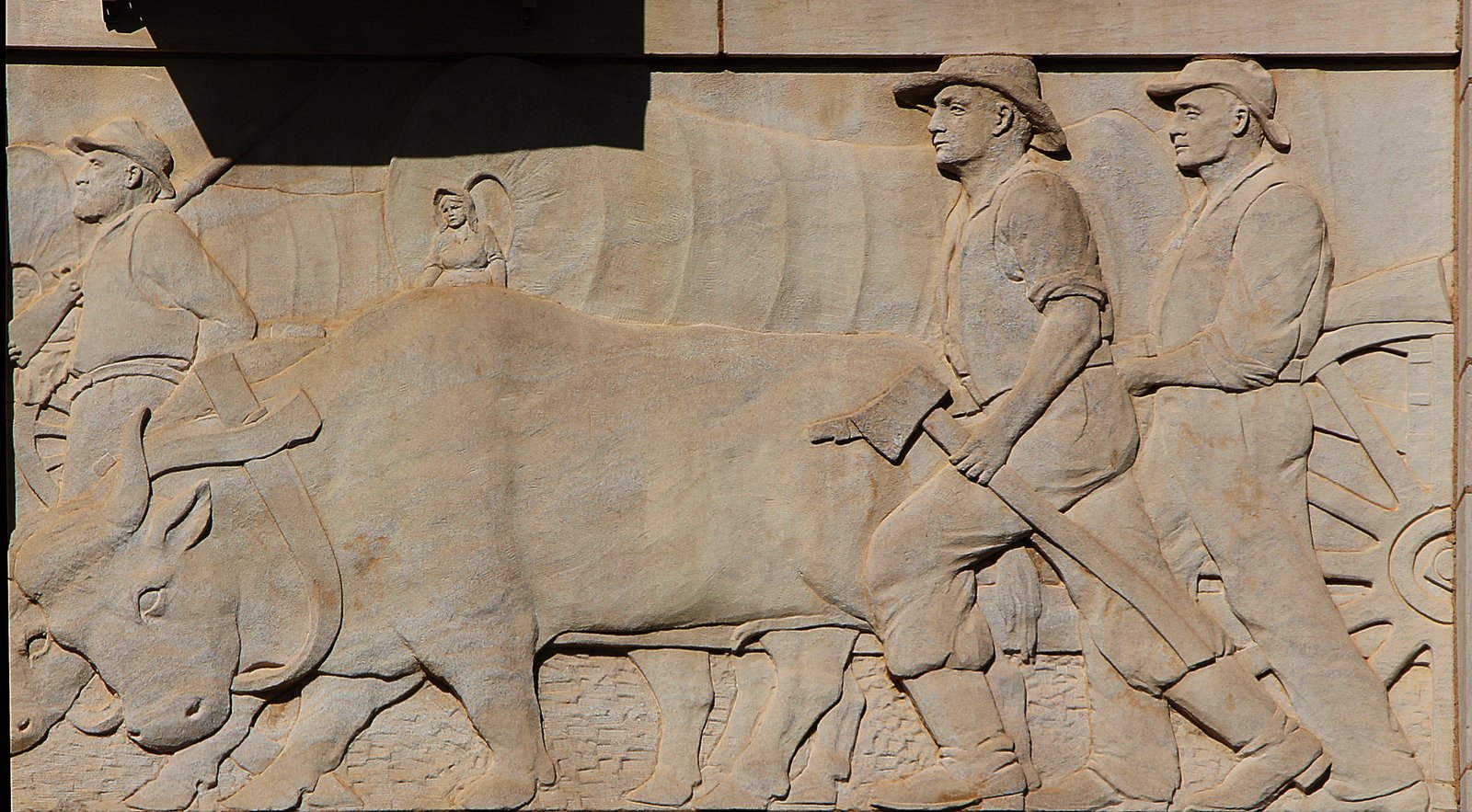
Smith & Senter’s 1932 Art Deco courthouse at 500 Harrison Street in Pawnee, Oklahoma, is one of only two courthouses in the state to attempt a synthesis of Native American and pioneer iconography in its ornamental program—bas-relief panels depicting an eagle, owl, rattlesnakes, and cow’s skull at the lintel, with heads of Native Americans at the building’s crown, creating an architectural document of Oklahoma’s bicultural heritage at the height of the Art Deco period.
At a glance
The Pawnee County Courthouse at 500 Harrison Street in Pawnee, Oklahoma was designed by the firm of Smith & Senter and built in 1932 by the Manhattan Construction Company. It is a three-story Art Deco brick building listed on the National Register of Historic Places on August 23, 1984. Pawnee County takes its name from the Pawnee Nation, one of the Great Plains tribes with deep historical roots in the Oklahoma Territory, and the courthouse’s ornamental program reflects this heritage: the lintel incorporates bas-relief panels depicting “an eagle, a cow’s skull, an owl, an open book and two rattlesnakes,” while the building’s upper section features “heads of Native Americans.” Wikipedia identifies it as “one of only two Oklahoma courthouses attempting to blend Native American and pioneer artistic imagery.”
Key facts
- Built: 1932
- Architects: Smith & Senter
- Contractor: Manhattan Construction Co.
- Style: Art Deco
- Address: 500 Harrison Street, Pawnee, OK 74058
- NRHP: ref. 84003406, listed 23 August 1984
- Ornament: Bas-relief panels: eagle, cow’s skull, owl, open book, rattlesnakes (lintel); heads of Native Americans (crown)
- Distinction: One of only two Oklahoma courthouses to blend Native American and pioneer imagery
History
Pawnee, Oklahoma is the county seat of Pawnee County, named for the Pawnee Nation, whose traditional homeland stretched across the Great Plains of Nebraska and Kansas and whose members were relocated to a reservation in what is now Pawnee County, Oklahoma in 1876. The county was organized at Oklahoma statehood in 1907, and Pawnee developed as the governmental and commercial center of an area where the historical presence of the Pawnee people—along with other Native American nations and the Anglo-American settler communities that arrived after the Land Run of 1889—created a bicultural environment that the courthouse’s designers chose to acknowledge in their ornamental program.
Smith & Senter’s 1932 design applies the Art Deco vocabulary to the Oklahoma county courthouse type: a three-story brick building whose geometric ornamental program incorporates the imagery of both Native American and pioneer heritage at the lintel and crown. The decision to use bas-relief imagery of rattlesnakes, cow skulls, owls, and eagles alongside representations of Native American figures is unusual in the Art Deco tradition, which more typically employed the abstract geometric ornament that the style had developed from Egyptian, Aztec, and modernist sources without reference to specific local or regional iconographies. The Pawnee County Courthouse’s attempt to embed local historical content into an Art Deco ornamental program makes it an architecturally singular document of its place and time.
The Manhattan Construction Company, which built the courthouse, was one of Oklahoma’s largest contracting firms, responsible for major building projects across the state during the early twentieth century. The NRHP listing in August 1984 placed the courthouse among Oklahoma’s recognized architectural landmarks.
What you see
The Pawnee County Courthouse presents its Art Deco character through the three-story brick mass and the distinctive ornamental program at the lintel and crown. The lintel bas-relief panel is the building’s most unusual architectural feature: the combination of eagle, cow skull, owl, open book, and rattlesnakes in a single continuous panel is a program that has no direct parallel in the Art Deco tradition and reflects the designers’ specific decision to embed the iconography of Oklahoma’s particular history into the building’s ornamental vocabulary.
The heads of Native Americans at the building’s crown continue this program at a scale visible from the street, making the courthouse a building whose upper portions carry a different iconographic message from its lower sections. The overall three-story massing is the standard Oklahoma county courthouse form of the 1930s, but the ornamental program lifts it out of the generic and into the specific: a building that records the ambitions and contradictions of its historical moment in permanently cast stone and brick.
Practical information
- Status: Active Pawnee County courthouse; open during normal government office hours
- Exterior: Freely viewable from Harrison Street; the bas-relief lintel is legible from the sidewalk
- Photography: Exterior from public areas freely permitted; bring a telephoto lens for the crown ornament
- Time needed: 15–20 minutes for careful exterior examination of the ornamental program
Getting there
Pawnee, Oklahoma is 55 miles west-southwest of Tulsa on US Route 64 and Oklahoma Route 18. The nearest major airport is Tulsa International Airport (55 miles east). Pawnee is 90 miles north of Oklahoma City. The courthouse is on Harrison Street at the center of Pawnee’s small downtown. The Pawnee Bill Ranch and Museum (NRHP), preserving the home and grounds of Wild West showman Gordon W. “Pawnee Bill” Lillie (1860–1942), is 1 mile west of the courthouse.
Nearby
- Pawnee Bill Ranch and Museum — National Historic Landmark preserving the home and ranch of Wild West showman “Pawnee Bill” Gordon Lillie (1860–1942), 1 mile west; museum of Wild West history and Native American artifacts
- Pawnee Nation College — tribal college of the Pawnee Nation, preserving and transmitting Pawnee language and cultural heritage in the town where the 1932 courthouse sought to document that same heritage
- Keystone Lake — 26,000-acre reservoir 30 miles east on the Arkansas River; major recreation area for northeastern Oklahoma
- Tulsa — 55 miles east; major Art Deco city with the largest concentration of Art Deco architecture in Oklahoma including the Boston Avenue Methodist Church (1929), Philcade Building (1931), and Philtower Building (1927)
Sources
- Wikipedia, “Pawnee County Courthouse (Oklahoma)” — primary narrative source
- National Register of Historic Places, ref. 84003406 (23 August 1984)
- Wikimedia Commons, Pawnee-Courthouse1.jpg (CC BY-SA 3.0)
Find it on the map
See this place and what’s around it →Record researched and written by Luigi De Marchi for Cultural Heritage Online, 2026.
📷 Become a Cultural Heritage Online photographer
Share your photos of places: they stay published under your name as the author. The more they're seen, the more you get noticed — and soon a contest will reward the most appreciated photos.
Log in or sign up free to add a photoIs this page about you?
This page is read by travellers and heritage enthusiasts who find it on Google. Tell us how you are connected to this place and we will take it from there.