

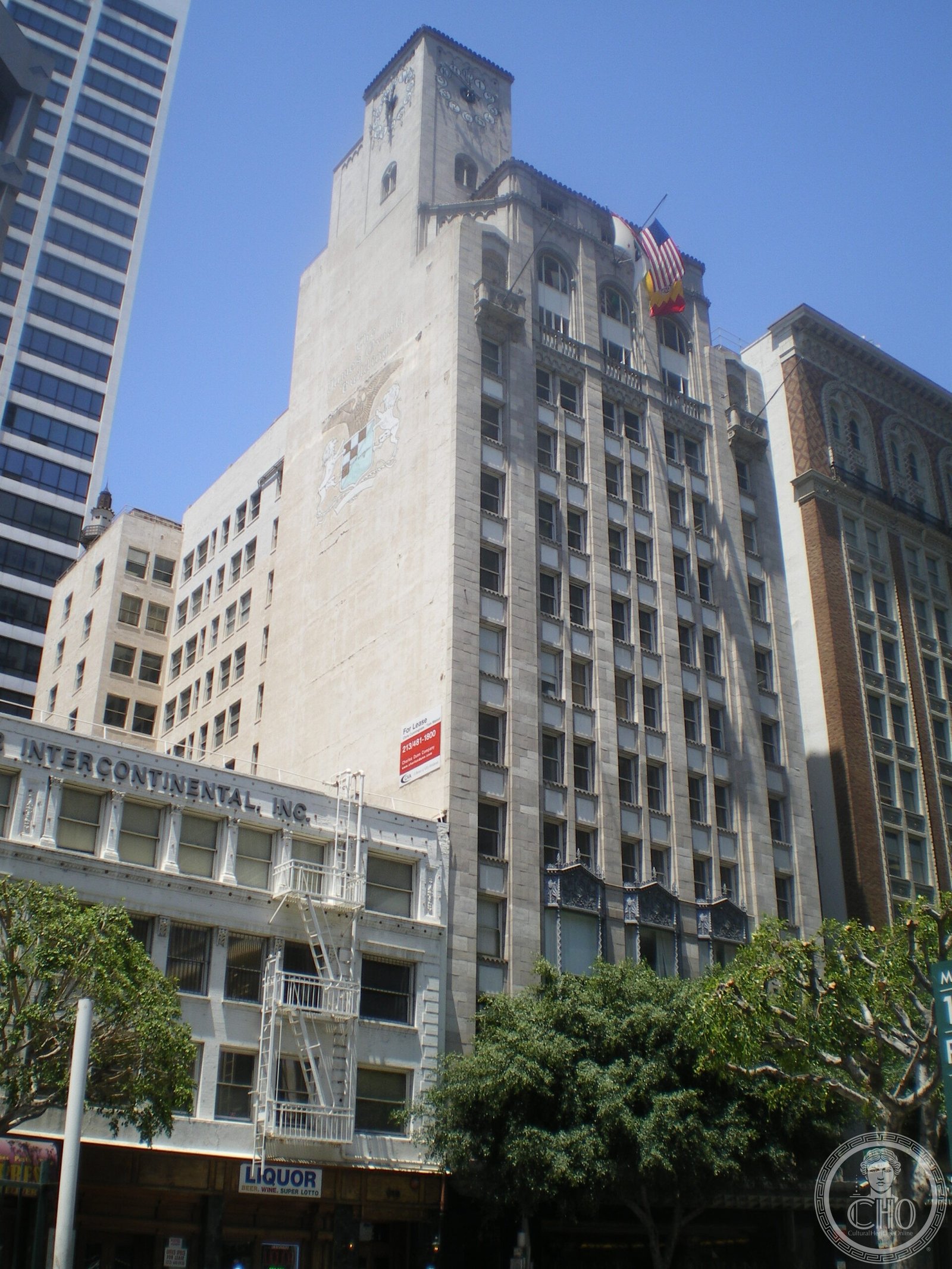
A haberdasher’s dream built in Art Deco glass and bronze — the only American building to contain a major commission of René Lalique glass installed in its original architectural context.
At a glance
The Oviatt Building at 617 South Olive Street opened in 1927 as the flagship store and office tower of James Oviatt, one of Los Angeles’s most prosperous clothiers. Designed by architects Walker & Eisen, the 13-story tower was conceived as the most refined commercial building in the city — and Oviatt traveled to Paris himself to commission its interiors from the leading decorative artists of the moment. The result was an installation of René Lalique glass panels, doors, elevator surrounds, and ceiling fixtures that remains unmatched anywhere in the United States: an entire building fitted out as a Lalique showcase, set within an Art Deco envelope that expressed the same vocabulary in limestone and bronze on the Olive Street facade. The building was listed on the National Register of Historic Places and has served as a film and television location for numerous Hollywood productions since the 1970s.
Key facts
- Completed: 1927
- Architect: Walker & Eisen
- Address: 617 South Olive Street, Downtown Los Angeles, California 90014
- Height: 13 stories
- Style: Art Deco
- Historic designation: National Register of Historic Places
- Lalique glass: commissioned 1927; largest surviving in-situ Lalique architectural installation in the United States
History
James Oviatt arrived in Los Angeles in the early twentieth century and built his fortune selling luxury menswear to the film industry and the city’s growing commercial elite. By the mid-1920s he was prosperous enough to commission an entire building of his own design, combining his store on the ground and mezzanine floors with rentable office space above. His trip to the 1925 Exposition Internationale des Arts Décoratifs in Paris — the exhibition that gave Art Deco its name — was decisive: Oviatt came back with a contract with René Lalique and a conviction that Los Angeles could host the finest decorative arts workshop in the country.
René Lalique, at the height of his reputation as the world’s premier glass artist and jeweler, designed a comprehensive program for the building: illuminated glass panels in the entrance lobby, etched glass doors, ceiling fixtures for the tower’s upper floors, and an elaborate glass penthouse conservatory for Oviatt’s personal apartment at the top of the building. The Lalique pieces arrived from France in 1927 and were installed by craftsmen imported for the purpose. The result, when the building opened, was recognized immediately as the most sophisticated interior in California.
Oviatt’s business declined during the Depression and he eventually sold the building, though the interiors survived largely intact. By the 1970s the building was threatened with demolition; a preservation campaign led to its NRHP listing and a series of sympathetic restorations that maintained the Lalique glass while adapting the lower floors to restaurant and event use. The Penthouse by Stacy Lapidus, reached by the building’s original Art Deco elevator, remains one of the most photographed event spaces in Los Angeles.
What you see
The Olive Street facade is organized in the vertical manner of 1920s commercial Art Deco: flat limestone pilasters frame tall, narrow window bays that draw the eye upward to a decorative cornice band at the twelfth floor and a stepped parapet above. The entrance portal, flanked by bronze grilles and lit through a deep glass canopy, establishes the transition between the public street and the Lalique interior immediately inside. The glass — opalescent, etched, backlit from behind by fixtures that Lalique designed to complement the panels — creates an effect quite different from any other commercial lobby in the United States: softer than typical Art Deco metalwork, more jewel-like, with the light diffusing through frosted molded-glass panels rather than reflecting off polished chrome.
The upper floors retain their original office configuration, with corridor details in bronze and plaster that match the lobby’s vocabulary. The penthouse, accessible by private arrangement, contains the most concentrated Lalique installation in the building: glass walls, ceiling panels, and a terrace that Oviatt used as a private retreat above the Los Angeles skyline.
Practical information
- Access: Ground-floor lobby accessible during business hours; restaurant and event space on lower floors; penthouse by booking
- Best time to visit: Morning, when Olive Street light enters the lobby through the glass canopy
- Nearest Metro: Pershing Square (B/D Line), two blocks east
- Time needed: 30–60 minutes for lobby and lower floors; longer for event visits
Getting there
617 South Olive Street is in Downtown Los Angeles, half a block south of Wilshire Boulevard and two blocks west of Pershing Square. The B Line (Purple) and D Line (Blue) Metro stations at Pershing Square are a two-minute walk east. LAX is approximately 30 minutes by car; Union Station is 15 minutes by Metro or car. Ample paid parking on Olive and adjacent streets.
Nearby
- Bradbury Building (1893) — ornate Victorian commercial landmark one block east; iron galleries and skylit atrium (also featured in Blade Runner)
- Grand Central Market — historic downtown food hall, Broadway and 3rd Street, five-minute walk east
- Bullocks Wilshire (1929) — Southwestern Law School’s home, Lalique glass in the same tradition; 20 minutes west on Wilshire
- Museum of Contemporary Art (MOCA) — Arata Isozaki building, Grand Avenue, 10-minute walk north
Sources
- National Register of Historic Places nomination: Oviatt Building, Los Angeles
- Los Angeles Conservancy, landmark records: Oviatt Building
- René Lalique Foundation documentation, Paris
- David Gebhard and Robert Winter, An Architectural Guidebook to Los Angeles (various editions)
Find it on the map
See this place and what’s around it →📷 Become a Cultural Heritage Online photographer
Share your photos of places: they stay published under your name as the author. The more they're seen, the more you get noticed — and soon a contest will reward the most appreciated photos.
Log in or sign up free to add a photoIs this page about you?
This page is read by travellers and heritage enthusiasts who find it on Google. Tell us how you are connected to this place and we will take it from there.