
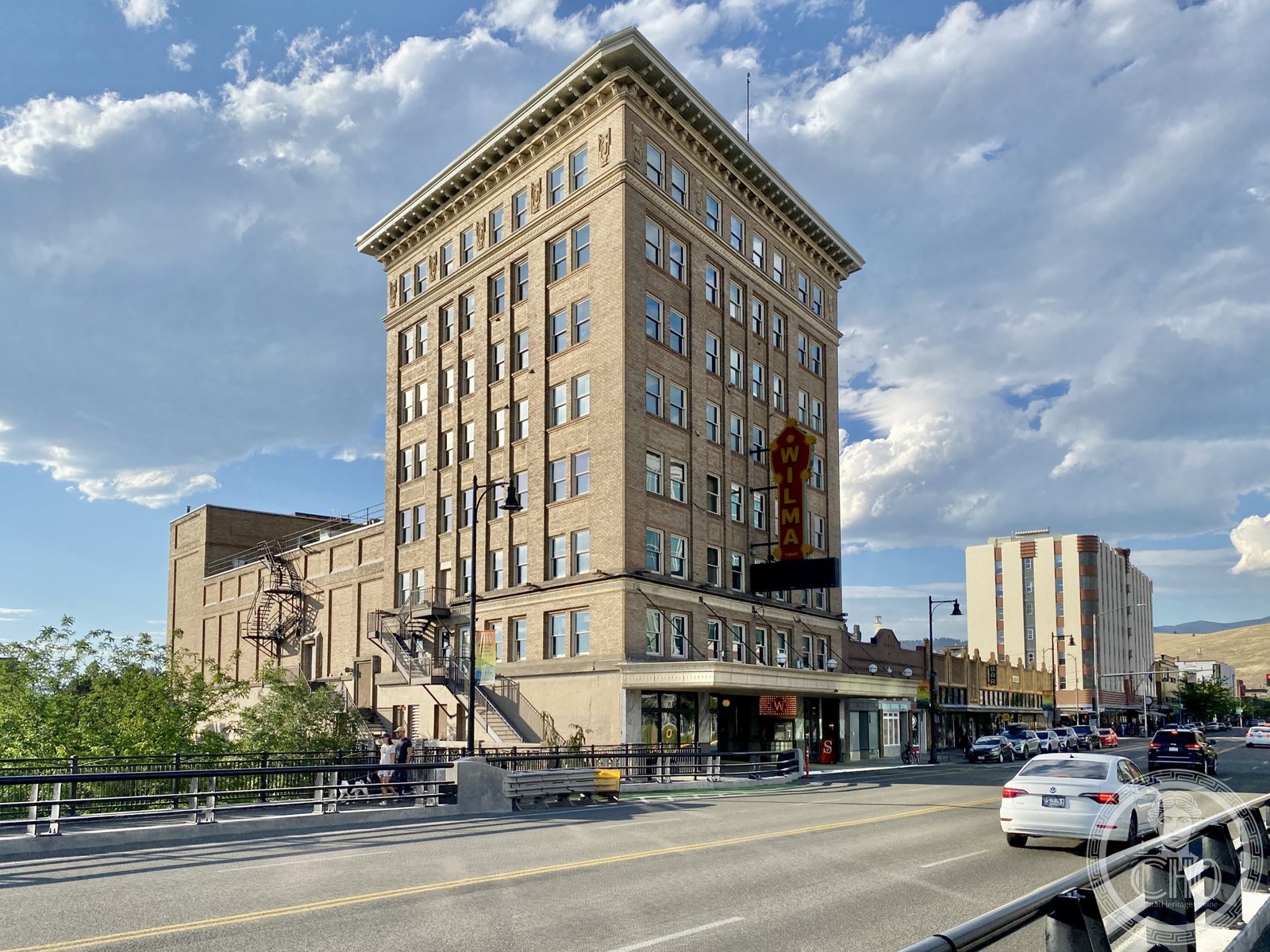
The Wilma Theatre has stood at the corner of Higgins Avenue and Front Street in Missoula since 1921, its mixed-use building combining a theater, hotel, and commercial spaces into one of the most recognizable landmarks in the Intermountain West city that the Clark Fork River runs through.
At a glance
Named for the wife of its developer, the Wilma Building opened in 1921 on Higgins Avenue, the main commercial spine of Missoula. The building’s corner tower and commercial facade made it the tallest and most prominent structure on the avenue for decades. The theater within the Wilma hosted films, traveling shows, and local events through the mid-twentieth century, while the upper floors provided hotel rooms to travelers passing through this railroad junction city. Today the Wilma operates as a music venue and event space, its historic interior serving a city that has developed a distinctive cultural identity around the University of Montana and the outdoor recreation culture of western Montana.
Key facts
- Address: 131 South Higgins Avenue, Missoula, MT 59801
- Opened: 1921
- Style: Early 20th century commercial with Italianate elements
- Listed: National Register of Historic Places
- Current use: Music venue, live events, community performances
History
Missoula grew up at the confluence of several river valleys in the northern Rocky Mountains, its position at the junction of the Northern Pacific Railway making it the commercial center of western Montana and the gateway to the Flathead Valley and the national parks beyond. The city’s economy in the early twentieth century was built on timber, mining supply, and the rail traffic that passed through on the way to the Pacific Northwest.
The Wilma Building opened in 1921 as a multi-use commercial property, combining theater, hotel, and retail functions in the manner common to western commercial buildings of the period. The theater hosted vaudeville acts, silent films, and later talking pictures, serving as the primary entertainment venue for Missoula through the 1920s and 1930s. The University of Montana, established in 1893 on the south side of the Clark Fork River, gave the city an intellectual dimension that shaped its cultural character alongside the working-class industries of the mining and timber economy.
The Wilma’s subsequent history as a music and event venue reflects Missoula’s evolution into a university and recreation city. The building has been adapted for contemporary use while preserving its physical character on Higgins Avenue, where it remains a downtown landmark recognized by the National Register of Historic Places.
What you see
The Wilma Building presents a substantial commercial facade on Higgins Avenue, its corner tower rising to a distinctive profile that marks it from several blocks in either direction. The architecture draws on the Italianate commercial tradition common in western American town-building of the late nineteenth and early twentieth centuries: round-arched windows, decorative cornices, and brick pier construction create a building that reads as solid and prosperous without attempting the atmospheric fantasy of the purpose-built picture palace.
The interior has been adapted for use as a standing-room music venue, with the floor cleared for audiences and the stage set at one end of the hall. The building’s historic fabric — brick walls, plasterwork detailing, and the proportions of the original commercial rooms — gives the space a character that newer venues cannot replicate. The Wilma’s acoustics and visual character make it one of the more distinctive concert environments in the region.
Practical information
- Access: South Higgins Avenue at Front Street, downtown Missoula
- Hours: Vary by event programming; check the Wilma website for current schedule
- Best for: Live music, western Montana heritage, university city atmosphere
- Tip: Downtown Missoula is compact and very walkable; the Wilma is close to the farmers’ market, bookshops, and restaurants along the Clark Fork River
Getting there
Missoula is served by Missoula Montana Airport (MSO) with direct connections to Denver, Seattle, Salt Lake City, and other western hubs. Interstate 90 passes through Missoula; take the Orange Street exit and head north to Higgins Avenue. Amtrak’s Empire Builder (Chicago to Portland/Seattle) stops at Missoula, and the station is approximately 10 minutes on foot from the Wilma. Downtown Missoula is entirely walkable; the Clark Fork River pedestrian trail connects the university to downtown in a scenic 15-minute walk.
Nearby
- University of Montana — across the Clark Fork River, with the Montana Museum of Art & Culture and Grizzly athletics
- Montana Natural History Center — natural science museum in downtown Missoula
- Rattlesnake National Recreation Area — wilderness hiking immediately north of downtown; access from the edge of the city
- Glacier National Park — 2.5 hours north on US-93 through the Flathead Valley, one of the most spectacular wilderness areas in North America
Sources
- The Wilma — official history and event programming
- National Register of Historic Places — Wilma Building, Missoula, Montana
- Montana Historical Society — Missoula commercial heritage documentation
Find it on the map
See this place and what’s around it →Record researched and written by Luigi De Marchi for Cultural Heritage Online, 2026.
📷 Become a Cultural Heritage Online photographer
Share your photos of places: they stay published under your name as the author. The more they're seen, the more you get noticed — and soon a contest will reward the most appreciated photos.
Log in or sign up free to add a photoIs this page about you?
This page is read by travellers and heritage enthusiasts who find it on Google. Tell us how you are connected to this place and we will take it from there.