
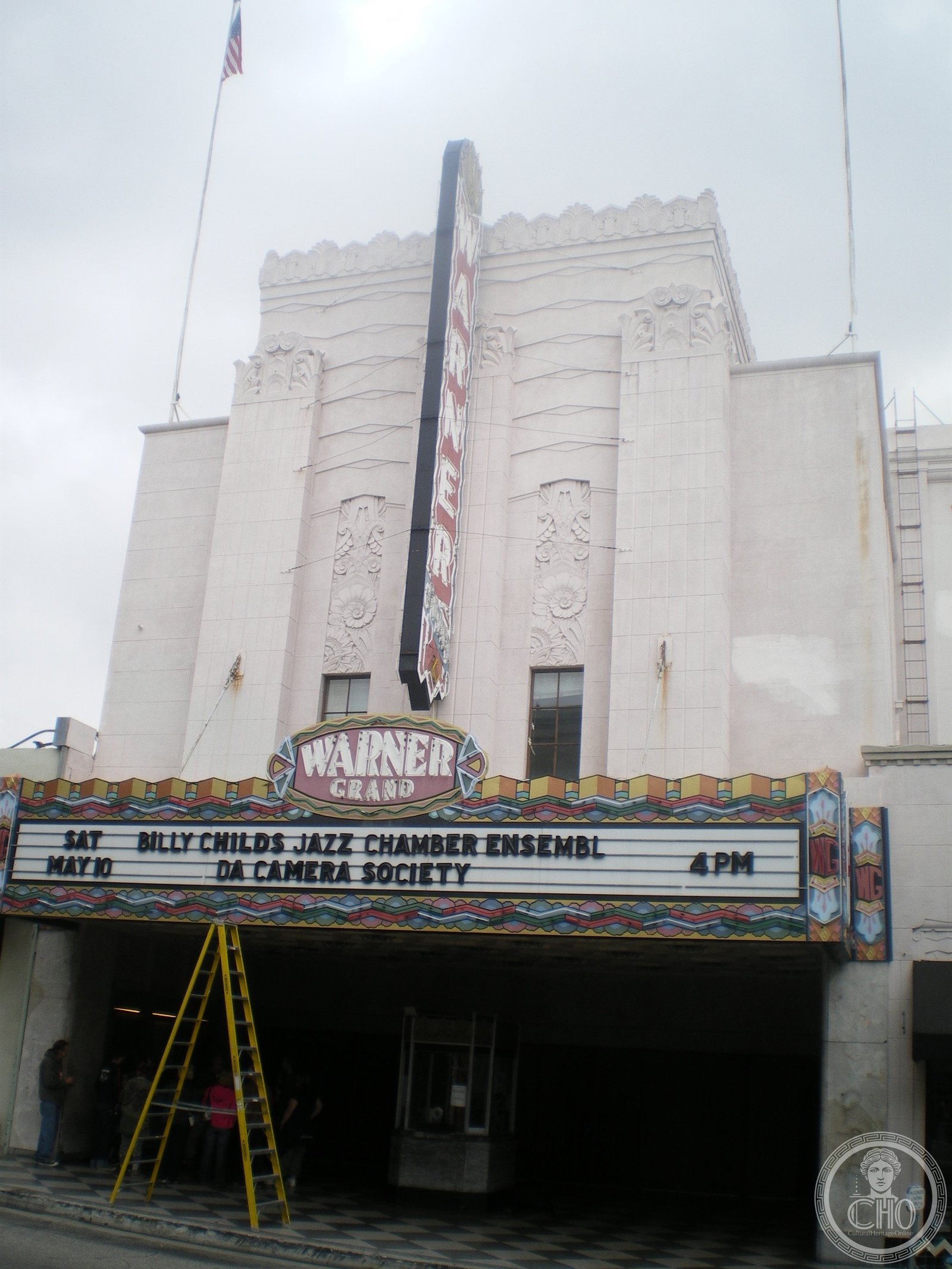
Where Pacific trade routes meet cinema’s golden age, the Warner Grand has anchored downtown San Pedro since 1931 — its stacked Art Deco tower rising above the port city skyline as a vertical beacon for the neighborhood’s working-class audiences.
At a glance
The Warner Grand Theatre stands as one of Southern California’s finest surviving Art Deco movie palaces. Designed by B. Marcus Priteca — the Seattle-based architect behind the Pantages Theatre in Hollywood — and opened in 1931 as part of the Warner Bros. West Coast Theatres chain, the Grand was built to serve San Pedro’s vibrant port community: dockworkers, merchant sailors, and families anchored to the working waterfront of Los Angeles Harbor. For four decades it brought Hollywood spectacle to a neighborhood defined by honest labor, before the multiplex era sent audiences elsewhere. Today, restored as a live performance venue simply called The Grand, it endures as the cultural centerpiece of San Pedro’s historic downtown.
Key facts
- Address: 478 West 6th Street, San Pedro, Los Angeles, CA 90731
- Completed: 1931
- Architect: B. Marcus Priteca
- Style: Art Deco with ornamental detail
- Original circuit: Warner Bros. West Coast Theatres
- Current use: Active performance venue (The Grand)
- Designation: Los Angeles Historic-Cultural Monument; National Register of Historic Places
History
Warner Bros. Pictures entered Southern California exhibition in force during the late 1920s, acquiring independent theaters and commissioning new houses to anchor neighborhood commercial districts. San Pedro — then a separate municipality soon to be absorbed by Los Angeles — was a natural target: its harbor generated constant transient population, and its permanent residents were hungry for affordable entertainment. The studio hired B. Marcus Priteca, already known throughout the West Coast for theater design, to create a cinema that would read as permanent and distinguished without sacrificing practicality.
Priteca delivered a three-story Art Deco front rising above a broad marquee, the kind of vertical composition that declared a theater’s presence from a block away in an era before neon could do that work alone. The theater opened in 1931 and operated through the studio system’s peak decades, presenting first-run Warner Bros. releases to packed houses during World War II — when San Pedro’s harbor was one of the busiest military departure points on the Pacific coast.
Attendance thinned through the 1970s and the theater eventually closed. The City of Los Angeles stepped in, acquiring the building through its Community Redevelopment Agency and undertaking a staged restoration. Reopened as a live venue for concerts, film screenings, and community events, the Warner Grand now operates as one of the anchor institutions of the Los Angeles Waterfront Arts District that has grown around San Pedro’s historic commercial core.
What you see
The facade on West 6th Street is a composition in vertical aspiration: a slender tower element climbs above the roofline, flanked by stepped parapets and framed by geometric ornament in glazed terracotta. The marquee projects over the sidewalk with the theater’s name in large letters — still the neighborhood’s single most visible sign after nine decades. Priteca used a palette of warm stone and polychrome terracotta typical of West Coast Art Deco commercial architecture, aiming for richness without the chrome-and-glass austerity of later Moderne.
Inside, the auditorium retains plaster ornamentation in the late-1920s decorative vocabulary: geometric friezes above the proscenium arch, decorative panels along the side walls, and a ceiling treatment that draws the eye upward even in a relatively intimate hall. The restoration work prioritized the original decorative layers, so what visitors see today closely approximates what a dockworker’s family would have encountered on opening night in 1931.
Practical information
- Events: Check The Grand (thegrandsanpedro.com) for current programming — concerts, film series, and community events year-round
- Tours: The theater occasionally opens for public tours; confirm availability with the venue directly
- Best time: Evening events when the marquee is lit reproduce the original atmosphere most faithfully
- Accessibility: The restored building includes accessible seating; contact venue for details
Getting there
The Warner Grand sits in downtown San Pedro, roughly 25 miles south of central Los Angeles. By Metro, take the Silver Line bus to the San Pedro Transit Center, then walk ten minutes west along 6th Street. By car, take the Harbor Freeway (I-110) south to its terminus and follow Harbor Boulevard into downtown San Pedro; parking is available in city lots on 6th and 7th Streets. The waterfront is a five-minute walk east, and the restored Angels Gate Park lies two miles south along the coast.
Nearby
- Port of Los Angeles — one of the busiest container ports in the Western Hemisphere, visible from downtown San Pedro; the waterfront promenade offers views of the harbor operations that defined the neighborhood’s history
- SS Lane Victory — a fully restored WWII Victory ship docked in San Pedro, open for tours; its presence links the neighborhood’s working port heritage to the same years the Grand was busiest
- Cabrillo Marine Aquarium — a Frank Gehry–designed facility (1981) on the San Pedro waterfront, focused on the marine ecology of Los Angeles Harbor
- Watts Towers — Simon Rodia’s mosaic towers (1921–1954), one of the great works of American outsider art, located roughly 12 miles north of San Pedro
Sources
- National Register of Historic Places nomination, Warner Grand Theatre
- Los Angeles Historic-Cultural Monument designation records
- Bernadette Hooper, The Theaters of B. Marcus Priteca
- Los Angeles Conservancy, Movie Palaces documentation
- Los Angeles Waterfront Arts District program materials
Find it on the map
See this place and what’s around it →Record researched and written by Luigi De Marchi for Cultural Heritage Online, 2026.
📷 Become a Cultural Heritage Online photographer
Share your photos of places: they stay published under your name as the author. The more they're seen, the more you get noticed — and soon a contest will reward the most appreciated photos.
Log in or sign up free to add a photoIs this page about you?
This page is read by travellers and heritage enthusiasts who find it on Google. Tell us how you are connected to this place and we will take it from there.