
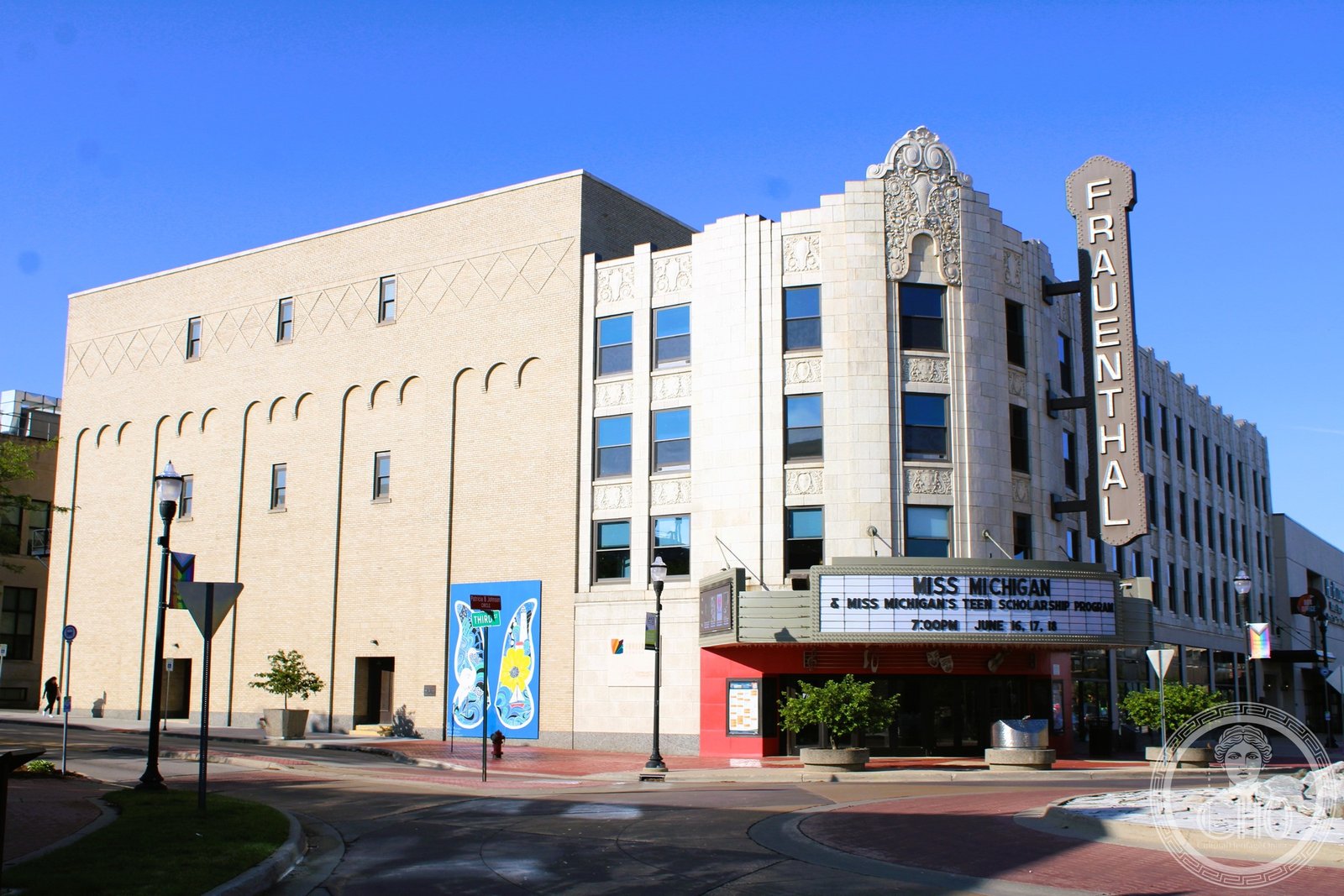
Where Muskegon’s industrial prosperity met Hollywood’s golden age, the Michigan Theatre opened in 1930 as the city’s grandest movie palace — a richly ornamented Art Deco hall that now bears the name Frauenthal and serves as the cultural anchor of Michigan’s Lake Shore.
At a glance
The Frauenthal Center for the Performing Arts — opened in 1930 as the Michigan Theatre and renamed in honor of a major benefactor following a twentieth-century restoration — stands as one of the finest surviving movie palaces in Michigan’s lakeshore region. Built at the height of Muskegon’s manufacturing wealth and designed in the elaborate decorative language of the great American movie palace tradition, the building brought cinematic grandeur to a city defined by its foundries, lumber interests, and Lake Michigan harbor. Restored and reopened as a presenting arts venue, it has been the central cultural institution of Muskegon for decades, hosting orchestral concerts, theatrical productions, touring artists, and community events in a setting that connects the city’s industrial-era ambitions to contemporary cultural life.
Key facts
- Address: 425 West Western Avenue, Muskegon, MI 49440.
- Completed: 1930.
- Original name: Michigan Theatre.
- Style: Art Deco with elaborately decorated theatrical interior.
- Current name: Frauenthal Center for the Performing Arts.
- Current use: Active performing arts venue; home of West Michigan Symphony.
- Designation: National Register of Historic Places.
History
Muskegon in 1930 was a working-class city with industrial ambitions and a proud history of manufacturing wealth. The furniture and foundry industries had given the city a prosperous merchant class, and the Michigan Theatre was their statement of cultural maturity: a cinema large enough and ornate enough to announce that Muskegon belonged in the company of Great Lakes industrial cities that expected the best. The theater opened as part of the network of large-scale movie palaces that major exhibition companies built across America during the late 1920s and early 1930s, the final wave before the Depression ended the era of palatial cinema construction.
The theater drew full houses through the studio system’s peak years, presenting first-run films to audiences from Muskegon and the surrounding lakeshore communities. Attendance thinned through the 1960s and 1970s as suburban multiplexes drew audiences away from the downtown core. The Michigan Theatre was eventually threatened with demolition before a community preservation effort secured its future. A major restoration, partially funded by the Frauenthal family, transformed the building into a modern performing arts center while preserving its original decorative fabric. The facility now operates as the Frauenthal Center and hosts the West Michigan Symphony among other resident and touring organizations.
Muskegon’s industrial economy went through severe contractions during the twentieth century as foundry work and manufacturing declined. The survival and renovation of the theater has been a touchstone of the city’s ongoing downtown revitalization, part of a broader effort to reclaim the commercial and cultural life of the lakefront core.
What you see
The facade on West Western Avenue presents the classic proportions of the American movie palace: a vertical marquee element rising above the street entrance, flanked by decorative panels in the Art Deco vocabulary of geometric ornament, stylized foliage, and polychrome terracotta. The composition is designed to be read from a moving automobile or a crowded sidewalk — everything about the exterior communicates spectacle and arrival.
Inside, the auditorium retains the atmospheric grandeur of its 1930 construction: ornate plasterwork along the proscenium arch and side walls, tiered balcony fronts with decorative railings, and a ceiling treatment that draws the eye upward and inward. The restoration work preserved and restored the original decorative layers rather than replacing them, so the theater communicates directly with its origins in the final flourishing of the American movie palace tradition.
Practical information
- Events: Check Frauenthal.org for the current season of West Michigan Symphony performances, touring artists, and community events.
- Tours: The theater occasionally opens for building tours; confirm availability with the center directly.
- Best experience: A West Michigan Symphony concert makes the best use of the restored acoustics and decorative setting.
- Downtown context: Western Avenue is Muskegon’s main cultural and commercial street; the Frauenthal anchors a block-long stretch of historic buildings.
Getting there
Muskegon lies on the eastern shore of Lake Michigan, roughly 45 miles west of Grand Rapids. The nearest major airport is Gerald R. Ford International Airport in Grand Rapids, about 50 miles east; driving time is under an hour. Within downtown Muskegon, the Frauenthal Center is on West Western Avenue, three blocks from the Muskegon Lake waterfront. The Muskegon State Park and Lake Michigan shoreline beaches are five miles west.
Nearby
- Muskegon Museum of Art — one of the most significant regional art museums in the Midwest, with a collection covering American and European art from the eighteenth century to the present; located two blocks from the Frauenthal.
- USS Silversides Submarine Museum — a fully preserved WWII-era Gato-class submarine docked in Muskegon Lake, one of the most visited maritime museums in the Great Lakes region.
- Muskegon State Park — 2,700 acres of Lake Michigan shoreline dunes, forest trails, and swimming beaches five miles west; the park includes the Muskegon Channel, where freighters enter the lake.
- Grand Rapids — 45 miles east, with the Grand Rapids Art Museum, Meijer Gardens, and the Frederik Meijer Gardens and Sculpture Park.
Sources
- National Register of Historic Places, Michigan Theatre / Frauenthal Center nomination.
- West Michigan Symphony, institutional history.
- Muskegon Area District Library, local history collection.
- Frauenthal Center for the Performing Arts, organizational documentation.
- Michigan Historic Preservation Network records.
Find it on the map
See this place and what’s around it →Record researched and written by Luigi De Marchi for Cultural Heritage Online, 2026.
📷 Become a Cultural Heritage Online photographer
Share your photos of places: they stay published under your name as the author. The more they're seen, the more you get noticed — and soon a contest will reward the most appreciated photos.
Log in or sign up free to add a photoIs this page about you?
This page is read by travellers and heritage enthusiasts who find it on Google. Tell us how you are connected to this place and we will take it from there.