
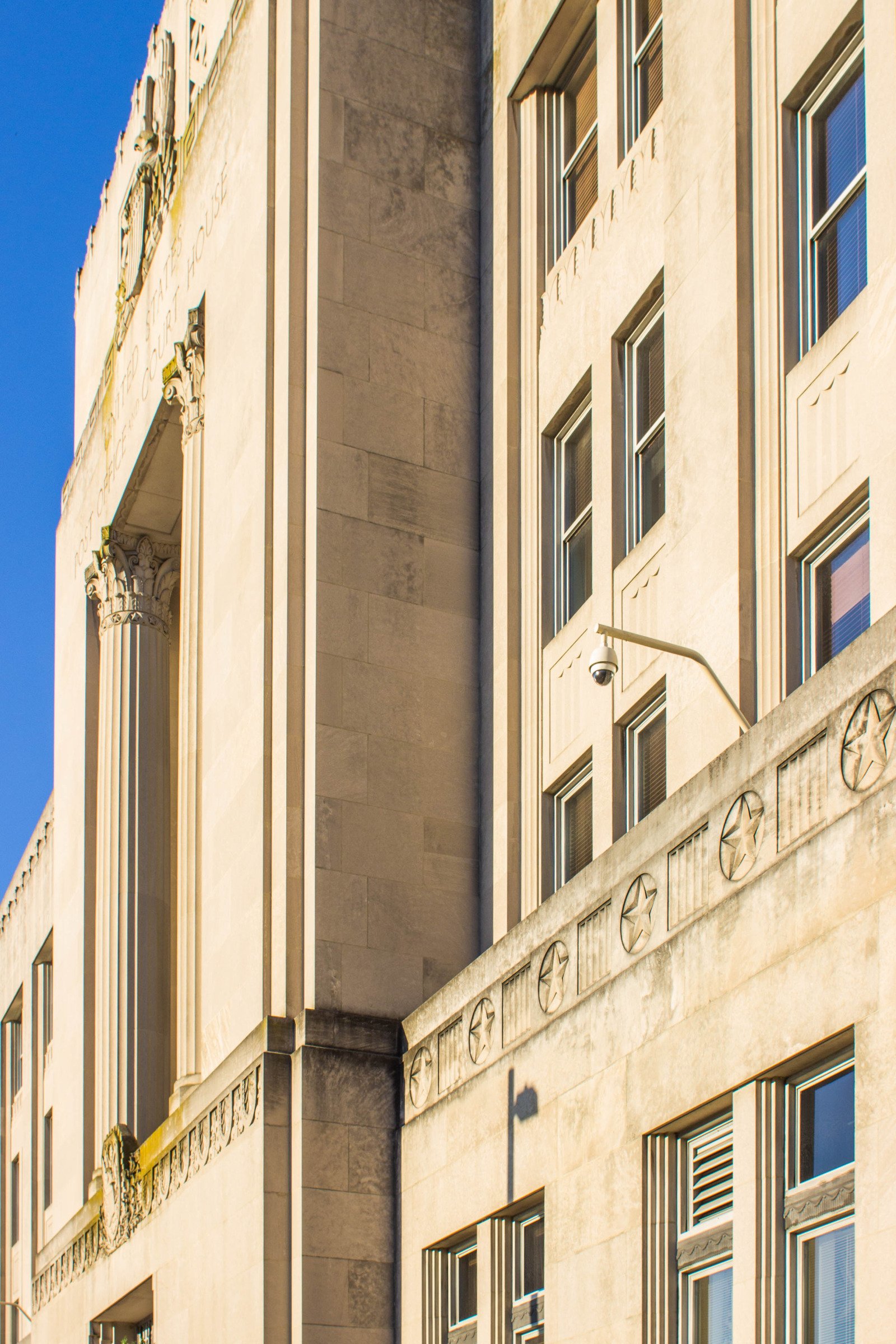
A four-story limestone building completed October 14, 1934, at 600 Granby Street in Norfolk that “showcases Art Deco and Art Moderne architectural styles” with a marble, terrazzo, and cast aluminum interior described on its opening as “ultramodern, combining beauty with utility to a high degree” — listed on the National Register in 1984 and later renamed to honor longtime Virginia federal judge Walter E. Hoffman.
At a glance
The Walter E. Hoffman United States Courthouse stands at 600 Granby Street in downtown Norfolk, Virginia. Completed on October 14, 1934, the four-story limestone federal building was constructed under the New Deal-era public works program to house Norfolk’s main post office and federal courthouse under one roof. Designed by Benjamin F. Mitchell in association with the Norfolk firm Rudolph, Cooke & VanLeeuwen, the building combines Art Deco and Art Moderne architectural expression in its exterior massing and limestone ornament, while the interior finishes — marble, terrazzo, and cast aluminum — represent the finest federal building standards of the Depression era. Listed on the National Register of Historic Places in 1984, the building was renamed in honor of Judge Walter E. Hoffman after his death and today serves the U.S. District Court for the Eastern District of Virginia.
Key facts
- Built: 1932–1934 (completed October 14, 1934)
- Style: Art Deco / Art Moderne
- Architects: Benjamin F. Mitchell; Rudolph, Cooke & VanLeeuwen (local associate)
- Stories: 4
- Exterior: Limestone
- Interior materials: Marble, terrazzo, cast aluminum
- Original use: Main post office and federal courthouse
- Current use: U.S. District Court for the Eastern District of Virginia
- NRHP listed: October 10, 1984
- Named for: Judge Walter E. Hoffman (1907–1996; U.S. District Judge, Eastern District of Virginia)
- Address: 600 Granby Street, Norfolk, Virginia
- GPS: 36.85361, −76.28861
History
The federal government’s decision to build a combined post office and courthouse for Norfolk in the early 1930s reflected the city’s growth as a major East Coast naval and commercial port. Norfolk was home to Naval Station Norfolk — the world’s largest naval base — and its federal administrative needs had outgrown the existing facilities. The Public Works Administration, operating under the New Deal’s program of federal employment through construction, provided the financing and administrative oversight for the project, which was completed between 1932 and October 1934 at a total cost funded through PWA grants and appropriations. Benjamin F. Mitchell led the design, working with the Norfolk firm Rudolph, Cooke & VanLeeuwen as local associate architects to handle site-specific execution and local subcontractor management.
When the building opened in October 1934, the Norfolk Virginian-Pilot praised it as “ultramodern, combining beauty with utility to a high degree” — a contemporary assessment that accurately captures the New Deal federal building aesthetic at its best. The postal operations that originally occupied the ground floors of the building relocated in 1984, the same year the structure was listed on the National Register of Historic Places. The building was subsequently renovated entirely for the U.S. District Court for the Eastern District of Virginia. Following the death of Judge Walter E. Hoffman — who had served on the Eastern District bench from 1954 to his death in 1996, presiding over significant civil rights cases and serving as the district’s chief judge — the courthouse was renamed in his honor.
What you see
The Hoffman Courthouse’s exterior presents the characteristic limestone cladding and rectilinear massing of New Deal-era federal architecture at its most polished. The four-story limestone block is organized with a formal entrance on Granby Street framed by the building’s most concentrated ornamental program: Art Deco geometric reliefs in the stone surround, the crisp incised ornament of the spandrel panels, and the massing proportions that reflect the stripped-classical tradition of federal building design in the 1930s. The limestone’s warm cream tone and the precision of its surface articulation are consistent with the highest quality levels of Depression-era federal construction, when the Public Works Administration set standards intended to ensure that federal buildings represented permanent civic investment.
Inside, the interior finishes express the same quality standard: marble in the public corridors and entry hall, terrazzo floors with geometric inlay patterns that echo the exterior ornamental vocabulary, and cast aluminum grilles and hardware that carry the Art Deco program through every visible surface of the building’s public zones. Cast aluminum — employed in federal buildings of the period for its precision casting qualities and resistance to corrosion — was among the signature materials of the Art Deco federal building interior, appearing at the same standard in dozens of New Deal courthouses and post offices from Maine to California. Norfolk’s example is among the best-preserved on the East Coast.
Practical information
- Active federal courthouse; the exterior is freely visible from Granby Street at all times.
- Interior access requires passing through federal security screening and is limited to litigants, attorneys, court staff, and authorized visitors; public court sessions may be observed.
- Located in downtown Norfolk on Granby Street, approximately 3 blocks from the Waterside waterfront development and MacArthur Center.
Getting there
The Hoffman Courthouse is at 600 Granby Street in downtown Norfolk, Virginia. Norfolk International Airport (ORF) is approximately 6 miles northeast. Hampton Roads Transit provides light rail (the Tide) and bus service through Norfolk; the Civic Plaza light rail station is approximately 1 block from the courthouse. By car, Interstate 264 terminates at downtown Norfolk, with the City Hall Avenue exit providing direct access to the Granby Street corridor. The Downtown Norfolk Tunnel connects via Interstate 264 to Portsmouth across the Elizabeth River.
Nearby
- Chrysler Museum of Art — one of the major American art museums, with a collection of over 30,000 works including the most comprehensive glass collection in North America, approximately 1 mile northwest at 1 Memorial Place
- MacArthur Memorial — the museum and memorial dedicated to General Douglas MacArthur, housed in the 1850 Norfolk City Hall building approximately 3 blocks south on Bank Street
- Nauticus — the maritime museum on the Norfolk waterfront, with the decommissioned battleship USS Wisconsin berthed alongside, approximately 5 blocks southwest on Waterside Drive
Sources
- Wikipedia: “Walter E. Hoffman United States Courthouse”
- National Register of Historic Places, listing October 10, 1984
- Norfolk Virginian-Pilot: September 8, 1934 (opening review)
- Wikimedia Commons: US_Post_Office_and_Courthouse,_Norfolk,_Va.jpg, CC BY-SA 4.0, Ser Amantio di Nicolao
Find it on the map
See this place and what’s around it →Record researched and written by Luigi De Marchi for Cultural Heritage Online, 2026.
📷 Become a Cultural Heritage Online photographer
Share your photos of places: they stay published under your name as the author. The more they're seen, the more you get noticed — and soon a contest will reward the most appreciated photos.
Log in or sign up free to add a photoIs this page about you?
This page is read by travellers and heritage enthusiasts who find it on Google. Tell us how you are connected to this place and we will take it from there.