
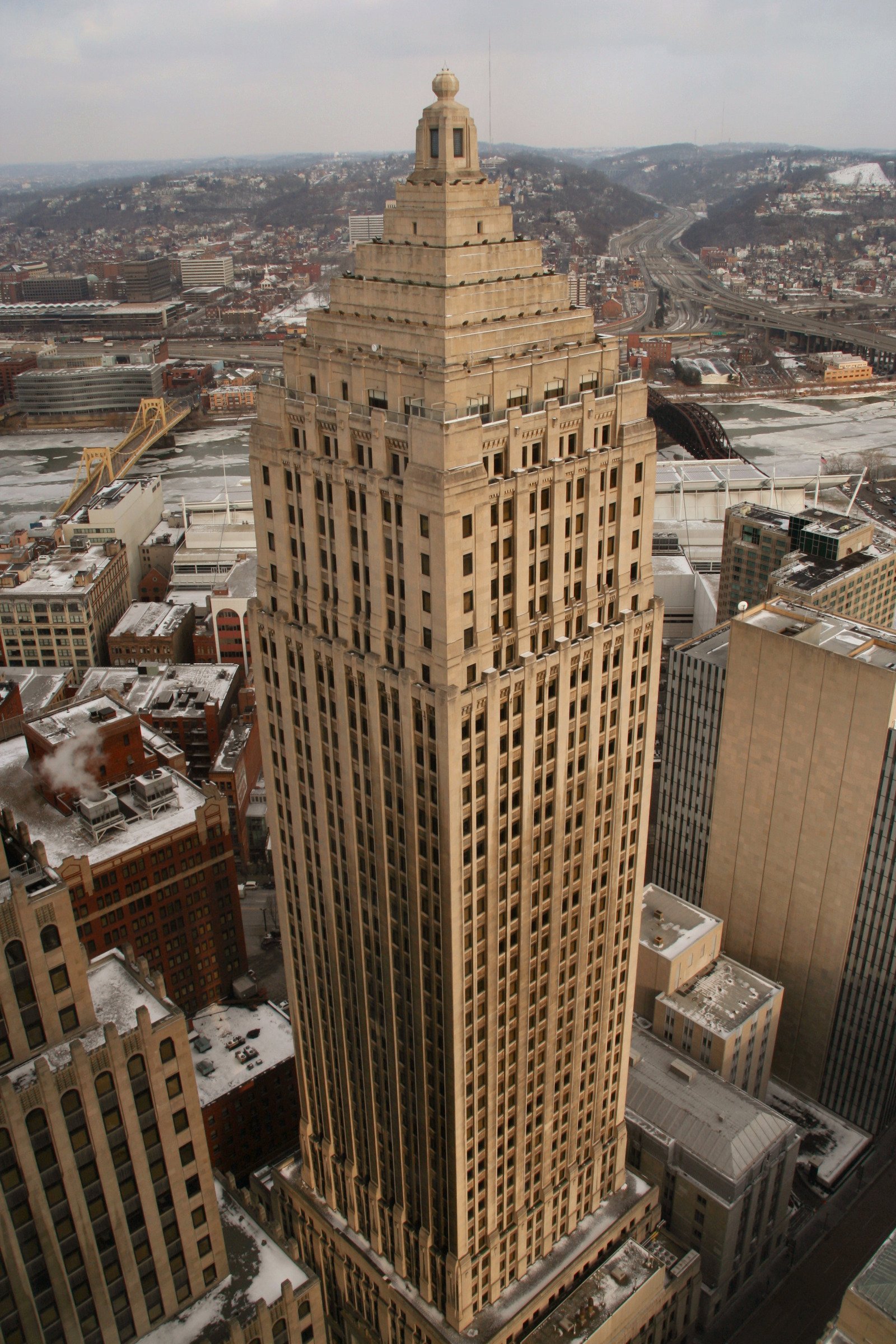
Pittsburgh’s most distinctive skyscraper — a 44-story, 582-foot Art Deco tower completed in 1932 for Gulf Oil Corporation, its stepped pyramid crown consciously modeled on the Mausoleum at Halicarnassus, one of the Seven Wonders of the Ancient World, and crowned by a weather beacon that has signaled forecasts to the city’s residents in colored light since the day it opened.
At a glance
The Gulf Tower stands at 707 Grant Street in downtown Pittsburgh, Pennsylvania. Completed in 1932 to the designs of New York firm Trowbridge & Livingston, working with local architect Edward Mellon, the 44-story, 177.4-meter Art Deco skyscraper was built as the Pittsburgh headquarters of Gulf Oil Corporation, then one of the largest oil companies in America. The building’s most architecturally distinctive feature — a stepped pyramid crown at the summit explicitly modeled on the Mausoleum at Halicarnassus, one of the Seven Wonders of the Ancient World — makes it instantly recognizable in the Pittsburgh skyline from every approach to the city. The weather beacon at the tower’s tip has operated continuously since 1932, changing color to signal weather forecasts: green for clear skies, amber for clouds, red for rain or snow, and blinking red for snow specifically. Pittsburgh History & Landmarks Foundation designated the building a historic landmark in 1973.
Key facts
- Built: 1932
- Style: Art Deco
- Architects: Trowbridge & Livingston; Edward Mellon (local associate)
- Stories: 44
- Height: 177.4 m (582 ft)
- Original tenant: Gulf Oil Corporation Pittsburgh headquarters
- Crown: Stepped pyramid modeled on the Mausoleum at Halicarnassus (one of the Seven Wonders of the Ancient World)
- Weather beacon: Green = clear; amber = cloudy; red = rain/snow; flashing red = snow
- Historic designation: Pittsburgh History & Landmarks Foundation Historic Landmark, 1973
- Former name: Gulf Building (until Gulf Oil’s acquisition by Chevron in 1984)
- Address: 707 Grant Street, Pittsburgh, Pennsylvania
- GPS: 40.44250, −79.99528
History
Gulf Oil Corporation was founded in Pittsburgh in 1907, emerging from the Spindletop oil strike in Texas and backed by the Mellon family banking interests that dominated Pittsburgh’s industrial economy. By the late 1920s Gulf was one of the integrated oil majors, and a new headquarters tower for its Pittsburgh base was a natural expression of the company’s standing. Trowbridge & Livingston — a New York firm that had designed numerous corporate skyscrapers and the St. Regis Hotel in New York — received the commission, working with local architect Edward Mellon (nephew of treasury secretary Andrew Mellon) to navigate local building requirements. The result was one of the finest Art Deco skyscrapers built in the United States during the Depression’s opening years.
The tower was completed in 1932, the same year construction on the Empire State Building and the Chrysler Building was wrapping up in New York — placing Gulf Tower in the national wave of major Art Deco skyscrapers that permanently redefined the American city skyline in the late 1920s and early 1930s. The building remained Gulf Oil’s Pittsburgh headquarters until the company’s acquisition by Standard Oil of California (Chevron) in 1984, the largest corporate merger in American history to that date. After the acquisition, the building was renamed Gulf Tower and converted to multi-tenant office use. Pittsburgh History & Landmarks Foundation had recognized its architectural significance earlier, designating it a Pittsburgh landmark in 1973, and the building has remained a defining presence in the Grant Street corridor ever since.
What you see
The Gulf Tower’s exterior is the most composed example of Art Deco setback skyscraper design in western Pennsylvania. The tower rises from a broad base on Grant Street in a series of controlled setbacks before narrowing toward the crown through successive terraced floors, each recession bringing the profile closer to the stepped pyramid that terminates the building at the 44th floor. The crown itself — consciously patterned on the Mausoleum at Halicarnassus as described in classical sources — is the building’s most self-conscious historical reference, a monument within a monument that anchors the building’s imagery to one of antiquity’s most celebrated structures. The precedent was not accidental: Gulf Oil’s founders wanted a building that projected permanence and world-historical ambition in equal measure.
The weather beacon that tops the tower — a colored light system that has operated since the building’s opening — is both a functional amenity and a piece of civic performance. Generations of Pittsburgh residents learned to read the city’s weather from the color of the Gulf Tower beacon before checking any digital forecast. The building’s base and lobby carry the Art Deco ornamental program through the entry experience: polished stone, metal grilles, geometric ornament, and the proportions of a building designed to impress tenants arriving to conduct the business of one of the world’s largest corporations.
Practical information
- Active office building; the lobby is accessible to office tenants and visitors during standard business hours.
- The exterior and pyramid crown are visible from multiple viewpoints throughout downtown Pittsburgh and from the bridges crossing the Monongahela River to the south.
- The weather beacon operates continuously and is most visible at night from across the Monongahela and Allegheny rivers.
Getting there
The Gulf Tower is at 707 Grant Street in downtown Pittsburgh, Pennsylvania, one block from the Allegheny County Courthouse. Pittsburgh International Airport (PIT) is approximately 18 miles west. The Port Authority of Allegheny County operates subway (T) and bus service throughout Pittsburgh; the Steel Plaza T station is directly below the Gulf Tower at the Grant Street entrance. By car, Interstate 376 (Parkway East) enters downtown Pittsburgh from the east; Interstate 279 approaches from the north.
Nearby
- Allegheny County Courthouse (1888) — H.H. Richardson’s Romanesque masterpiece one block from the Gulf Tower at Grant Street and Forbes Avenue; one of the great buildings of American architecture, with its granite arcades and central courtyard
- PPG Place (1984) — Philip Johnson and John Burgee’s neo-Gothic glass tower complex two blocks west at Stanwix Street; Pittsburgh’s most prominent postmodern skyscraper
- Carnegie Museum of Natural History / Carnegie Museum of Art — Oakland neighborhood approximately 2.5 miles east of downtown, the most comprehensive museum complex in western Pennsylvania, founded by Andrew Carnegie in 1895
Sources
- Wikipedia: “Gulf Tower”
- Pittsburgh History & Landmarks Foundation Historic Landmark designation, 1973
- Toker, Franklin: Pittsburgh: An Urban Portrait (1986; revised 2009) — on Gulf Tower in the context of downtown Pittsburgh’s architectural development
- Wikimedia Commons: Pittsburgh-gulf-tower-2007.jpg, Public Domain, Derek Jensen (Tysto)
Find it on the map
See this place and what’s around it →Record researched and written by Luigi De Marchi for Cultural Heritage Online, 2026.
📷 Become a Cultural Heritage Online photographer
Share your photos of places: they stay published under your name as the author. The more they're seen, the more you get noticed — and soon a contest will reward the most appreciated photos.
Log in or sign up free to add a photoIs this page about you?
This page is read by travellers and heritage enthusiasts who find it on Google. Tell us how you are connected to this place and we will take it from there.