
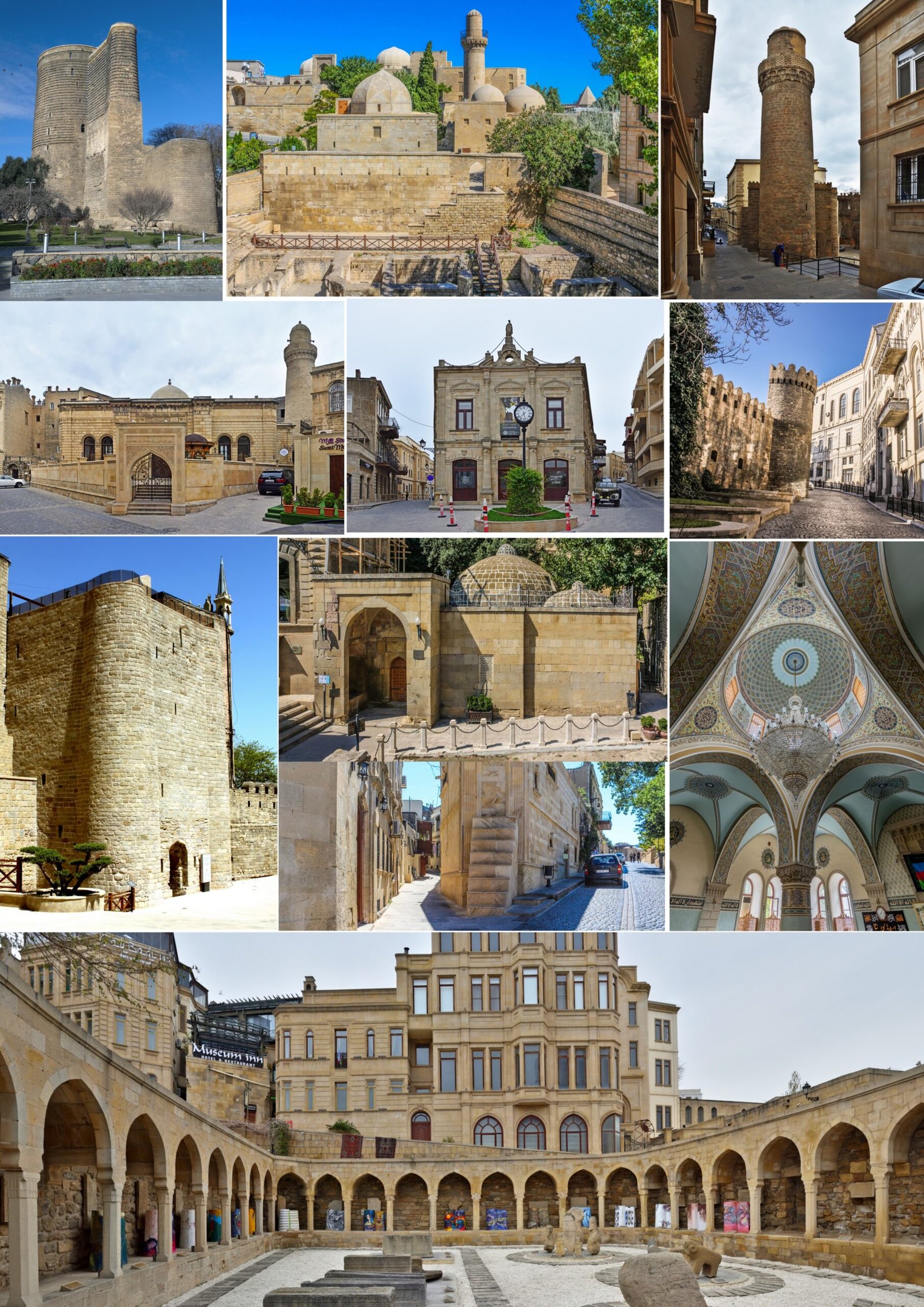
The ancient walled core of Azerbaijan’s capital — the Icherisheher — preserves a remarkable density of medieval Islamic monuments around two masterpieces: the enigmatic 12th-century Maiden Tower and the palatial 15th-century Shirvanshah complex, enclosed within walls that watched over a millennium of oil, Silk Road trade, and empire.
At a glance
The Walled City of Baku (Azerbaijani: Bakının İçərişəhər hissəsi) was inscribed on the UNESCO World Heritage List in 2000 for its exceptional medieval urban fabric on the western shore of the Caspian Sea. Within its 12th-century walls, the Icherisheher (Inner City) preserves mosques, caravanserais, baths, and two outstanding monuments: the cylindrical Maiden Tower (Qız Qalası), the symbol of Baku, and the Palace of the Shirvanshahs, the largest medieval monument in Azerbaijan. The medieval city sits at the geological heart of one of the world’s oldest oil-producing landscapes — oil was traded from this region since the 9th century — and the contrast between the ancient inner city and the early 20th-century oil-boom Art Nouveau architecture of outer Baku is one of the most dramatic urban juxtapositions in the world.
Key facts
- UNESCO designation: 2000 (World Heritage Site)
- Maiden Tower height: 28 metres; 16 metres diameter; 8 storeys
- Maiden Tower date: 12th century (Masud ibn Davud inscription)
- Shirvanshah Palace: 15th century; largest medieval monument in Azerbaijan
- Wall circuit: 12th century; several gates survive
- Area of Icherisheher: Approximately 22 hectares
- Silk Road connection: Yes — Baku was a significant Silk Road node
- Oil history: Commercial oil extraction predates the Pennsylvania oil rush of 1859
History
Baku’s bay, sheltered by the Absheron Peninsula from Caspian winds, has been a maritime settlement since ancient times. Greek and Arab geographers noted the oil seeps and eternal flames of the Absheron as curiosities of the natural world; the Zoroastrian fire temple at Surakhani (Ateshgah), a few kilometres outside Baku, drew fire-worshipping pilgrims from Persia and India for centuries. The medieval city walls were built in the 12th century, and the Maiden Tower dates from this period or possibly earlier.
The Shirvanshah state, a polity that controlled much of what is now northern Azerbaijan, made Baku its capital in the 15th century after the destruction of their earlier capital at Shamakhi. They built the palace complex between 1411 and 1435: an ensemble of reception halls, a mosque, a mausoleum for Shirvanshah Ibrahim I, a bathhouse, a dervish lodge, and courtyards, in refined ashlar masonry showing the influence of Persian and Azerbaijani traditions. The Safavid Shah Ismail I conquered Baku in 1501, ending the Shirvanshah state, but the palace survived.
The Russian Empire took Baku in 1806. The discovery of commercial oil in the 1870s transformed the city from a quiet Caspian port into one of the world’s great boom towns: by 1900, Baku produced half the world’s oil, and the fortunes made — including the Nobel brothers’ — funded the extravagant European-style mansions of the outer city. The Icherisheher survived this transformation intact.
What you see
The Maiden Tower is the most immediately striking monument: a cylindrical tower of finely cut limestone ashlar, 28 metres tall and 16 metres in diameter. Its most unusual feature is a projecting blade or buttress on the eastern face whose function remains debated. The interior has eight circular chambers stacked atop each other, connected by a spiral staircase cut into the walls, with a well in the lowest chamber. Today the tower is a museum with exhibits on its history.
The Shirvanshah Palace complex spreads across a sloping terrace in the upper Icherisheher. The Divanhane (ceremonial pavilion) is an elegant hexagonal structure with a shallow dome and fine muqarnas (honeycomb vaulting) at the entry portal. The Shah’s Mosque is a compact jewel of 15th-century Azerbaijani stonework. The surrounding streets of the Icherisheher are filled with caravanserais, hammams, and mosques, many still in use.
Practical information
- Metro: Icherisheher station (Line 1, Green); the Inner City is compact and walkable
- Maiden Tower: Open daily; entrance fee; museum inside
- Shirvanshah Palace Museum: Open daily except Monday; entrance fee
- Guided tours: Available at both monuments and from the Icherisheher main entrance
- Photography: Freely permitted in the streets; check rules inside monuments
- Currency: Azerbaijani Manat (AZN); cards widely accepted
Getting there
Baku’s Heydar Aliyev International Airport is well connected to European, Turkish, and Asian hubs. From the airport, the metro (30-40 minutes) or taxi (20 minutes) reaches the Icherisheher station, at the foot of the city walls. The Inner City is entirely pedestrianized and can be covered on foot in a morning; allow a full day if visiting both major monuments in depth.
Nearby
- Flame Towers — contemporary LED skyscrapers of modern Baku; striking contrast with the medieval city
- Ateshgah (Fire Temple), Surakhani — Zoroastrian/Hindu fire temple on eternal natural gas seep, 30 km from Baku
- Gobustan Rock Art — UNESCO-listed petroglyphs, 60 km south
- Sheki with Khan’s Palace — UNESCO-listed Silk Road city with 18th-century painted palace, 4 hours northwest
Sources
- UNESCO World Heritage List: Walled City of Baku, no. 958
- Wikipedia: Walled City of Baku
- Wikipedia: Maiden Tower, Baku
- Wikipedia: Palace of the Shirvanshahs
Find it on the map
See this place and what’s around it →📷 Become a Cultural Heritage Online photographer
Share your photos of places: they stay published under your name as the author. The more they're seen, the more you get noticed — and soon a contest will reward the most appreciated photos.
Log in or sign up free to add a photo