
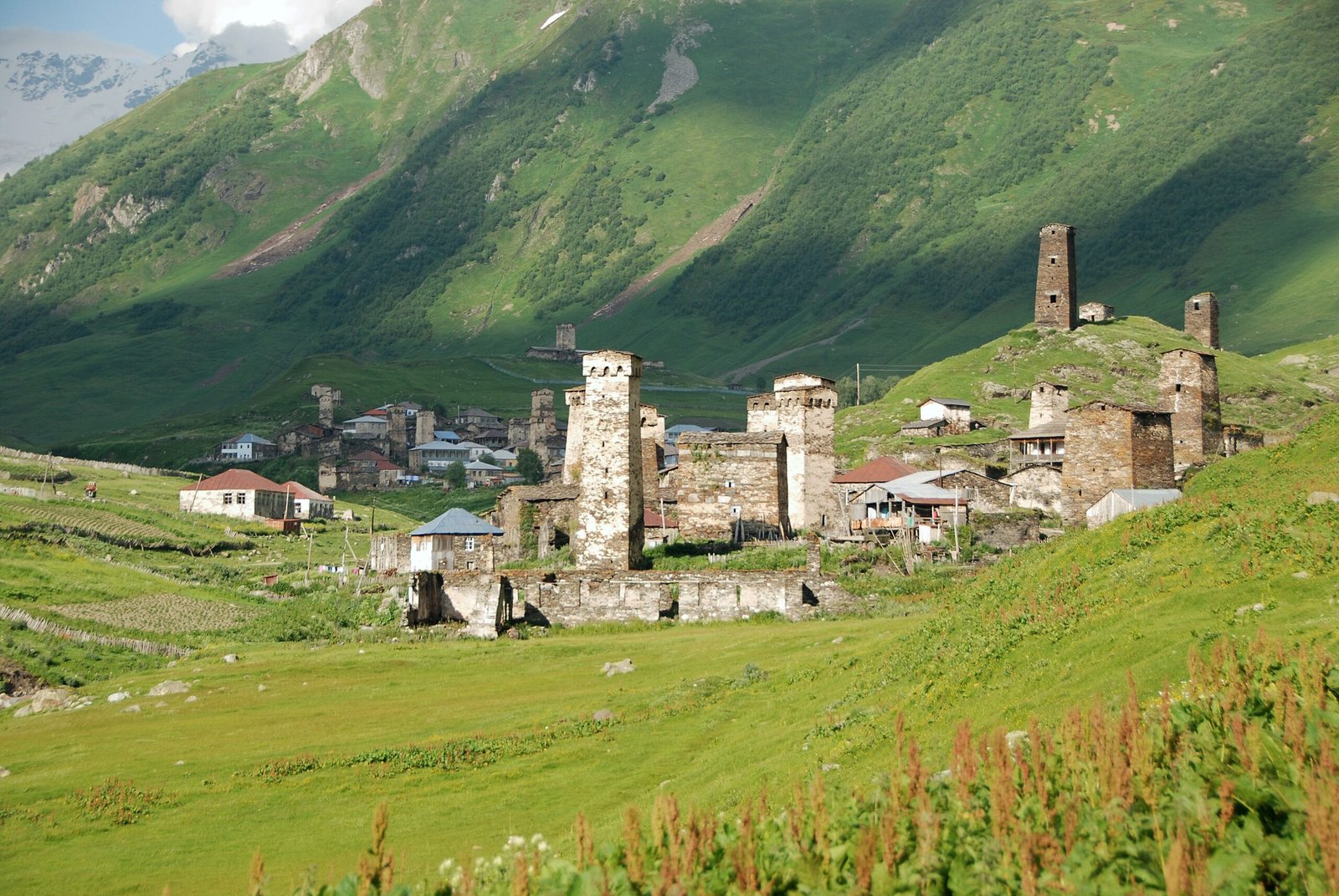
A living medieval landscape of stone defensive towers, 10th-century frescoed churches, and ancient mountain villages, perched at 2,200 metres in the Greater Caucasus and inhabited continuously for over 2,000 years.
At a glance
Upper Svaneti (Georgian: ღემო სვანეთი) is a high-altitude region in northwestern Georgia, inscribed on the UNESCO World Heritage List in 1994. Cradled between glacier-capped peaks of the Greater Caucasus, it preserves one of the most intact medieval cultural landscapes on earth: over 175 defensive tower-houses (koshkebi) survive in the village of Ushguli alone, alongside centuries-old churches filled with Byzantine frescoes and gilded icons that were hidden here from invaders for a thousand years. The Svan people — whose language has no close relatives — still inhabit the same stone towers their ancestors built between the 9th and 13th centuries. Mestia is the regional capital; Ushguli, at 2,200 metres, is one of the highest permanently inhabited settlements in Europe.
Key facts
- UNESCO designation: 1994 (World Heritage Site)
- Altitude: 1,500-2,200 m above sea level (Ushguli)
- Towers surviving: 175+ in Ushguli alone; hundreds more across the region
- Tower height: Up to 25 metres (square stone construction)
- Tower function: Defense against blood feuds and Mongol raids (9th-13th century)
- Language: Svan (South Caucasian, no close relatives)
- Nearest airport: Mestia (small domestic airport from Tbilisi) or Kutaisi (3-4 hours by road)
- Best season: June-September (road to Ushguli impassable in winter)
History
Archaeological evidence shows continuous human presence in Svaneti from at least 2000 BCE. The region’s natural fortifications — deep gorges, high passes, glacial rivers — made it a refuge for successive waves of populations fleeing lowland instability. By the early medieval period, Svaneti had developed a distinctive feudal clan society in which each family built a stone tower for defense not only against external enemies but against rival clans in the endemic blood-feud system (lashkroba).
The golden era of tower construction ran from the 9th to the 13th century, coinciding with the cultural flowering of medieval Georgia under Queen Tamar (1184-1213). The frescoes of Ipari, Latali, and Ushguli churches rank among the finest Byzantine provincial painting in the Caucasus. The monastery treasures — gilded icons, jewelled crosses, and illuminated gospel manuscripts — were brought to Svaneti from lowland Georgia to protect them from the Mongol invasions of the 13th century and the Timurid raids of the 14th-15th centuries.
Svaneti’s extreme isolation preserved both the architecture and the culture, but also kept the region economically marginal. Today a paved road connects Mestia to Zugdidi, and a small airport operates seasonal flights from Tbilisi, opening the region to tourism without yet transforming it beyond recognition.
What you see
The koshkebi (tower-houses) are the architectural signature of Svaneti. Each tower is square in plan, typically 5-6 metres per side, built of rough-hewn local stone without mortar, rising 20-25 metres through four or five storeys. The ground floor housed livestock; the upper floors provided living quarters and, at the top, a fighting platform with arrow slits. The towers of Ushguli — four distinct hamlets now collectively designated a UNESCO site — rise against the backdrop of the Shkhara glacier (5,068 m).
The medieval churches of Svaneti are architecturally modest — small stone basilicas with low-pitched roofs — but their interiors are extraordinary. The 10th-12th century frescoes cover every surface: scenes of the Transfiguration, the Last Judgment, equestrian saints, and local donors rendered in vigorous provincial Byzantine style. The Svaneti Museum of History and Ethnography in Mestia holds gilded icons, niello crosses, and manuscript gospels from the 10th century — one of the most important medieval Christian collections in the world.
Practical information
- Access from Tbilisi: Shared marshrutka daily, 8-9 hours; or fly 30 minutes (seasonal, book early)
- Ushguli from Mestia: 45 km mountain road, ~2 hours by 4WD taxi
- Accommodation: Guesthouses throughout the region; book ahead July-August
- Svaneti Museum, Mestia: Houses the main icon and manuscript treasury
- Hiking: Mestia is base for the classic 4-day Mestia-Ushguli trek and routes toward Elbrus
- Currency: Georgian Lari (GEL); ATMs in Mestia
Getting there
From Tbilisi, the most comfortable option is to fly to Mestia (30 minutes, scenic). Marshrutkas depart daily from Tbilisi’s Didube terminal via Zugdidi, taking 8-9 hours. From Kutaisi International Airport (well connected to Europe via Wizz Air), a taxi to Zugdidi takes about 1.5 hours, then onward to Mestia. Private car hire allows stops en route at the Enguri Dam, one of the largest arch dams in the world.
Nearby
- Shkhara Glacier — visible above Ushguli; meltwater forms the source of the Inguri River
- Enguri Reservoir — dramatic hydroelectric dam on the approach from Zugdidi
- Latali and Ipari churches — 10th-12th century frescoes in the Mestia valley
- Lower Svaneti (Lentekhi) — less visited, equally dramatic tower villages
- Kutaisi — UNESCO-listed Gelati Monastery and Bagrati Cathedral, 3-4 hours south
Sources
- UNESCO World Heritage List: Upper Svaneti, no. 623
- Wikipedia: Upper Svaneti
- Wikipedia: Ushguli
Find it on the map
See this place and what’s around it →📷 Become a Cultural Heritage Online photographer
Share your photos of places: they stay published under your name as the author. The more they're seen, the more you get noticed — and soon a contest will reward the most appreciated photos.
Log in or sign up free to add a photo