

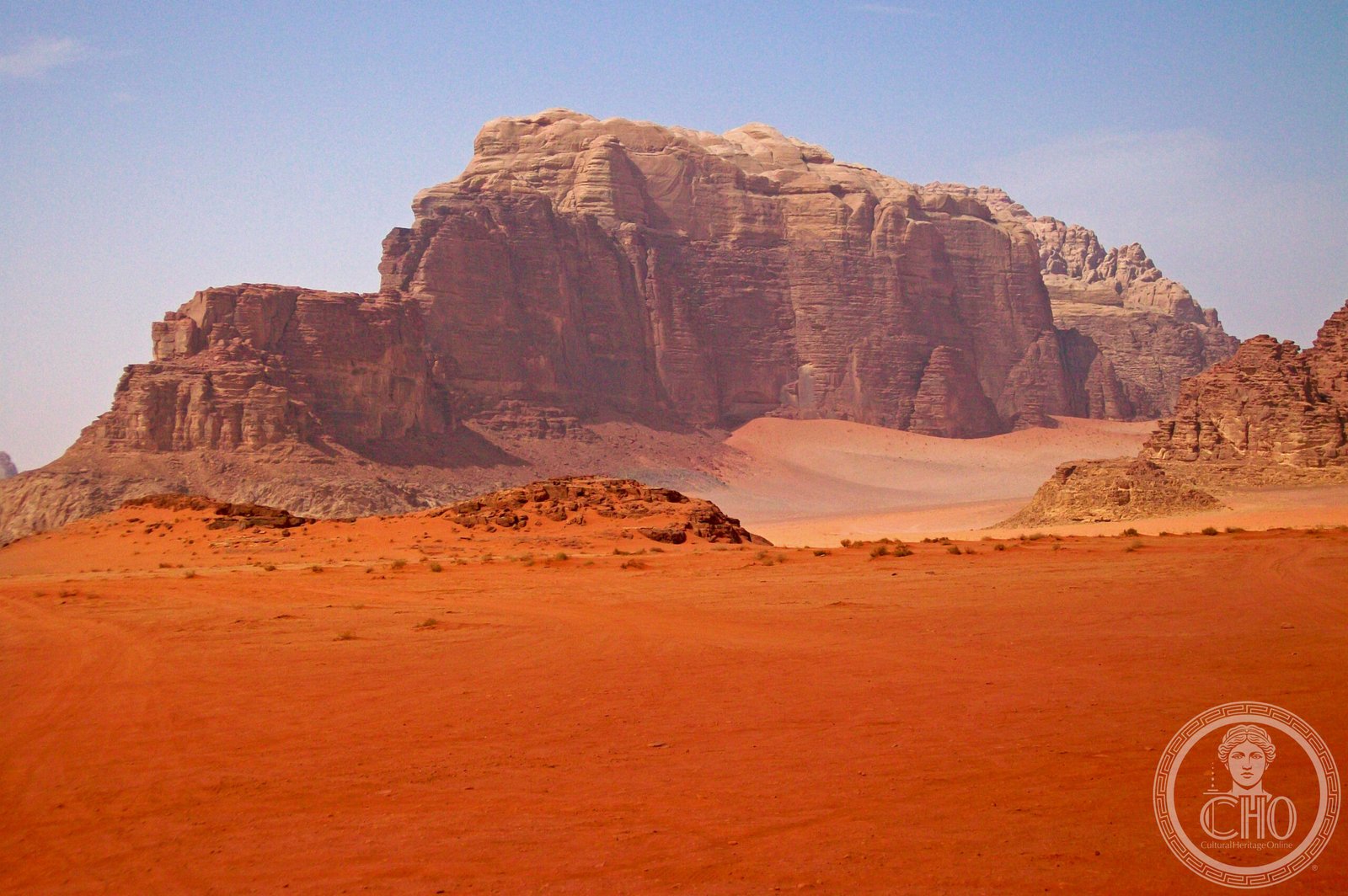
“Vast, echoing and godlike,” wrote T.E. Lawrence of Wadi Rum in 1917. A century later, four major film productions chose these same sandstone valleys and granite monoliths to stand in for Mars, Arrakis, and alien moons — because nothing on Earth looks quite so otherworldly. The valley is also the oldest occupied landscape in southern Jordan, with Nabataean inscriptions, prehistoric petroglyphs, and a Bedouin culture that has lived here without interruption for millennia.
At a glance
Wadi Rum — the Valley of the Moon — covers 720 square kilometres of southern Jordan, 60 kilometres east of the port city of Aqaba. The landscape is defined by enormous monolithic inselbergs of reddish-orange sandstone and darker granite rising up to 1,850 metres above the desert floor, weathered into arches, pillars, canyons, and rippled sand plains over millions of years. The protected area received UNESCO World Heritage designation in 2011 as a “mixed” site recognising both its cultural heritage (rock inscriptions, Nabataean remains, Lawrence of Arabia connections) and its exceptional natural geology. Today it supports a functioning Bedouin community — mainly from the Zalabia and Zawaideh tribes — who run the tourist economy of jeep safaris, camel treks, and permanent Bedouin camp experiences within the protected zone.
History: Nabataeans, Lawrence, and the caravan routes
Wadi Rum has been inhabited since prehistoric times; cave paintings and carved petroglyphs at sites including Khaz’ali Canyon document human presence across many millennia. The Nabataean civilisation — the trading kingdom based at Petra, 120 kilometres north — established a significant presence in the valley from at least the 4th century BC, using it as a waypoint on the incense and spice routes linking Arabia Felix (modern Yemen) to the Mediterranean ports. The ruins of a Nabataean temple at the foot of Jebel Rum, excavated partially in the 20th century, are among the most visible historical remains in the valley.
Modern historical consciousness of Wadi Rum was shaped almost entirely by T.E. Lawrence, the British officer who coordinated the Arab Revolt against Ottoman forces in 1917–1918. Lawrence used Rum as a base and described it at length in Seven Pillars of Wisdom (1922): “Rum the magnificent — the greatest wadi in Arabia.” His specific phrase “vast, echoing and godlike” has become the valley’s de facto motto. The rock known as Lawrence’s Spring, a natural water source he described ascending to, is still a named landmark on guided tours.
Cinema in the desert
Wadi Rum’s landscape — alien, monumental, and photogenic in any light — has made it one of the most filmed locations on Earth. Four landmark productions have used it as a primary shooting location:
Lawrence of Arabia (David Lean, 1962): The film that introduced Wadi Rum to world cinema. Director David Lean spent months scouting Arabian locations and chose Rum specifically for its scale — he needed a landscape that could make human figures look genuinely small. The desert campaign sequences, including the famous charge on Aqaba and the long tracking shots of Peter O’Toole riding across open plains, were filmed here. The production was based in the valley for weeks; crew members’ accounts describe waking to the monoliths turning pink at sunrise, which gave Lean some of his most celebrated lighting setups. The film won seven Academy Awards.
The Martian (Ridley Scott, 2015): Wadi Rum doubled as Mars in its entirety. Production designer Arthur Max (who had worked with Scott on Gladiator and Black Hawk Down) chose it because its reddish iron-rich sandstone and flat gravel plains matched the colour palette of NASA’s Mars Reconnaissance Orbiter photographs. Matt Damon and the production team filmed exterior sequences over six weeks; the Bedouin camps at the valley’s edge served as the production base. To reduce post-production colour grading, the location was chosen partly because it needed the least digital manipulation of any candidate site.
Rogue One: A Star Wars Story (Gareth Edwards, 2016): The desert sequences set on the planet Jedha — the Force-sensitive desert moon quarried for kyber crystals — were filmed at Wadi Rum. The valley’s scale and the interplay of sand plain and monolith gave the Jedha sequences their particular sense of a landscape scarred by occupation. The film’s visual effects team augmented the real location with digital city structures, but the ground and rock formations seen in the finished film are the actual geology of the valley.
Dune (Denis Villeneuve, 2021): Wadi Rum was the primary location for the desert planet Arrakis. Production designer Patrice Vermette spent six weeks scouting the valley and described the Siiq slot canyon and the 1,850-metre face of Jebel Um Ishrin as “Arrakis incarnate.” Timothée Chalamet and Zendaya filmed desert sequences here over several weeks, with the production employing hundreds of local Bedouin crew members and camel handlers. Villeneuve publicly credited the location as being essential to the film’s visual language: the sand is real, the rock is real, the wind is real — and that physical reality is what distinguishes the film’s desert from CGI alternatives.
What you see: landscape and landmarks
The valley floor lies at roughly 900 metres elevation and is carpeted with red and golden sand between exposures of pale granite. The dominant forms are the inselbergs — isolated rock masses that tower 400–700 metres above the plain, their bases scoured smooth by millennia of sand-laden wind. The most visited specific features include: Jebel Rum (1,734 m), the highest point, with technical rock climbing routes established by European expeditions in the 1980s; Jebel Um Ishrin (1,850 m); the Khaz’ali Canyon, a narrow slot whose walls are carved with Nabataean inscriptions and animal petroglyphs; the seven natural arches of Burdah Rock Bridge (80 m span); and the red sand dunes near Um Sabatah. Lawrence’s Spring, a Nabataean water channel carved into the cliff face, is a short scramble from the visitor centre.
Key facts
- Country: Jordan
- Nearest city: Aqaba (60 km west)
- Area: 720 km² (280 sq miles)
- Coordinates: 29.57°N, 35.42°E
- UNESCO World Heritage Site: 2011 (mixed natural/cultural designation)
- Key historical period: Nabataean (4th century BC onwards); Arab Revolt 1917–18
- Inhabited community: Zalabia and Zawaideh Bedouin tribes
- Highest peak: Jebel Um Ishrin, 1,850 m
- Films shot here: Lawrence of Arabia (1962), The Martian (2015), Rogue One (2016), Dune (2021)
Practical information & getting there
From Aqaba: minibuses and taxis to the Wadi Rum village and visitor centre (JRTT — Jordan Royal Tourism Train route also stops at Rum station). The protected area charges an entrance fee payable at the visitor centre gate. Independent travel within the protected zone is not permitted; all visitors must use a licensed Bedouin guide or pre-booked tour. Options range from two-hour jeep safaris to multi-day camel trekking circuits with overnight stays in Bedouin camps. Rock climbing (traditional and sport routes) can be arranged with specialist operators out of Aqaba or Wadi Rum village. The best conditions are October to April; summer temperatures regularly exceed 40°C. Starred Bedouin camps provide accommodation ranging from canvas tents to pressurised bubble domes with transparent ceilings for stargazing.
Sources & resources
- Wadi Rum on Wikipedia
- T.E. Lawrence, Seven Pillars of Wisdom, 1922
- UNESCO World Heritage — Wadi Rum Protected Area (WHC 1377)
- Cultural Heritage Online
Find it on the map
See this place and what’s around it →Historical events at this place (5)
- 1917 Lawrence of Arabia — T.E. Lawrence and the Arab Revolt in Wadi Rum (1917)
- 2021 Dune (Denis Villeneuve, 2021) — Arrakis Filmed at Wadi Rum
- 2015 The Martian (Ridley Scott, 2015) — Wadi Rum as Mars
- 2016 Rogue One: A Star Wars Story — Jedha Desert Filmed at Wadi Rum (2016)
- 2019 Star Wars: The Rise of Skywalker — Pasaana Desert Filmed at Wadi Rum (2019)
📷 Become a Cultural Heritage Online photographer
Share your photos of places: they stay published under your name as the author. The more they're seen, the more you get noticed — and soon a contest will reward the most appreciated photos.
Log in or sign up free to add a photo