
Wadi Rum Protected Area

Wadi Rum Jordan desert sandstone moonscape UNESCO World Heritage
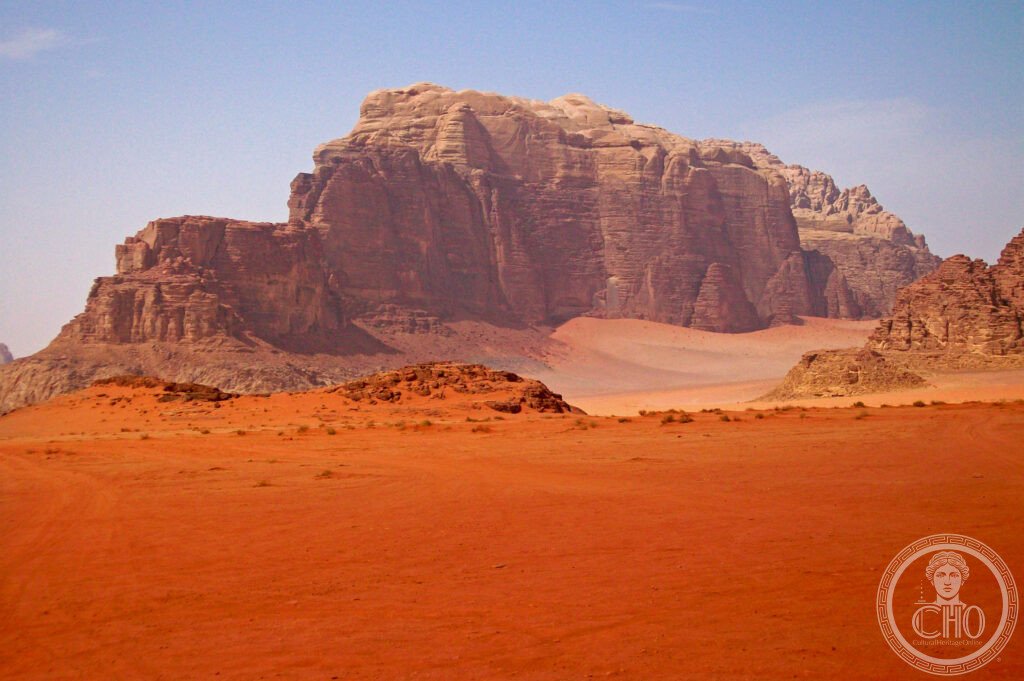
Wadi Rum (“Valley of the Moon”) (the Wadi Rum desert landscape: the characteristic towering sandstone and granite monoliths and inselbergs (isolated rock mountains rising abruptly from the flat sandy desert floor): the rust-red desert sand (the Wadi Rum sand is colored by iron oxide in the sandstone); the curved arching rock faces (the distinctive rounded forms of the Wadi Rum massifs are caused by millennia of wind erosion and the chemical dissolution of the sandstone by slightly acidic rainwater); the natural rock arch in the background (Wadi Rum has 17 natural rock arches including the Umm Fruth Rock Bridge and the Burdah Rock Bridge (the highest natural arch in Jordan at approximately 35m above the desert floor)); the desert floor (a mixture of red sand and smooth bedrock with scattered flash-flood channels (wadis)); the Nabataean and early Arab inscriptions carved into the rock faces (the rock art and Nabataean writing is found at over 25,000 sites across the protected area); the star-dark sky (Wadi Rum is one of the best locations in the Middle East for stargazing; the annual Wadi Rum Star Festival is held each October), Wadi Rum Protected Area, Aqaba Governorate, Jordan. UNESCO World Heritage Site 2011. Photo via Wikimedia Commons.
Wadi Rum Protected Area, Aqaba Governorate, Jordan · the most dramatic desert landscape in the Middle East; T.E. Lawrence; Nabataean rock art; Mars film location; UNESCO WHS 2011

Wadi Rum Protected Area

The most visually dramatic desert landscape in the Middle East and the location where T.E. Lawrence experienced the defining moments of the Arab Revolt — Wadi Rum (“Valley of the Moon”; Aqaba Governorate, Jordan; UNESCO WHS 2011) is a 720 km² protected area of towering sandstone and granite monoliths rising from a rust-red sand desert floor, inhabited by the Zalabia Bedouin and marked with over 25,000 Nabataean inscriptions and rock art sites.

At a glance

Wadi Rum (the most precisely WadiRum single 720 sqkm sandstone granite inselbergs rust-red iron oxide sand Jebel Rum 1754m Jebel Umm Ishrin Khazali Canyon rock bridge Burdah Bridge 35m Nabataean 25000 inscriptions Lawrence Arabia Arab Revolt 1917 Zalabia Bedouin UNESCO heritage: the landscape (Wadi Rum is the largest wadi (dry valley) in Jordan (the term “Wadi Rum” means “Valley of the Moon” in Arabic (rum means “high” or “the Rum people” depending on interpretation)); the landscape is a desert plateau at approximately 1,000m altitude characterized by: the sandstone massifs (the distinctive rounded towers of Nubian sandstone (300-600m tall) that rise vertically from the flat sandy desert floor; the largest massif is Jebel Rum (1,754m; the highest point in southern Jordan)); the rock arches (17 natural rock bridges/arches in the protected area; the most accessible (Umm Fruth Bridge; 15m high) and the most dramatic (Burdah Rock Bridge; approximately 35m high; requires a moderate climb to reach)); the Nabataean inscriptions (the Nabataeans (the Arab trading people who controlled the incense trade route between Yemen and the Mediterranean from approximately 300 BCE to 106 CE) carved over 25,000 inscriptions and petroglyphs onto the rock faces of Wadi Rum; the inscriptions are the largest collection of Nabataean writing in the world)); the Bedouin culture (the Zalabia tribe of the Howeitat Bedouin confederation have traditionally lived in the Wadi Rum area; the Jordanian government has given the Zalabia the right to run tourism operations within the protected area (the jeep tours, the camel rides, and the Bedouin camp experiences are managed by Zalabia family businesses)) — the most precisely WadiRum single 720 sqkm sandstone granite inselbergs rust-red iron oxide sand Jebel Rum 1754m Jebel Umm Ishrin Khazali Canyon rock bridge Burdah Bridge 35m Nabataean 25000 inscriptions Lawrence Arabia Arab Revolt 1917 Zalabia Bedouin UNESCO heritage in any UNESCO world heritage site)).

Key facts

  • Lawrence of Arabia: the most precisely WadiRum single Lawrence Arabia T.E. Lawrence Thomas Edward Lawrence Seven Pillars Wisdom 1926 Arab Revolt 1917 1918 Hejaz Railway sabotage Damascus October 1918 Seven Pillars dedication S.A. Farraj Dahoum Lawrence Spring UNESCO heritage — the most famous visitor to Wadi Rum: T.E. Lawrence (Thomas Edward Lawrence; 1888-1935 CE; the British Army officer and writer who coordinated the Arab Revolt against the Ottoman Empire (1916-1918 CE) on behalf of the British government; Lawrence lived in and around Wadi Rum for extended periods during the Arab Revolt campaign (July 1917 CE and through to October 1918 CE); Seven Pillars of Wisdom (Lawrence’s autobiographical account of the Arab Revolt, written in 1922 CE and published in a private edition in 1926 CE and publicly in 1935 CE; the description of Wadi Rum (especially the chapter “Rum” which begins “Our little Bedouin band looked up in silence at this stupendous place”) introduced the landscape to English-speaking readers for the first time; the site “Lawrence’s Spring” (a natural spring near Jebel Rum marked on maps as the water source Lawrence used) bears his name))
  • GPS: 29.5759° N, 35.4213° E

History

From Nabataean trade route to Arab Revolt to Mars (the most precisely WadiRum single Neolithic rock art 7000 BCE Nabataean 300 BCE Thamudic inscriptions Aqaba Roman Vicus Wadi Rum Hejaz Railway Ottoman Arab Revolt Lawrence 1917 1918 modern Jordan 1946 Bedouin tourism film location David Lean 1962 Ridley Scott The Martian 2015 UNESCO heritage: the ancient history (Wadi Rum has been inhabited and traversed since the Neolithic period (rock art and stone tools found from approximately 7000 BCE); the Nabataeans (approximately 300 BCE to 106 CE) controlled the trade route from Hejaz (western Arabia) to the port of Aqaba (the Red Sea port) and inscribed their language and imagery on the rock faces at hundreds of sites throughout the wadi; the Roman period (106 CE: the Roman Emperor Trajan annexed the Nabataean Kingdom as the province of Arabia Petraea; the Wadi Rum area was part of the Roman road network)); T.E. Lawrence and the Arab Revolt (July 1917 CE: Lawrence and the forces of Faisal ibn Hussein (the son of the Sharif of Mecca) used Wadi Rum as a base of operations for the sabotage of the Hejaz Railway (the Ottoman railway connecting Damascus to Medina); the railway sabotage operations from Wadi Rum between 1917-1918 CE contributed significantly to the Ottoman military collapse in the Middle East)); the film history (1962 CE: David Lean used Wadi Rum as the principal filming location for Lawrence of Arabia (the most critically acclaimed film about the Arab Revolt; winner of 7 Academy Awards); 2000 CE: Ridley Scott used Wadi Rum for Gladiator (the exterior scenes of ancient Carthage); 2015 CE: Ridley Scott used Wadi Rum as the surface of Mars in The Martian) — the most precisely WadiRum single Neolithic rock art 7000 BCE Nabataean 300 BCE Thamudic inscriptions Aqaba Roman Vicus Wadi Rum Hejaz Railway Ottoman Arab Revolt Lawrence 1917 1918 modern Jordan 1946 Bedouin tourism film location David Lean 1962 Ridley Scott The Martian 2015 UNESCO heritage in any UNESCO world heritage site)).

What you see

Jeep tours, Bedouin camps, and stargazing (the most precisely WadiRum single Visitor Centre jeep tour Zalabia Bedouin Jebel Khazali Canyon Nabataean inscriptions Anfaishiyya inscriptions camel ride Lawrence Spring Umm Fruth rock bridge Burdah Bridge 35m overnight Bedouin tent camp bubble dome stargazing UNESCO heritage: the visitor experience: the entry and visitor center (Wadi Rum Village (Rum Village); the entry checkpoint and visitor center; the only paved road in the protected area; beyond the village, the desert floor is accessible only by jeep, camel, or on foot); the jeep tours (the standard visit is a 2-4 hour jeep tour into the protected area guided by a Zalabia Bedouin driver; the jeep tour covers: the Khazali Canyon (a narrow sandstone canyon (500m long; approximately 3-4m wide at floor level) with Nabataean and Thamudic inscriptions at the entrance (the camel and human figures in the rock are approximately 2,000 years old)); Lawrence’s Spring (the natural spring in the rock face; accessible by a 20-minute walk up the rock face following iron rungs); the Anfaishiyya inscriptions (the most important collection of Nabataean inscriptions in the area (a cliff face covered with Nabataean writing)); Umm Fruth Rock Bridge (a 15m natural arch (climbable; the most accessible of the rock bridges)); the overnight camp experience (a night in a Bedouin tent camp in the desert is the recommended way to see Wadi Rum; the bedouin dinner (zarb: a slow-cooked meal of meat and vegetables in a underground pit oven); the stargazing (Wadi Rum has essentially zero light pollution; the Milky Way is visible to the naked eye; the star density is extraordinary); the bubble camps (transparent-dome rooms on the desert floor; approximately €200-400 per night; the view of the sky is from a reclined position inside the transparent dome)) — the most precisely WadiRum single Visitor Centre jeep tour Zalabia Bedouin Jebel Khazali Canyon Nabataean inscriptions Anfaishiyya inscriptions camel ride Lawrence Spring Umm Fruth rock bridge Burdah Bridge 35m overnight Bedouin tent camp bubble dome stargazing UNESCO heritage in any UNESCO world heritage site)).

Practical information

  • Getting there: from Aqaba (Queen Alia International Airport, Amman (AMM); 4h drive south; or drive from Aqaba (60 km north; 1h)); from Wadi Musa/Petra (60 km; 1h; the most common combined visit: Petra + Wadi Rum in a 2-3 day circuit); JETT bus from Amman to Aqaba (passes through Wadi Rum on some routes); entry fee (approximately 5 JOD (€7) per person for the protected area; the jeep tour must be booked with a registered Zalabia operator (Jordan Tourism Board registrations visible at the visitor center)); the Jordan Pass (the Jordan Pass (approximately €75; pre-purchased online) covers Wadi Rum entry (5 JOD) and Petra (50 JOD) and the 30-day Jordan visa (a saving of approximately €100 in total; recommended for any visitor spending 3+ days in Jordan)); the best seasons (March-May and September-November are ideal; June-August temperatures reach 40°C+ in the shade; December-February is cold at night (below freezing) but spectacular during the day (cold, clear sky))

Getting there

From Aqaba (60 km, 1h) or Petra (60 km, 1h). Entry 5 JOD. Jordan Pass covers entry + Petra + visa. Best March-May or Sept-Nov. GPS: 29.5759, 35.4213.

Nearby

  • Petra — 60 km north (UNESCO WHS 1985; the “Rose-Red City” of the Nabataeans; the Treasury (Al-Khazneh; the most iconic facade of rock-cut architecture in the Middle East); the Siq (the 1.2 km narrow gorge entrance); the Roman Colonnaded Street; the Monastery (Ad-Deir; 50m × 45m; the largest monument in Petra); the most visited archaeological site in Jordan))
  • Aqaba — 60 km south (the Jordanian Red Sea resort and port city; the best access point for Wadi Rum; the coral reefs of the Gulf of Aqaba (the Red Sea); the Aqaba Flagpole (132m; one of the tallest in the world); the Mamluk fort and museum))

Sources

  • Wikipedia, Wadi Rum; T. E. Lawrence; Nabataean inscriptions, accessed June 2026
  • UNESCO, Wadi Rum Protected Area, WHS reference 1377, inscribed 2011

Hero image: Wadi Rum desert landscape, Aqaba Governorate, Jordan, Wikimedia Commons. Editorial text © Cultural Heritage Online, 2026.

📷 Diventa un fotografo di Cultural Heritage Online

Condividi le tue foto dei luoghi: restano pubblicate con la tua firma come autore. Più vengono viste, più ti fai conoscere — e presto un concorso premierà le foto più apprezzate.

Accedi o registrati gratis per aggiungere una foto
📋 Copy & share on social
Scroll to Top