
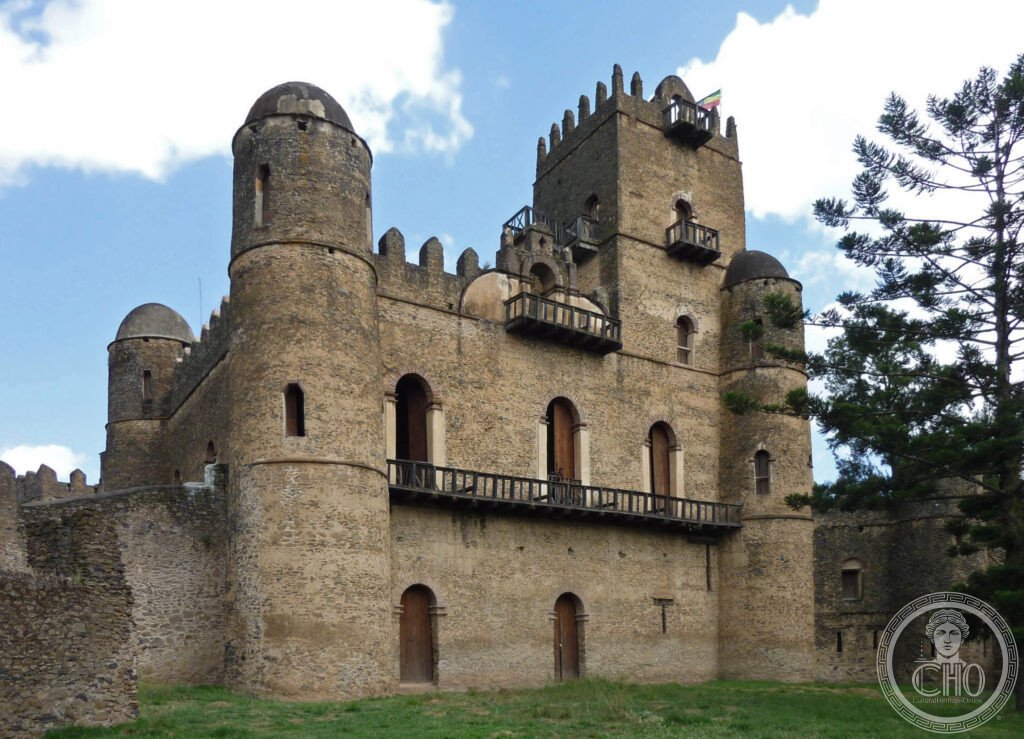
Fasil Ghebbi is the walled royal compound of six seventeenth-century castles at Gondar, built by successive Ethiopian emperors and fusing Axumite, Portuguese, Sudanese and Indian building traditions. As Ethiopia’s first permanent capital, it remains the country’s densest surviving concentration of medieval fortified architecture.
At a glance
Fasil Ghebbi, the Royal Enclosure of Gondar, is a walled compound at the centre of the town enclosing six castles raised by successive emperors between the 1630s and 1730s. Each ruler built his own residence rather than occupying his predecessor’s, so the enclosure reads as a sequence of related but distinct buildings within a single defensive wall punctuated by towers and gates.
The architecture is known as the Gondarine style, a hybrid combining Axumite decorative details, Portuguese Jesuit features such as pointed-arch windows and two-storey stone construction, Sudanese flat rooftop balconies, and cusped arches of Indian Mughal origin passed on through Portuguese contacts with Goa. A kilometre or so from the enclosure stands the Debre Berhan Selassie Church, whose ceiling is covered with rows of painted angel faces and is considered one of the most celebrated interiors in Ethiopian religious art.
Key facts
- Type: walled royal compound with six castles built by successive Ethiopian emperors
- Founder: Emperor Fasilides, whose castle of 1635 is the oldest and most prominent structure
- Enclosure: rectangular compound surrounded by a stone battlement wall roughly 900 metres in circumference, with twelve towers and six gates
- Nearby monument: Debre Berhan Selassie Church, about a kilometre from the enclosure, famed for its painted cherubim ceiling
- Coordinates: 12.6030° N, 37.4667° E
History
Before Fasilides, the Ethiopian court had no fixed capital. The emperor and his household, said to have numbered tens of thousands including army, clergy, administrators and artisans, moved continually across the country in a mobile tent-palace because no single place could sustain such numbers permanently.
In 1635 Emperor Fasilides founded Gondar as Ethiopia’s first permanent capital, choosing a site at the edge of Lake Tana and the Amhara highlands that sat between major trade routes and the military frontier. The following year he expelled the Portuguese Jesuit missionaries who had been active in Ethiopia since the early sixteenth century and had briefly converted his predecessor Susenyos to Catholicism, an episode that had triggered civil war. The Jesuits left, but the architectural forms they had introduced, notably the pointed arch and two-storey stone building, remained absorbed into the new Gondarine style.
Later rulers, including Iyasu I, Dawit III, Bakaffa, Iyasu II and Ras Mikael Sehul, added their own castles within the enclosure through the early eighteenth century. The compound suffered when Sudanese Mahdist forces attacked Gondar and burned churches in 1888, and again when Italian occupying forces used the Ghebbi as a military depot in the early 1940s, a period during which British bombing caused damage that was only partially repaired in later restoration work.
What you see
The visitor circuit runs through the walled enclosure past the six castles. Fasilides’ own castle, the oldest and most striking, has three storeys, round corner towers and battlements, and its roof gives the widest view over the compound and the town beyond. The Iyasu I Library, built in 1687, carries the most elaborate surviving interior decoration of any castle here, including faded wall paintings of a royal tree of life and scenes of court life. Walkways along the battlement walls link the various castles.
A short distance away, the Debre Berhan Selassie Church has an east-facing apse in the Ethiopian Orthodox tradition and an interior painted almost entirely across walls and ceiling. The ceiling’s rows of angel faces, each rendered slightly differently with large dark eyes and full lips in a flattened, stylised manner, are widely regarded as among the finest paintings in Ethiopian art. The side walls carry scenes from the Old and New Testaments, and a portrait of Emperor Iyasu I, who commissioned the church, appears in the nave.
North of the enclosure lies the Bath of Fasilides, a large stone-walled pool normally kept dry and used as a courtyard, but filled with water once a year for the Timkat, or Ethiopian Epiphany, celebrations, when the pool is blessed and pilgrims in white robes re-enact the baptism of Christ.
Practical information
- Entry: the Fasil Ghebbi enclosure and the Debre Berhan Selassie Church are ticketed separately; check current arrangements with the site’s official tourism office before travelling
- The Bath of Fasilides: can be viewed from outside without charge; it is filled with water only for the Timkat festival
- Timkat festival: held over two days around 19–20 January, with a procession of church relics to the bath the evening before; accommodation and flights should be arranged well in advance for this period
Getting there
Gondar is served by Ethiopian Airlines flights from Addis Ababa, with the airport lying some distance outside the town centre; onward transport into Gondar is straightforward to arrange on arrival. Travellers combining Gondar with Lalibela can often do so on a single domestic routing, allowing the two sites to be visited within one Ethiopian itinerary.
Nearby
- Simien Mountains National Park — inland from Gondar; a UNESCO World Heritage Site since 1978, home to the endemic Walia ibex and to gelada monkeys, with escarpment trails running along dramatic cliff edges
- Debre Berhan Selassie Church — about a kilometre from the Royal Enclosure, noted for its painted angel ceiling
- Bath of Fasilides — a short walk north of the enclosure, the setting for the annual Timkat celebrations
Sources
- UNESCO
Find it on the map
See this place and what’s around it →📷 Become a Cultural Heritage Online photographer
Share your photos of places: they stay published under your name as the author. The more they're seen, the more you get noticed — and soon a contest will reward the most appreciated photos.
Log in or sign up free to add a photoIs this page about you?
This page is read by travellers and heritage enthusiasts who find it on Google. Tell us how you are connected to this place and we will take it from there.