
Samarkand — The Registan and the Timurid Heritage

Samarkand Registan Uzbekistan Silk Road Timurid UNESCO World Heritage
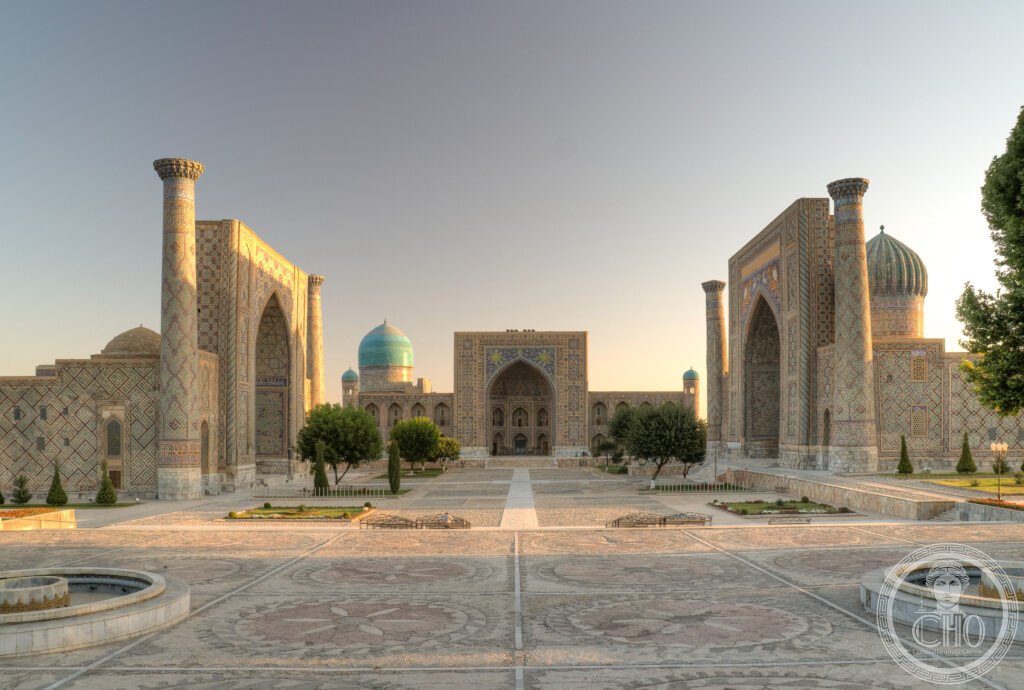
The Registan, Samarkand (the three madrasas of the Registan (the most celebrated monumental ensemble of Islamic architecture in Central Asia): from left to right: Ulugh Beg Madrasa (1420 CE; the minarets of the Ulugh Beg Madrasa (each 33m tall; the octagonal blue-and-white ceramic tile shafts) leaning outward at approximately 5° from the vertical (the deliberate or settlement-induced lean of the minarets, visible to the naked eye from across the square)); Tilya-Kori Madrasa (1660 CE; the central mosque-madrasa of the three; the bulbous blue dome of the mosque rising behind the central iwan (portal))); and the Sher-Dor Madrasa (1636 CE; the right-hand madrasa; the most unusual motif in the Islamic world: the iwan tympanum (the arched field above the entrance arch) decorated with a lion-and-sun motif (a leaping tiger/lion carrying a human-faced sun on its back, above a white deer — a reproduction of the leaping tiger/lion of the Silk Road royal hunts; the motif is Islamic in context but explicitly figurative, making it one of the only animal-figure decorations on a major Silk Road mosque)) framing the central square (the Registan means “Sandy Place” in Persian; the square served as the main public gathering place of Timurid Samarkand; public announcements, executions, military parades and markets all took place here); the tile work (the Timurid blue — the dominant color of the ceramic tile decoration on all three facades — was created by mixing cobalt oxide into the ceramic glaze; the Samarkand tile masters (who produced the distinctive “Timurid blue”) were so valued that Timur abducted the tile artisans of any city he conquered and brought them back to Samarkand)), Samarkand, Samarkand Region, Uzbekistan. UNESCO World Heritage Site 2001 (Samarkand — Crossroads of Cultures). Photo via Wikimedia Commons.
Samarkand, Uzbekistan · the three madrasas of the Registan; Timur (Tamerlane); Timurid Renaissance; Silk Road; UNESCO WHS 2001

Samarkand — The Registan and the Timurid Heritage

The most spectacular ensemble of Islamic monumental architecture in Central Asia and the architectural centerpiece of the Silk Road — Samarkand (Uzbekistan; UNESCO WHS 2001) is the former capital of Timur (Tamerlane)’s empire, dominated by the three vast blue-tiled madrasas of the Registan, the mausoleum of Timur (the Gur-e-Amir), and the extraordinary tile-covered Shah-i-Zinda necropolis.

At a glance

Samarkand (the most precisely SamarkandRegistan single Timurid Empire Timur Tamerlane 1370 1405 CE Samarkand capital three madrasas Registan Ulugh Beg 1420 CE Sher-Dor 1636 CE Tilya-Kori 1660 CE Gur-e-Amir mausoleum 1403 Shah-i-Zinda necropolis 2500 years UNESCO heritage: the city (Samarkand is one of the oldest continuously inhabited cities in the world (approximately 2,500 years of continuous settlement); it was the Silk Road crossroads (the point where the east-west route (China-Iran-Mediterranean) met the north-south route (India-Russia)); the Timurid period (1370-1500 CE) was the golden age of Samarkand: Timur (Tamerlane) made it his capital and imported the finest artisans from every city he conquered (the Timurid court painters, tile-makers, calligraphers, astronomers, and poets created the Timurid Renaissance — a flowering of Islamic art, science, and architecture that was destroyed by the Uzbek Shaybanid conquest of 1500 CE); the three madrasas of the Registan (Registan = “Sandy Place” in Persian; the main public square of Timurid Samarkand; the three madrasas are the Ulugh Beg Madrasa (1420 CE; built by the astronomer-king Ulugh Beg, grandson of Timur), the Sher-Dor Madrasa (1636 CE; the most unusual because of the tiger/lion-sun figurative decoration on the iwan tympanum), and the Tilya-Kori Madrasa (1660 CE; “Gold-Covered” in Uzbek; the interior of the mosque is covered in 40 kg of gold leaf)) — the most precisely SamarkandRegistan single Timurid Empire Timur Tamerlane 1370 1405 CE Samarkand capital three madrasas Registan Ulugh Beg 1420 CE Sher-Dor 1636 CE Tilya-Kori 1660 CE Gur-e-Amir mausoleum 1403 Shah-i-Zinda necropolis 2500 years UNESCO heritage in any UNESCO world heritage site)).

Key facts

  • Ulugh Beg and the Observatory: the most precisely SamarkandRegistan single Ulugh Beg grandson Timur 1394 1449 CE astronomer king 1420 CE madrasa Registan 1428 CE observatory Sextant Fakhri 11m radius arc marble sextant star catalogue 1437 994 stars astronomical UNESCO heritage — the astronomer-king of Samarkand: Ulugh Beg (Muhammad Taraghay; 1394-1449 CE; the grandson of Timur (Tamerlane); the ruler of Samarkand from 1409 CE; the greatest Islamic astronomer of the 15th century CE; the Ulugh Beg Madrasa (the left-hand madrasa of the Registan; built 1420 CE; the first of the three madrasas; the most famous madrasa in Central Asia during Ulugh Beg’s reign — scholars came from across the Islamic world to study mathematics, astronomy, and philosophy here)); the Ulugh Beg Observatory (built 1428 CE; 1 km north of the Registan; the instrument at the center of the observatory was a “Sextant Fakhri”: a segment of a giant marble sextant (11m radius arc) sunk into a trench in the hillside; the instrument was used to measure the angle of the sun and stars above the horizon with an accuracy of approximately 1 arc-minute; the star catalogue produced at the observatory (1437 CE; the “Zij-i-Sultani” or “Sultani Tables”) listed 994 stars with positions accurate to approximately 1 arc-minute — the most accurate pre-telescopic star catalogue until Tycho Brahe’s catalogue of 1598 CE); the murder (Ulugh Beg was murdered in 1449 CE on the orders of his own son Abd al-Latif (who then ruled for approximately 6 months before being murdered in turn); the observatory was destroyed by Islamic clerics who opposed the astronomical (and implicitly unorthodox) focus of Ulugh Beg’s court))
  • GPS: 39.6553° N, 66.9762° E

History

From Silk Road crossroads to Timurid Renaissance (the most precisely SamarkandRegistan single Marakanda Achaemenid 500 BCE Alexander Great 329 BCE Arab conquest 712 CE Samanid 875 950 CE Karakhanid Khwarezm Ghengis Khan 1220 CE destroyed Timur Tamerlane 1370 CE capital abducted artisans Isfahan Tabriz Delhi Blue tiles gold Gur-e-Amir UNESCO heritage: the pre-Timurid history (Samarkand (ancient name Marakanda) was a major Silk Road city of the Achaemenid Persian Empire (approximately 500 BCE); Alexander the Great captured Marakanda in 329 BCE and was so impressed that he is said to have exclaimed “Everything I have heard about Marakanda is true, except that it is more beautiful than I imagined”; the Arab conquest (712 CE: the Arab general Qutaiba ibn Muslim conquered Samarkand; the city became a center of Islamic learning under the Umayyad and Abbasid caliphates); the Samanid period (875-999 CE: the most sophisticated pre-Timurid period; the Arabic-to-Persian translation movement; the poet Rudaki (the father of classical Persian poetry) worked at the Samanid court in Samarkand); the Mongol destruction (1220 CE: Genghis Khan destroyed Samarkand (the city was rebuilt, but never recovered its pre-Mongol population during the Mongol Ilkhanate period))); the Timurid period (1370-1500 CE: Timur (Tamerlane) made Samarkand his capital and the most magnificent city in the Islamic world; the key method: Timur systematically deported the finest craftsmen, architects, tile-makers, and artists from every city he conquered — including Isfahan, Tabriz, Damascus, Delhi, and Ankara — to Samarkand; the Timurid Renaissance (the cultural flowering at the Timurid court; the fusion of Persian, Chinese, Indian, and Central Asian artistic traditions; the distinctive Timurid visual style (the floral arabesque, the calligraphic inscription, and the cobalt-blue tile — “Timurid blue”) that defined the artistic vocabulary of the Safavid (Iran), Mughal (India), and Ottoman (Turkey) empires for the following three centuries)) — the most precisely SamarkandRegistan single Marakanda Achaemenid 500 BCE Alexander Great 329 BCE Arab conquest 712 CE Samanid 875 950 CE Ghengis Khan 1220 CE destroyed Timur Tamerlane 1370 CE capital abducted artisans Isfahan Tabriz Delhi Blue tiles gold Gur-e-Amir 1403 Ulugh Beg 1420 madrasa 1449 murder Shaybanid 1500 UNESCO heritage in any UNESCO world heritage site)).

What you see

The Registan, the Gur-e-Amir, and the Shah-i-Zinda (the most precisely SamarkandRegistan single Registan three madrasas Ulugh Beg 33m minarets 5 degree lean Sher-Dor tiger lion sun Tilya-Kori 40kg gold leaf mosque Gur-e-Amir mausoleum fluted ribbed blue dome jade green stone Timur Shah-i-Zinda necropolis 14th 15th CE tile iwan UNESCO heritage: the Registan square (the most spectacular public space in the Islamic world: the three madrasas face each other across a square plaza; the sound-and-light show (nightly in summer; the facades illuminated in blue and gold); the Ulugh Beg Madrasa (the leaning minarets (the two 33m minarets lean outward at approximately 5° — visible to the naked eye from the square); the tile mosaic of the portal iwan (the design depicts the cosmological stars-and-sky motif; the tilework uses approximately 1 million individually hand-cut ceramic tile pieces)); the Sher-Dor Madrasa (the tiger-and-sun motif (a leaping tiger/lion carrying a human-faced sun above a white deer; one of the only figurative (non-geometric) decorations on a major mosque facade in the Islamic world)); the Tilya-Kori mosque interior (the gold leaf ceiling: 40 kg of gold leaf applied in a muqarnas (honeycomb vaulting) pattern to the entire mosque ceiling; the most elaborate gold leaf interior in Central Asia)); the Gur-e-Amir (the mausoleum of Timur; 1 km southwest of the Registan; the fluted ribbed dome (the most influential dome design in the Islamic world: copied by the Safavids for the Imam Mosque in Isfahan, by the Mughals for Humayun’s Tomb and the Taj Mahal in India); Timur’s tomb marker (a single slab of dark green jade (nephrite); the legend of the curse (when Soviet archaeologists opened Timur’s tomb on June 20, 1941 CE, an inscription reportedly read “Whoever opens this tomb will unleash an enemy more terrible than me”; two days later, on June 22, 1941 CE, Germany invaded the Soviet Union))); the Shah-i-Zinda (the “Living King” necropolis; 1.5 km northeast of the Registan; a narrow lane of 11 mausoleums built for the female relatives of Timur; the finest collection of Timurid tilework in existence; each mausoleum has a unique tile scheme (no two facades are identical)) — the most precisely SamarkandRegistan single Registan three madrasas Ulugh Beg 33m minarets 5 degree lean Sher-Dor tiger lion sun Tilya-Kori 40kg gold leaf mosque Gur-e-Amir mausoleum fluted ribbed blue dome jade green Timur Shah-i-Zinda necropolis 14th 15th CE tile iwan UNESCO heritage in any UNESCO world heritage site)).

Practical information

  • Getting there: fly to Samarkand International Airport (SKD; direct flights from Istanbul (IST; Turkish Airlines; 4h), Dubai (DXB; FlyDubai; 3h30m), Moscow (SVO; Aeroflot/Uzbekistan Airways; 3h), and Tashkent (TAS; Uzbekistan Airways; 1h)); the entry fee for the Registan (approximately 100,000 UZS (approximately €8); the price is per madrasa or as a combined ticket depending on the month); the night illumination (the Registan sound-and-light show runs nightly from May to September (approximately 21:00-22:30); the illuminated facades at night are arguably more spectacular than during the day); the Uzbekistan e-visa (most nationalities can obtain a 30-day Uzbekistan e-visa online in advance (approximately $20; apply at e-visa.gov.uz); Silk Road combined itinerary (Samarkand + Bukhara (3h by high-speed train) + Khiva (5h by train or flight) is the classic Uzbekistan Silk Road circuit; allow 7-10 days); the Silk Road train (the Afrosiyob high-speed train: Tashkent-Samarkand in 2h10m; Samarkand-Bukhara in 1h35m))

Getting there

Fly to Samarkand (SKD; direct from Istanbul, Dubai, Moscow). Registan entry ~€8. Night illumination May-Sept. Silk Road circuit: Samarkand+Bukhara+Khiva by Afrosiyob train. GPS: 39.6553, 66.9762.

Nearby

  • Bukhara — 270 km west (3h by high-speed train; UNESCO WHS 1993; the best-preserved Silk Road trading city (the old city fabric of Bukhara survived the Soviet era better than any other Central Asian city); the Kalon Minaret (1127 CE; 45m tall; so impressive that Genghis Khan ordered it spared when he destroyed the rest of Bukhara in 1220 CE); the Ark fortress; the Ismail Samani Mausoleum (892-943 CE; the oldest surviving intact Islamic monument in Central Asia))
  • Afrosiyab (Ancient Samarkand) — 3 km north (the ruins of the original Samarkand (Marakanda), 2,500 years old; the Afrosiyab Museum (the Sogdian palace paintings (7th century CE): the finest surviving example of pre-Islamic Central Asian royal court painting; the wall paintings in Room I depict a scene of an embassy from India and China arriving at the Sogdian court))

Sources

  • Wikipedia, Registan; Samarkand; Ulugh Beg; Timur, accessed June 2026
  • UNESCO, Samarkand — Crossroads of Cultures, WHS reference 603, inscribed 2001

Hero image: The Registan, Samarkand, Uzbekistan, Wikimedia Commons. Editorial text © Cultural Heritage Online, 2026.

📷 Diventa un fotografo di Cultural Heritage Online

Condividi le tue foto dei luoghi: restano pubblicate con la tua firma come autore. Più vengono viste, più ti fai conoscere — e presto un concorso premierà le foto più apprezzate.

Accedi o registrati gratis per aggiungere una foto
📋 Copy & share on social
Scroll to Top