
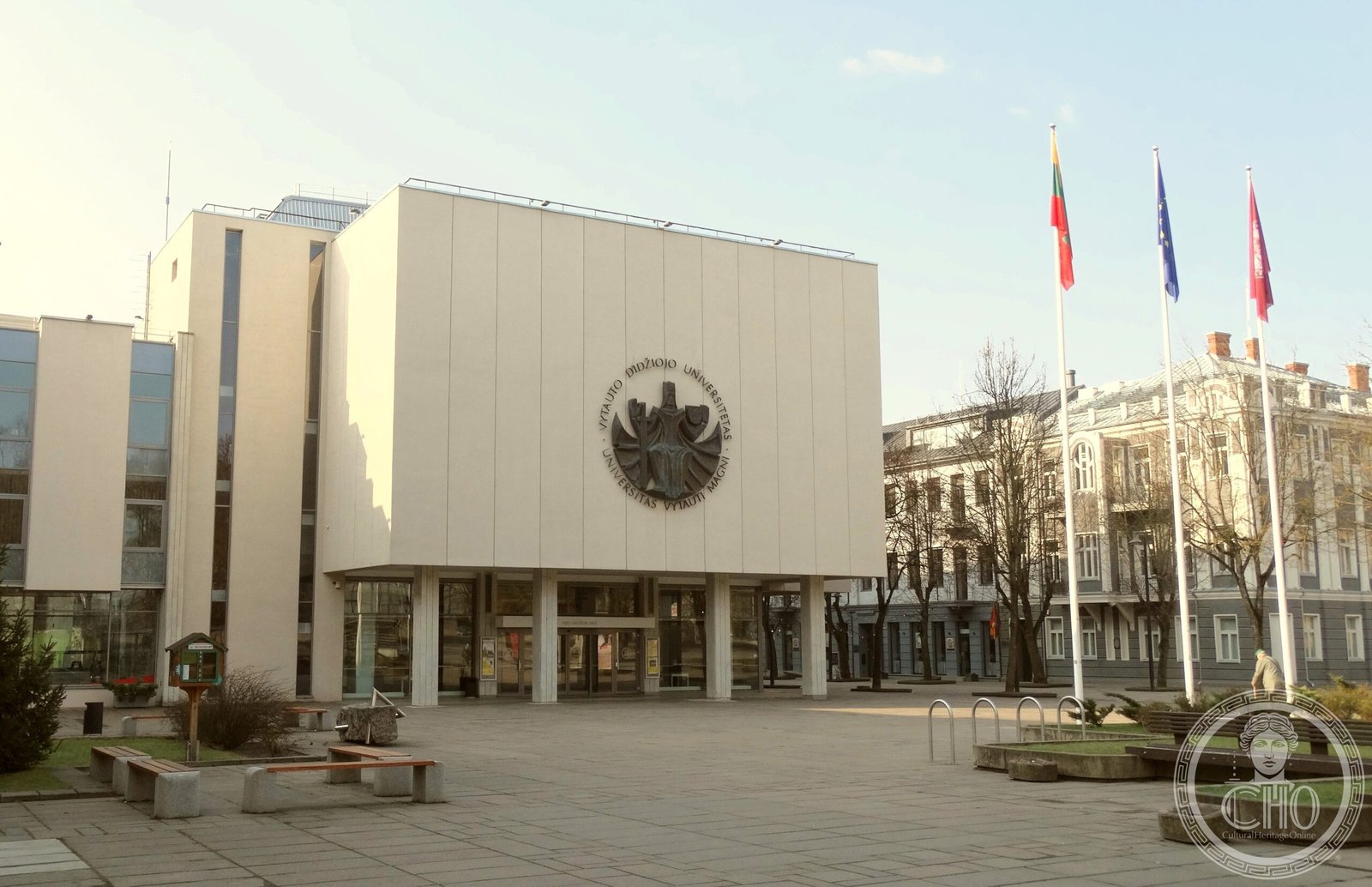
In the heart of Kaunas, a city that served as Lithuania’s provisional capital between 1920 and 1939, the main building of Vytautas Magnus University stands as a monument to the ambitious cultural and intellectual project of the interwar Lithuanian state. Founded in 1922 as the University of Lithuania and renamed in 1930 to honour the medieval Grand Duke Vytautas the Great, the institution was housed in a purpose-built ensemble that expressed the new republic’s aspirations in brick and stone. Architect Augustas Didžgalvis designed the central building in 1925, blending the restrained geometry of Central European Functionalism with decorative details rooted in Baltic vernacular tradition. Kaunas today is recognised as one of Europe’s most coherent interwar Modernist cities, its UNESCO World Heritage listing in 2023 placing VDU’s campus in an exceptionally rich architectural context that draws growing numbers of heritage visitors from across the continent.
At a glance
- Type
- University main building
- Period
- 1922 (founded); main building 1925
- Style
- Lithuanian Functionalism / Art Deco
- Location
- Daukanto g. 28, Kaunas, Lithuania
- Coordinates
- 54.8983° N, 23.9139° E
- Architect(s)
- Augustas Didžgalvis
Overview
Vytautas Magnus University occupies a prominent position in central Kaunas, its main building facing a landscaped square that connects the campus to the Old Town. The building’s sober facades, regular fenestration, and restrained decorative programme reflect the Functionalist sensibility that dominated Lithuanian institutional architecture in the 1920s. Today the university is a mid-sized liberal arts institution with around 7,700 students and a strong emphasis on humanities, social sciences, and theology, maintaining the intellectual traditions established during the interwar period.
History
Lithuania declared independence in 1918 and needed its own national university to anchor the new state’s cultural identity. The University of Lithuania was founded in Kaunas in 1922, taking its current name in 1930 to mark the 500th anniversary of Vytautas the Great’s death. During the interwar decades the institution flourished, attracting scholars from across Europe and contributing to the rapid development of Lithuanian literature, law, and natural sciences. Soviet occupation in 1940 forced the university to close; it was reopened only in 1989 as Lithuania moved towards independence, making its restoration one of the cultural milestones of the national revival.
Architecture & Design
Didžgalvis’s design mediates between the monumental symmetry expected of a national institution and the stripped, geometric aesthetic entering Lithuanian architecture from Western Europe. The main facade presents a rhythmic grid of windows framed by minimal pilasters, with a central entrance bay given slightly greater emphasis through modest projections rather than heavy ornament. Inside, a generous entrance hall and connecting corridors serve the lecture rooms and administrative spaces beyond. The building’s sober palette of light-coloured brick and stone complements the broader Kaunas interwar streetscape, now protected as a UNESCO World Heritage Site under the designation “Modernist Kaunas: Architecture of Optimism, 1919–1939.”
Cultural significance
VDU’s main building is inseparable from Lithuania’s twentieth-century story: founded as an act of national self-determination, suppressed under occupation, and revived as a symbol of renewal. The Kaunas UNESCO listing of 2023 brought international attention to the city’s interwar heritage and positioned VDU as one of the anchors of a growing cultural tourism circuit. For scholars of Baltic Modernism, Kaunas offers one of Europe’s most intact interwar urban ensembles, and the university campus is among its most institutionally significant nodes.
Visiting today
The university campus is open during working hours; the entrance hall and public areas can be visited freely. Guided tours of Kaunas interwar architecture, including the VDU campus, are offered by the local tourism office and several specialist heritage operators. The UNESCO World Heritage Visitor Centre nearby provides maps and context for the broader Kaunas Modernism trail.
Getting there
The main building is a ten-minute walk from Kaunas central bus and train stations. City buses and trolleybuses serve the city centre. Kaunas is approximately 100 km from Vilnius and is connected by frequent rail and bus services; journey time from the capital is around one hour fifteen minutes.
Sources & resources
Find it on the map
See this place and what’s around it →📷 Diventa un fotografo di Cultural Heritage Online
Condividi le tue foto dei luoghi: restano pubblicate con la tua firma come autore. Più vengono viste, più ti fai conoscere — e presto un concorso premierà le foto più apprezzate.
Accedi o registrati gratis per aggiungere una fotoDo you manage this place?
This page is read by travellers and heritage enthusiasts who find it on Google. Keep it accurate — and make it work for you. Free for non-profit heritage institutions.