
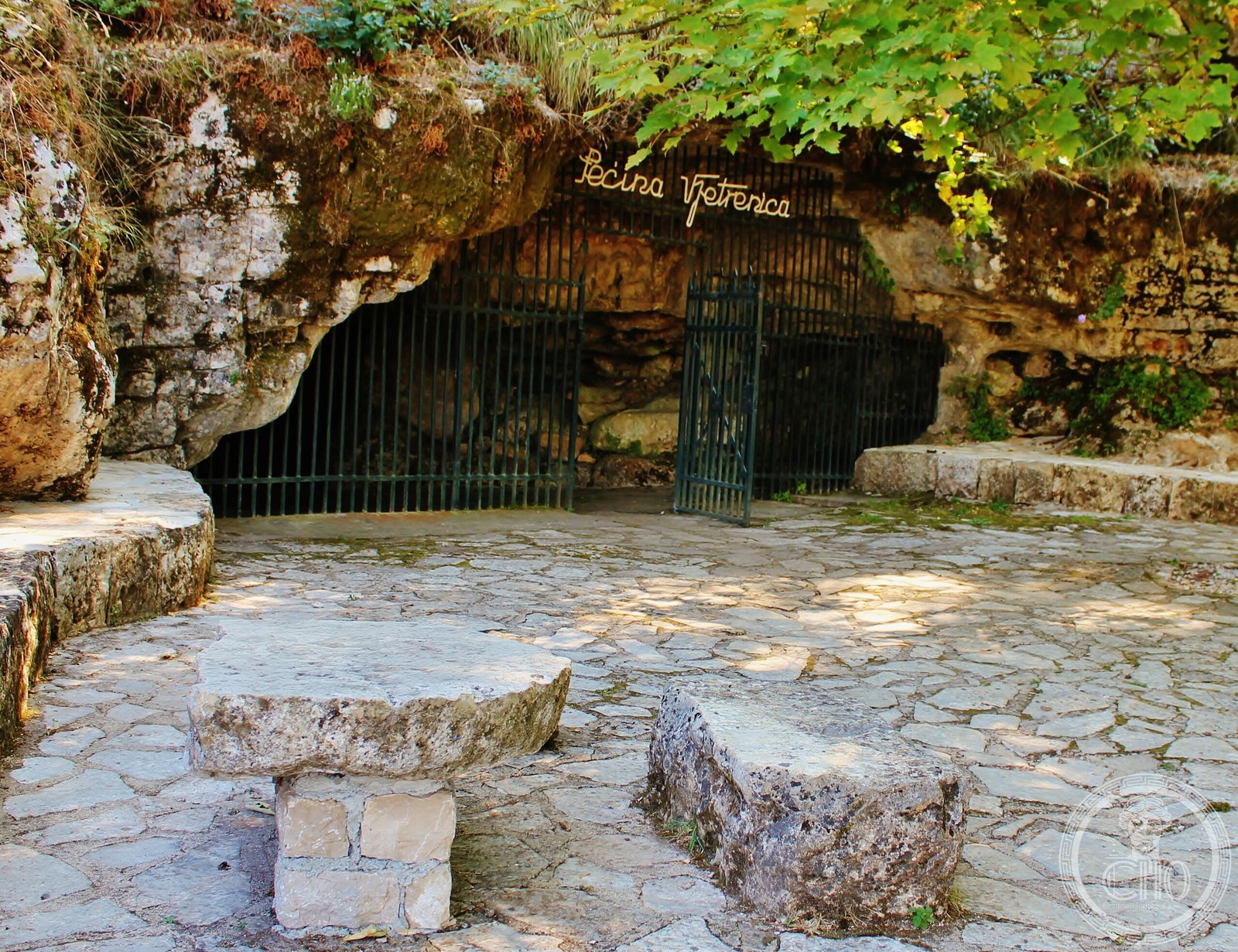
On the karst plain of Popovo polje, deep in the Herzegovinian interior, the Vjetrenica cave — whose name means “the cave of the wind” — is the most extraordinary speleological site in the Balkans. With more than 7 km of explored galleries, underground lakes and a cave ecosystem of a density unique in the world, it is home to more than 200 animal species, 55 of them endemic to the cave alone: blind crustaceans, salamanders, spiders and insects adapted to centuries of darkness. A UNESCO World Heritage site since 2023, as a jewel of European karst biodiversity.
At a glance
Vjetrenica Cave (“Wind Cave”) near the village of Zavala in Ravno municipality, south-eastern Herzegovina, is the longest and most biodiversity-rich cave in Bosnia and Herzegovina. Over 7 km of passages have been explored (of an estimated 12+ km of actual galleries), containing a sequence of chambers, underground rivers and lakes, stalactite and stalagmite formations, and an extraordinary fauna of cave-adapted animals. UNESCO inscribed Vjetrenica in 2023 (ref. 1673) for its outstanding natural value — specifically its exceptional concentration of endemic cave fauna, representing one of the richest subterranean ecosystems on Earth.
Key facts
- UNESCO: World Heritage since 2023 (Vjetrenica Cave, ref. 1673)
- Length: over 7 km explored; total estimated at 12+ km
- Fauna: over 200 animal species recorded; 55 endemic to the cave and found nowhere else on Earth
- Key endemics: cave crayfish (Troglocaris schmidtii), cave beetle (Anthroherpon), blind cave fish
- Air current: strong airflow (up to 35 km/h) from interior during barometric changes — hence “Wind Cave”
- Karst: part of the Dinaric karst, the world’s classic karst formation (the word “karst” derives from this region)
History
Vjetrenica has been known and entered by local inhabitants since ancient times — the strong air currents from the cave entrance are unmistakable and make the cave memorable as a natural landmark. The first systematic scientific exploration was conducted by Austrian researchers in the 19th century. The cave’s extraordinary biodiversity was documented through the 20th century by Yugoslav biologists; the density of endemic cave fauna became recognised as globally significant.
During World War II, the cave was used by partisan fighters as a shelter and weapons cache; some traces of this use are still visible in the outer galleries. Bosnia and Herzegovina’s UNESCO nomination was submitted after independence, and Vjetrenica was inscribed in 2023 as the country’s first natural World Heritage Site. The inscription highlighted the cave’s role as a living laboratory for the study of cave evolution and subterranean biodiversity in the Dinaric Karst.
What you see
Approximately 600 m of the cave’s outer galleries are open to visitors on guided tours, taking about 45 minutes. The route passes through chambers decorated with stalactites and stalagmites, skirts underground lakes with crystal-clear water, and illustrates the main geological and biological features. The strong air current at the entrance is immediately noticeable — wear a jacket even in summer.
Scientific expeditions venture further into the deeper galleries, where many endemic species are concentrated. The visitor centre at the cave entrance has exhibits on cave biology and the Dinaric karst ecosystem.
Practical information
- Guided tours: available spring–autumn; book at the visitor centre in Zavala village
- Duration: 45 min for visitor gallery; specialist tours of deeper sections available for groups
- Temperature: 11°C year-round inside the cave; bring a warm layer
- Base: Trebinje (30 km north, the main city of eastern Herzegovina)
Getting there
Vjetrenica is in Zavala village, Ravno municipality, about 30 km south-west of Trebinje. From Trebinje drive south-west via Ravno; the cave is signed. From Mostar: 100 km south via the M17 and local roads. No public transport; taxi from Trebinje available. GPS: 42.85° N, 17.98° E.
Nearby
- Trebinje — the elegant southern Herzegovina city with its Old Town and the Tvrdoš Monastery
- Dubrovnik (UNESCO) — the walled Old City of Dubrovnik, 30 km south-west (Croatia)
- Popovo polje — the dramatic Dinaric karst plain between Trebinje and Metković, one of the largest karst poljes in the world
Sources
- UNESCO World Heritage Centre — “Vjetrenica Cave” (ref. 1673)
- Encyclopaedia Britannica — Dinaric Karst
- Biospeleological Society of Bosnia and Herzegovina — Vjetrenica fauna surveys
Find it on the map
See this place and what’s around it →📷 Become a Cultural Heritage Online photographer
Share your photos of places: they stay published under your name as the author. The more they're seen, the more you get noticed — and soon a contest will reward the most appreciated photos.
Log in or sign up free to add a photo