
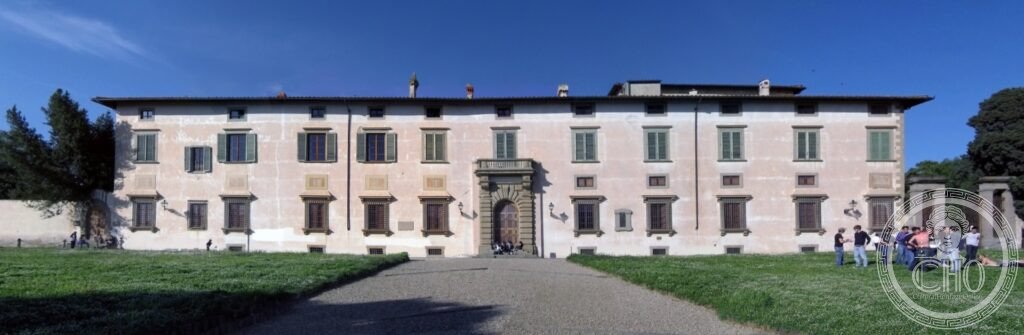
The villa that holds the Birth of Venus di Botticelli — dipinta qui per questa stanza — e il giardino terrazzato con fontane di Tribolo, prototipo del giardino mediceo della maturità.
At a glance
Villa Medicea di Castello stands 5 km north-west of Florence in the suburban comune of Castello, on a hillside that gives broad views over the city and the Arno plain. Built in 1477 for Lorenzo and Giovanni di Pierfrancesco de’ Medici (cousins of Lorenzo the Magnificent), it became famous as the commission address of two of Botticelli’s most celebrated paintings — the Primavera and the Birth of Venus — both painted for the villa’s main hall and today in the Uffizi. When Cosimo I consolidated Medici rule in 1537, he chose Castello as his principal suburban residence. In 2013, UNESCO inscribed the villa as one of twelve Medici Villas and Gardens in Tuscany (ref. 175bis), recognising the garden designed by Niccolò Tribolo as a founding example of Italian Renaissance garden design.
Key facts
- UNESCO inscription: 2013, “Medici Villas and Gardens in Tuscany,” ref. 175bis (serial nomination of 12 sites)
- Built: 1477 for Lorenzo and Giovanni di Pierfrancesco de’ Medici; acquired and renovated by Cosimo I, 1537
- Garden designer: Niccolò Tribolo, from 1537; later work by Bartolomeo Ammannati and Bernardo Buontalenti
- Botticelli connection: Primavera (c. 1478) and Birth of Venus (c. 1484–1486) painted for this villa, now in Uffizi Gallery
- Current use: seat of the Accademia della Crusca (Italian language academy) since 1966
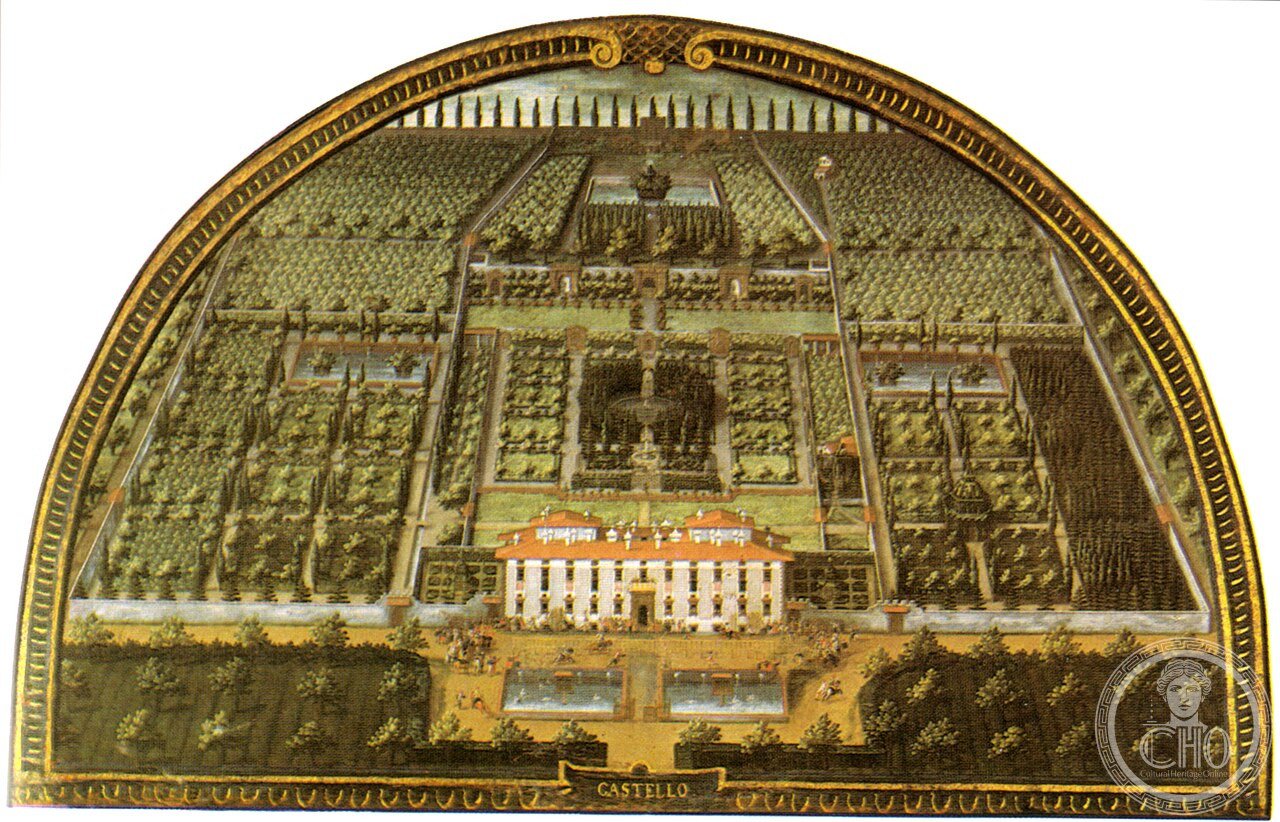
- Garden: Italian formal garden with two terraces, Tribolo’s Fontana di Ercole e Anteo, Fontana dell’Appennino, ice cave (ghiacciaia)
History
Lorenzo and Giovanni di Pierfrancesco de’ Medici were the patrons who commissioned Sandro Botticelli’s mythological paintings for Castello in the late 1470s and 1480s. Giorgio Vasari records that the Primavera and Birth of Venus hung in the villa’s main hall — a room designed to present Neoplatonic ideas of love and beauty through allegory. The paintings left Castello for the Uffizi only in 1815. The iconographic programme of the garden, designed by Tribolo from 1537 onward for Cosimo I, continued this allegorical tradition: the garden was conceived as a representation of the Tuscan land itself, with water drawn from the Apennines through an underground aqueduct ending in the central fountain of Hercules and Antaeus — symbolising Cosimo’s dominion over Florence.
Tribolo died in 1550 before the garden was complete; Ammannati and Buontalenti continued and modified the scheme over the following decades. The ice cave (ghiacciaia) is a Buontalenti invention for preserving ice gathered from the Apennine snowfields — a luxury supply chain only the Medici could maintain in 16th-century Tuscany.
After the end of the Medici line in 1737, the villa passed to the Lorraine grand dukes, who used it as a hunting residence. In 1966, the Italian state assigned the villa to the Accademia della Crusca — the institution founded in 1583 to codify the Italian language — which still operates here today, making Castello one of the few Medici villas with an active intellectual function.
What you see
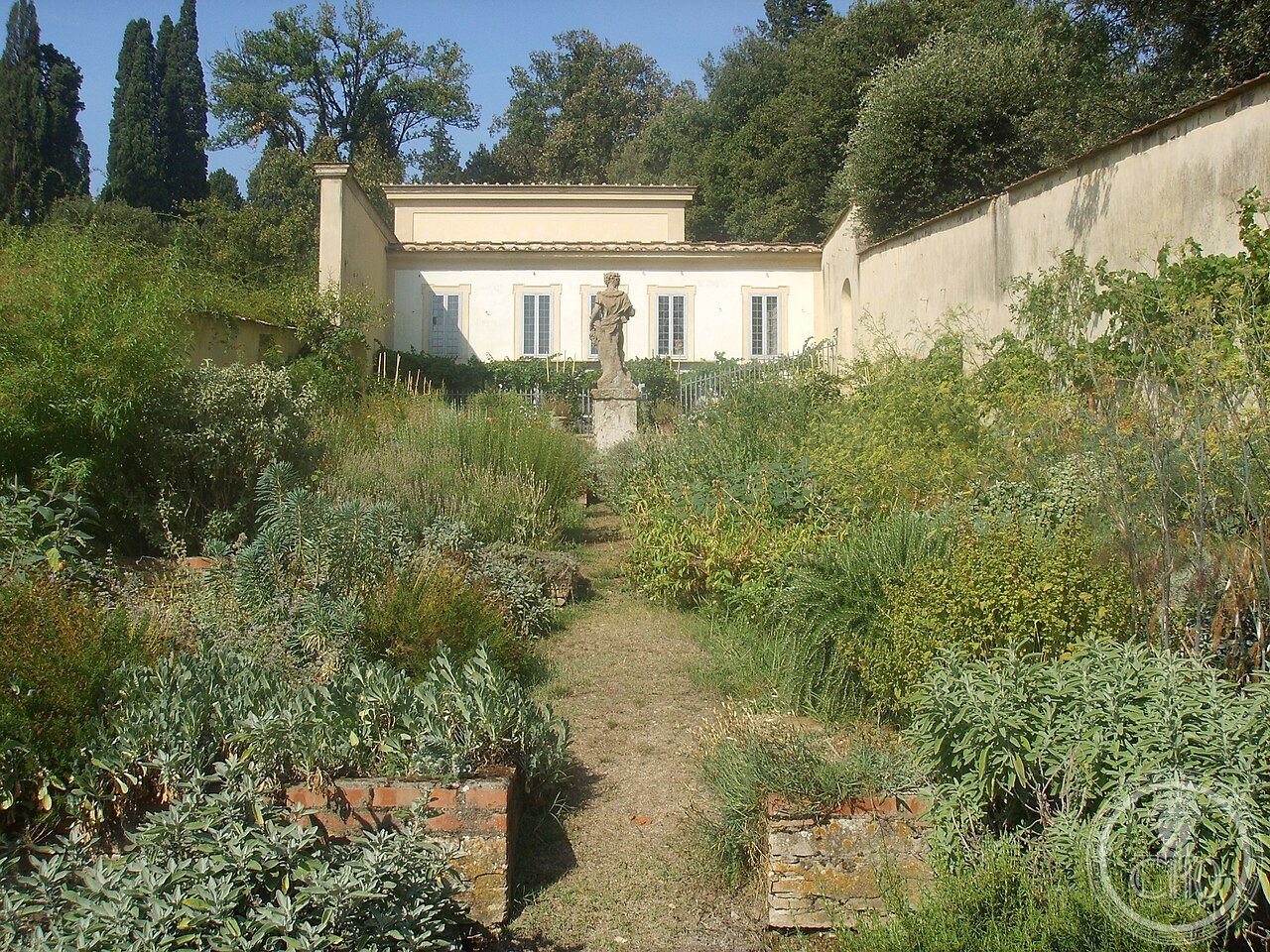
The villa’s facade is a sober two-storey 15th-century block, its loggia looking out over the lower terrace toward Florence. The garden unfolds on the slope above the building in two terraced levels: the lower parterre with a central path and clipped hedges descends from the villa’s rear loggia, while the upper terrace — reached through a grotto encrusted with artificial stalactites, shells and coloured glass — culminates in a large fishpond. The Fontana di Ercole e Anteo by Tribolo and Ammannati occupies the central axis of the lower terrace; the figure of Hercules strangling the giant Antaeus once served as the spout of a water jet driven by the pressure of the Apennine aqueduct.
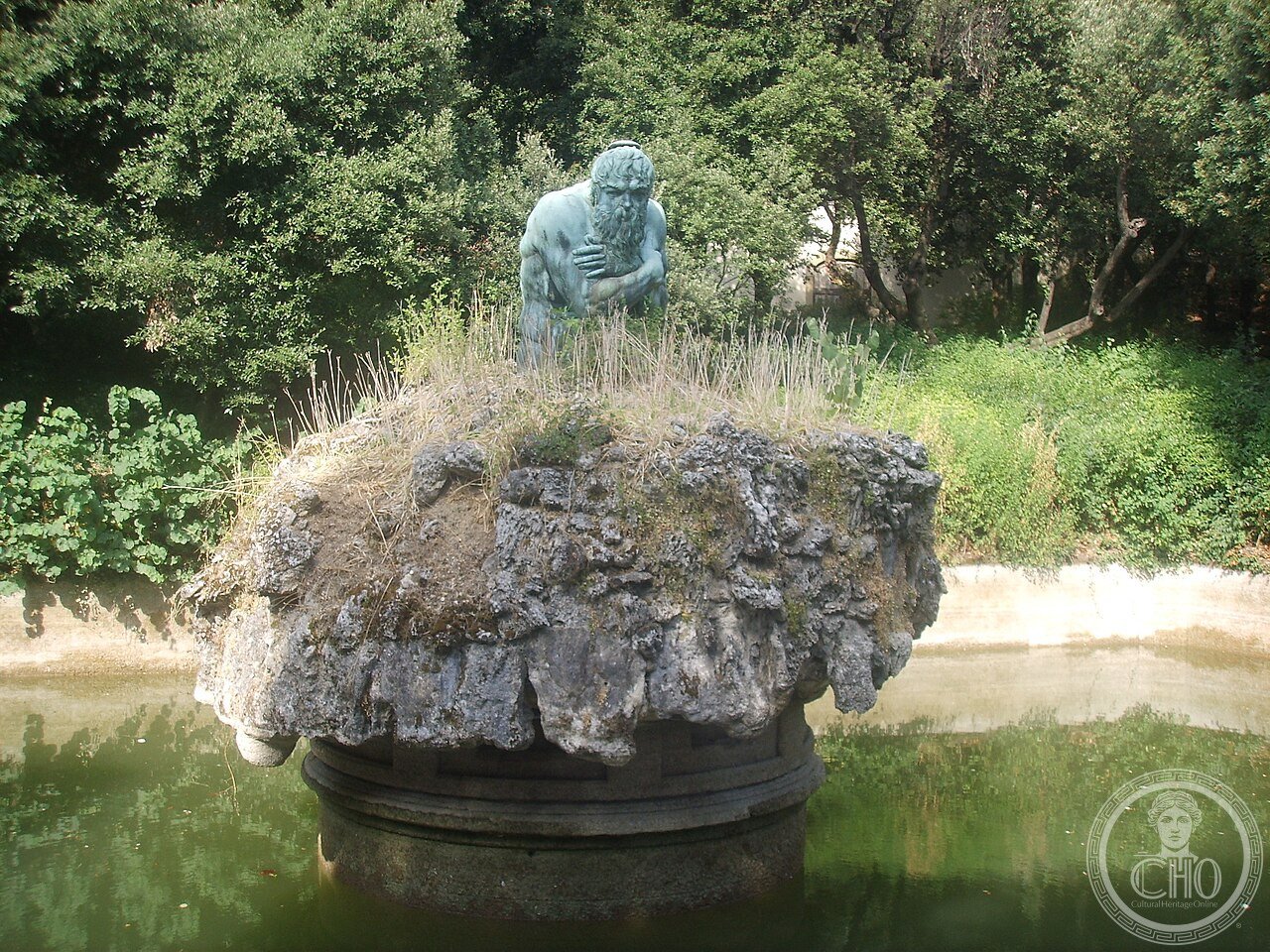
The shaded grotto between the two terraces is a cool, damp interlude of mannerist invention: bronze animals emerge from the stalactite walls, and Giambologna’s Appennino figure crowns the upper pool — a bearded giant squeezing a fish, from whose mouth water falls. The overall effect is of a garden as a mythological narrative, each element placed to be read in sequence as you climb.
Practical information
- Opening hours: garden open daily (variable by season); the villa interior is the seat of Accademia della Crusca and has restricted access
- Admission: reduced fee; included in combined Medici Villas circuit ticket (Polo Museale della Toscana)
- Best season: spring for flowering lemon trees and garden; the view over Florence is clearest in autumn and winter
- Time needed: 1–1.5 hours for garden and exterior
- Combine with: Villa Medicea La Petraia, a 10-minute walk up the hill (same garden system, more opulent interior)
Getting there
Bus ATAF line 28 from Piazza della Libertà (Florence) to Castello stop, journey 20 minutes. By car: take Via Reginaldo Giuliani north from Florence; Villa di Castello is signposted. From Florence SMN station: Tram T1 to Careggi, then short bus connection. GPS: 43.8076° N, 11.2394° E.
Nearby
- Villa Medicea La Petraia — the grander Medici villa 700 m uphill, with Giambologna bronze fountain and panoramic terraces, UNESCO 2013
- Villa di Careggi — Cosimo the Elder’s favoured retreat, where the Platonic Academy met; 2 km east
- Giardino di Boboli — Medici garden behind Palazzo Pitti, 8 km south-east in the city centre
Sources
- UNESCO World Heritage List — “Medici Villas and Gardens in Tuscany,” ref. 175bis (whc.unesco.org)
- Wikipedia — “Villa di Castello” (en.wikipedia.org/wiki/Villa_di_Castello)
- Polo Museale della Toscana — Villa medicea di Castello (polomuseale.firenze.it)
- Giorgio Vasari, Le vite de’ più eccellenti pittori, scultori e architettori, 1550/1568
- Judith Chatfield, A Tour of Italian Gardens, Rizzoli, 1988
Find it on the map
See this place and what’s around it →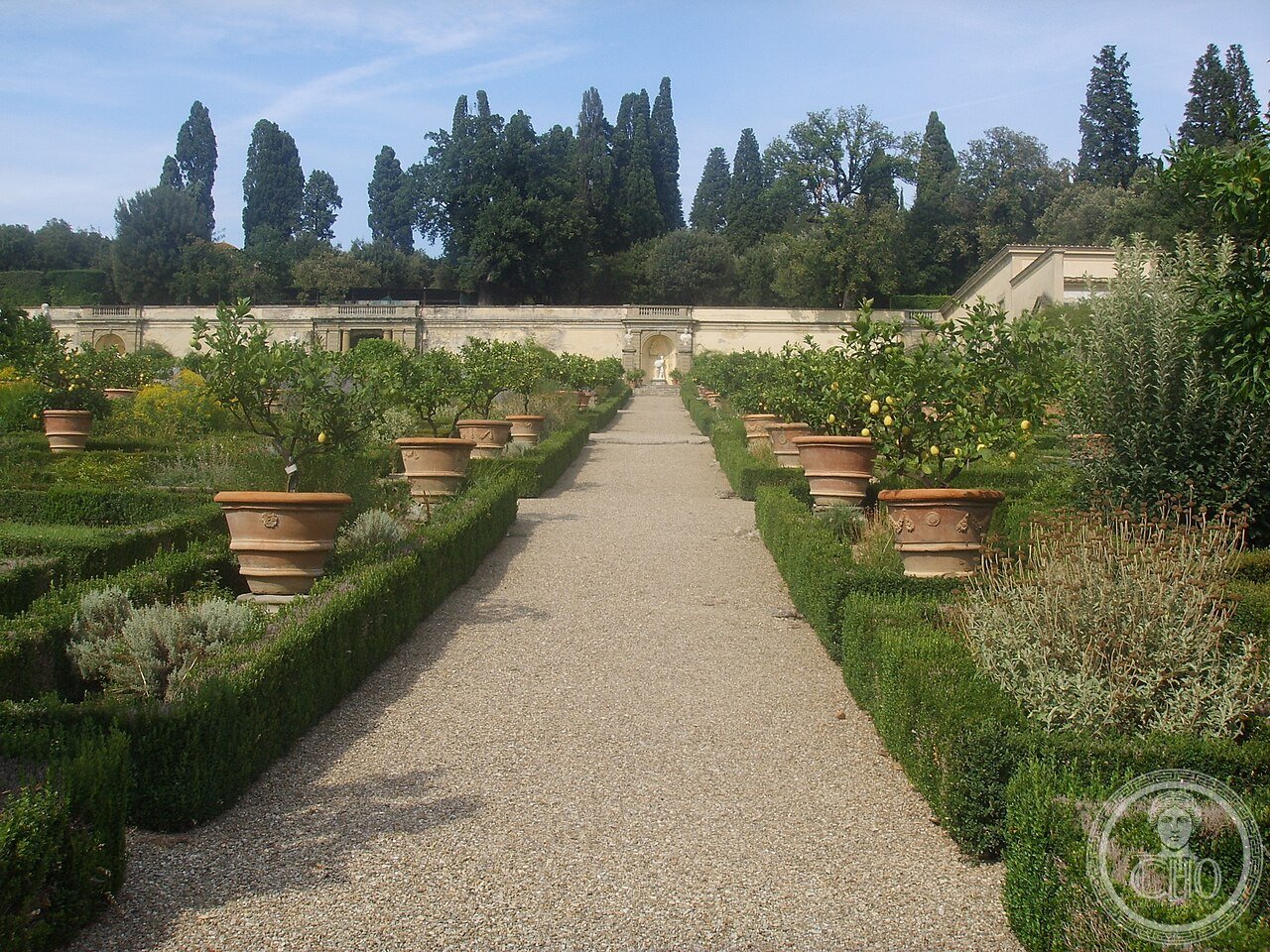
📷 Become a Cultural Heritage Online photographer
Share your photos of places: they stay published under your name as the author. The more they're seen, the more you get noticed — and soon a contest will reward the most appreciated photos.
Log in or sign up free to add a photoIs this page about you?
This page is read by travellers and heritage enthusiasts who find it on Google. Tell us how you are connected to this place and we will take it from there.