
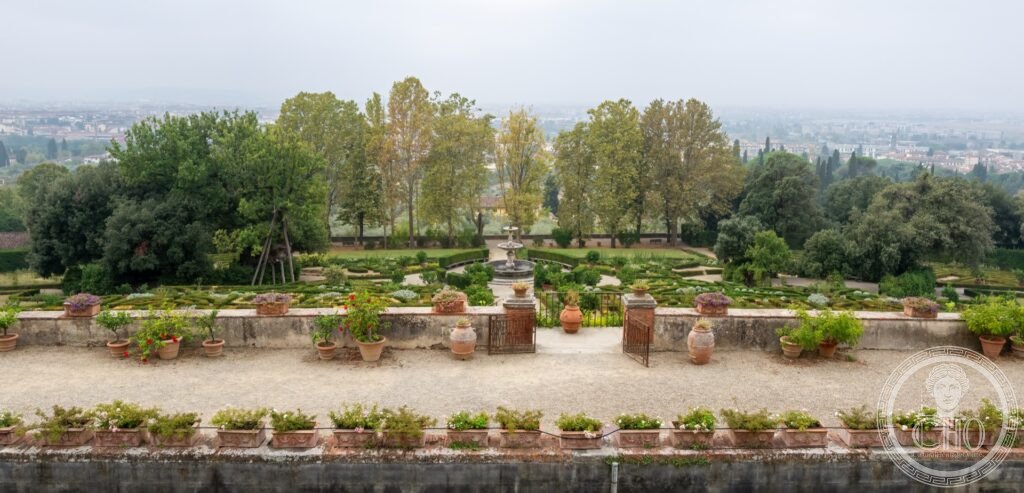
On the hill above Castello, Buontalenti turned a medieval tower into a belvedere villa with the finest panoramic garden in Florence — Victor Emmanuel II’s favourite after the unification of Italy.
At a glance
Villa Medicea La Petraia occupies the highest point of the Castello hill, 5 km north-west of Florence, commanding a panorama over the city and the Arno valley that reaches the Apennines on clear days. Converted from a medieval tower-house by Bernardo Buontalenti between 1575 and 1590 for Cardinal Ferdinando de’ Medici (later Grand Duke Ferdinando I), the villa combines the defensive verticality of a fortified tower with the terraced gardens of Renaissance leisure architecture. Its centrepiece is the courtyard fountain by Giambologna — the Venere Uscente dall’Acqua (1560–1572), a bronze Venus wringing water from her hair, originally at the Villa di Castello — and the landscape terrace above the town with its axial view toward the Duomo. In 2013, UNESCO inscribed La Petraia as one of the twelve Medici Villas and Gardens in Tuscany (ref. 175bis).
Key facts
- UNESCO inscription: 2013, “Medici Villas and Gardens in Tuscany,” ref. 175bis
- Built: redesigned from a medieval tower-house by Bernardo Buontalenti, 1575–1590, for Cardinal Ferdinando de’ Medici
- Fountain: Venere Uscente dall’Acqua by Giambologna (c. 1560–1572), originally at Villa di Castello; moved to La Petraia, 1788
- Royal residence: favourite suburban villa of King Vittorio Emanuele II after 1865; covered the courtyard with an iron-and-glass roof for ballroom dances
- Garden: three terraces with Italian parterre, statue gallery, bosco; view from upper terrace spans the Duomo to the Apennines
- Current use: state property managed by Polo Museale della Toscana; interior rooms (ballroom, royal apartments) open to public
History
The site takes its name from the pietraie — the quarries of pietraforte limestone that once scarred the hill. The Strozzi family built a country house here in the 14th century; the Medici acquired it in 1530, when Cosimo I consolidated Medici rule over Florence. Serious investment began only under Cardinal Ferdinando, who entrusted Buontalenti with a complete redesign in 1575. Buontalenti retained the medieval tower, incorporating it into the central block of a three-storey villa, and rearranged the hillside into a system of three terraces — the upper bosco, the middle ornamental parterre, and the lower service zone.
The famous Giambologna fountain was originally commissioned for Villa di Castello but proved too large for that courtyard; it was transferred to La Petraia in 1788. When Ferdinando became Grand Duke in 1587, La Petraia became his preferred retreat outside the pressure of court life in the Palazzo Pitti. The last major transformation came after Italian Unification: Vittorio Emanuele II, who used Florence as his capital 1865–1871, adopted La Petraia as his personal residence. He commissioned the covering of the central courtyard with an iron-and-glass roof to create an indoor ballroom — a Victorian intervention that is now itself listed as a historic element.
What you see
The exterior retains Buontalenti’s characteristic restraint: a three-storey block with the medieval tower absorbed into its bulk, the windows arranged with the precise rhythm Buontalenti preferred over ornamental exuberance. The courtyard — now covered — is dominated by Giambologna’s bronze Venus, which stands on its original hexagonal base; the bronze caught green from two centuries of outdoor exposure before it was sheltered by the iron roof. The frescoed cycle on the courtyard walls depicts the history of the Medici family in a readable cartoon narrative commissioned by Grand Duke Cosimo III (1670s).
The garden’s chief spectacle is the upper terrace: an axial parterre of box hedges and lemon trees, ending at a balustrade from which the Florentine skyline — Brunelleschi’s dome, Giotto’s campanile, the Bargello tower — is arranged as a deliberate panoramic composition. The bosco above is an informal English-style park added under the Lorraine grand dukes in the 18th century, with century-old ilex oaks and a small icehouse.
Practical information
- Opening hours: Tuesday–Sunday 08:15 to dusk (varies by season); first and last Monday closed
- Admission: combined Medici Villas circuit ticket available (Polo Museale della Toscana)
- Best season: spring (April–May) for the parterre lemon trees and clear panoramic air
- Time needed: 1.5–2 hours for villa interior + terraced garden
- Combine with: Villa Medicea di Castello, a 10-minute walk downhill
Getting there
Bus ATAF line 28 from Piazza della Libertà (Florence) to Castello stop, then 15-minute walk uphill. By car: from Florence take Via Reginaldo Giuliani north; La Petraia is signposted above Villa di Castello. GPS: 43.8148° N, 11.2505° E.
Nearby
- Villa Medicea di Castello — Botticelli’s villa with Tribolo’s allegorical garden, 700 m downhill; UNESCO 2013
- Villa di Careggi — Cosimo the Elder’s retreat and seat of the Platonic Academy, 2 km east
- Giardino di Boboli — the great Medici city garden behind Palazzo Pitti, 8 km south-east
Sources
- UNESCO World Heritage List — “Medici Villas and Gardens in Tuscany,” ref. 175bis (whc.unesco.org)
- Wikipedia — “Villa della Petraia” (en.wikipedia.org/wiki/Villa_della_Petraia)
- Polo Museale della Toscana — Villa medicea La Petraia (polomuseale.firenze.it)
- Detlef Heikamp, “The Medici villas” in The Dictionary of Art, Macmillan, 1996
Find it on the map
See this place and what’s around it →
📷 Become a Cultural Heritage Online photographer
Share your photos of places: they stay published under your name as the author. The more they're seen, the more you get noticed — and soon a contest will reward the most appreciated photos.
Log in or sign up free to add a photoIs this page about you?
This page is read by travellers and heritage enthusiasts who find it on Google. Tell us how you are connected to this place and we will take it from there.