
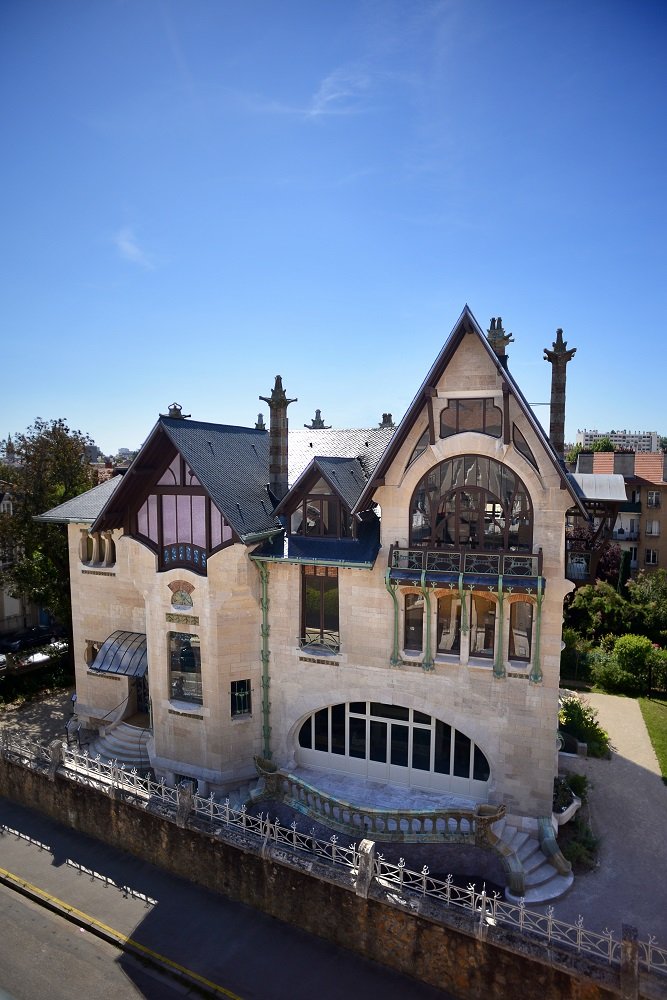
The furniture maker Louis Majorelle wanted a home that was itself a manifesto. The Villa Majorelle was the first fully Art Nouveau house in Nancy, designed inside and out.
At a glance
The Villa Majorelle was designed by the architect Henri Sauvage (1873–1932) and built in 1901–1902 as the home and studio of the decorator and furniture maker Louis Majorelle, a leading figure of the École de Nancy. It is regarded as the first house in the city conceived entirely in the Art Nouveau idiom, with structure, ironwork, stained glass and furnishings designed as one. Sometimes called Villa Jika, it is now a museum restored to its early appearance.
Key facts
- Architect: Henri Sauvage
- Owner: Louis Majorelle, furniture maker
- Built: 1901–1902
- Movement: École de Nancy / French Art Nouveau
- Status: listed monument, open as a museum after restoration
History
Louis Majorelle ran one of the most successful art-furniture workshops in France and was a driving force of the École de Nancy, the regional movement that gave French Art Nouveau much of its energy. He commissioned the young Parisian architect Henri Sauvage to design a house that would show what the new style could do at full scale.
The villa brought together Nancy’s leading makers: Sauvage for the architecture, Majorelle for the woodwork and metal, Jacques Grüber for stained glass and the ceramicist Alexandre Bigot for tiling. After years of partial use the house was acquired by the city and museum authorities and restored, reopening to the public as part of the École de Nancy collections.
What you see
The villa breaks free of the symmetrical townhouse: bays, a tower and a deep loggia step in and out, and the roofline rises and falls without a fixed centre. Carved stone plant forms, sinuous ironwork and large windows announce the new style from the street.
Inside, the rooms keep their fitted furniture, stained glass and decorative schemes, so the house reads as a single designed environment. The staircase and the principal rooms show how Majorelle’s workshop translated natural forms into wood and metal.
Practical information
- Function: house museum, part of the Musée de l’École de Nancy
- Setting: a residential street west of central Nancy
- Time needed: about 1 hour
Getting there
Nancy is about 1.5 hours from Paris by direct TGV to Nancy-Ville station. The villa lies west of the centre, reachable on foot in around 25 minutes or by city bus or tram.
Nearby
- Musée de l’École de Nancy, the movement’s dedicated museum
- Place Stanislas, the eighteenth-century UNESCO square in central Nancy
- Nancy — The École de Nancy and French Art Nouveau (CHO city guide)
Sources
- Musée de l’École de Nancy, Villa Majorelle (musee-ecole-de-nancy.nancy.fr)
- French Ministry of Culture, base Mérimée listed-monument record
- Encyclopaedia Britannica, “Art Nouveau” and “Louis Majorelle”
Find it on the map
See this place and what’s around it →Record researched and written by Luigi De Marchi for Cultural Heritage Online, 2026.
📷 Become a Cultural Heritage Online photographer
Share your photos of places: they stay published under your name as the author. The more they're seen, the more you get noticed — and soon a contest will reward the most appreciated photos.
Log in or sign up free to add a photoIs this page about you?
This page is read by travellers and heritage enthusiasts who find it on Google. Tell us how you are connected to this place and we will take it from there.