
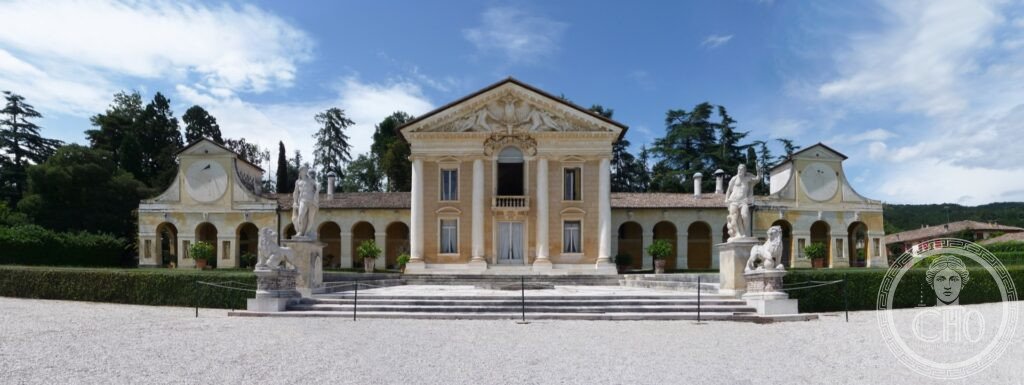
Villa Barbaro at Maser — designed by Palladio around 1558 for the brothers Daniele and Marcantonio Barbaro, and frescoed throughout by Paolo Veronese around 1560 — is the only surviving collaboration between the two greatest figures of the Veneto High Renaissance, producing the most joyful and humanistically complex interior of any Italian villa: Veronese’s trompe-l’oeil painted servants looking down from painted mezzanines, the painted landscape views beyond fictive open windows, and the mythological ceiling scenes that blend the natural and the divine make Villa Barbaro the supreme expression of the Renaissance idea of the villa as a painted paradise.
At a glance
Villa Barbaro (province of Treviso, Veneto; UNESCO 1996, ref. 712 — inscribed as one of the “Palladian Villas of the Veneto”) is unique among Palladian villas in being the only one with a completely intact cycle of Renaissance frescoes painted by a major master in the rooms as originally conceived, in permanent dialogue with Palladio’s architecture. The villa was commissioned by Daniele Barbaro (1513-1570 — patriarch-elect of Aquileia, translator of Vitruvius into Italian, commentator, architect-theorist — Daniele and Palladio worked together on the Italian edition of Vitruvius published in 1556) and his brother Marcantonio Barbaro (1518-1595 — Venetian senator and ambassador to France and the Ottoman Empire); the choice of Veronese (rather than Titian or Tintoretto, the other great Venetian painters of the period) for the fresco commission was Daniele’s — Veronese had recently completed the frescoes at Villa Soranzo and was known for his mastery of illusionistic architectural settings.
Key facts
- Gli affreschi di Veronese (1560-1561): Paolo Veronese (Paolo Caliari, 1528-1588, known as “Veronese” because he was born in Verona) painted the entire interior of Villa Barbaro in approximately 1560-1561 — a relatively short time for a commission of this scope (approximately 1,800 square metres of fresco surface); the programme was devised by Daniele Barbaro and is one of the most intellectually complex humanist iconographic programmes of the 16th century: the main hall (Sala dell’Olimpo) has a ceiling showing Mount Olympus with the gods surrounding a central figure of Providence (or Virtue), framed by four trompe-l’oeil balconies with figures of the four seasons; the secondary rooms have cycles of hunting scenes, pastoral landscapes, mythological scenes (Diana and Actaeon, Bacchus and Ariadne), and fictive architectural elements (painted columns, painted windows with views over an invented landscape); the most famous element is the series of painted “intruders” — painted figures dressed as servants, children, and visitors looking down from fictive doorways and mezzanines into the real space of the rooms, creating a continual confusion between real and painted space that anticipates the 17th-century Baroque illusionism
- Daniele Barbaro e la traduzione di Vitruvio: Daniele Barbaro’s translation and commentary of Vitruvius (“I Dieci Libri dell’Architettura di M. Vitruvio tradotti et commentati da Monsignor Barbaro”, Venice 1556, with illustrations by Palladio himself) is the most influential 16th-century edition of Vitruvius and the theoretical foundation of Palladio’s architecture; the collaboration between Daniele Barbaro (as humanist theorist) and Palladio (as architect-illustrator) at Villa Barbaro is the physical realization of the ideas developed in the Vitruvius translation — the villa itself is an experiment in the principles of the classical villa described by Vitruvius and interpreted by Palladio
- Il Tempietto (1580, Scamozzi): In the garden across the road from the villa, a small circular tempietto was built (ca. 1580, attributed to Vincenzo Scamozzi, possibly designed by Palladio before his death) as the private family chapel; it is a miniature version of the Pantheon (circular cella, Corinthian portico with pediment, cofered dome) and the most elegant small sacred building in the Veneto; it remains in private use (family funerary chapel) and is accessible by appointment
- UNESCO: 1996 (added to the Vicenza inscription), rif. 712
- GPS: 45.7476, 11.9869 — Google Maps (Villa Barbaro, Maser)
History
Villa Barbaro was built by the Barbaro brothers (Daniele and Marcantonio) between approximately 1558 and 1560 on agricultural land at Maser that the family had owned since the 15th century; the commission to Palladio came after the brothers’ collaboration with Palladio on the Vitruvius edition (1556). Paolo Veronese painted the interiors approximately 1560-1561, within a year of the building’s completion. After Daniele Barbaro’s death (1570), the villa passed to Marcantonio and then through female inheritance to the Grimani family; it was purchased in 1760 by Giambattista Volpato, and in 1934 by the Volpato-Bressa-Sartorelli family, who opened it to tourism and still own it. The villa has never been significantly modified since the 16th century — the Veronese frescoes are substantially intact (though the colors have somewhat faded from humidity and the surface has been cleaned several times); the 17th-century alterations (a secondary staircase, some window modifications) are minor.
What you see
Villa Barbaro is open for guided tours (exterior and interior) and is the most rewarding of the Palladian villas to visit in terms of sheer artistic richness. The circuit (45-60 min, guided): the exterior nymphaeum (a semicircular fountain court with exedra and classical sculptures, behind the main villa body — the best view of the villa from the garden); the main hall (Sala dell’Olimpo — the most photographed interior, with Veronese’s ceiling and the fictive balconies); the subsidiary rooms with the painted servants and landscape windows (count the number of “fake” figures looking into the room — the effect is still surprising after 460 years); the hunting fresco room; the Sala delle Mappe (Barbaro’s study, with painted geographical maps of the world in the pre-Columbian tradition); the dog painting (Veronese’s dog portrait, one of the earliest surviving large-scale dog portraits in Western art, in the entrance loggia). The Tempietto across the road is occasionally accessible during the tour — ask the guide.
Gallery
Practical information
- Villa Barbaro: Via Cornuda 7, Maser (TV); open Tue-Sun 10:00-18:00 (April-October), Sat-Sun only 10:00-17:00 (November-March), closed Monday; admission ~€10 (full), ~€8 (reduced); guided tours in Italian only included in admission; English-language guided tours must be pre-booked; the small villa shop sells the Barbaro family’s own wine (produced in the villa vineyard). Reservations recommended for groups; individual visitors can usually enter without reservation but call +39 0423 923004 to confirm. Photography inside the frescoed rooms is NOT permitted (very strictly enforced — confiscation of camera).
- Assolo: The village of Asolo (5 km from Villa Barbaro) is a must-see combined destination — the fortified medieval village with the Rocca, the Palazzo del Vescovo, and the house of Caterina Cornaro (Queen of Cyprus, exiled to Asolo in 1489 by Venice, whose court attracted Pietro Bembo and became the setting of his “Gli Asolani”) is one of the most beautiful small hill towns in the Veneto.
Getting there
Villa Barbaro, Maser (TV), Veneto. GPS 45.7476, 11.9869. By car (virtually required — no direct public transport to Maser): from Vicenza, A4 toward Venice, exit Montebelluna, then SP248 toward Asolo, then direction Maser (55 km, 50 min); from Venice, A27 toward Treviso, then SP248 (70 km, 1h). By public transport: Trenitalia to Castelfranco Veneto or Montebelluna, then local Dolomiti Bus (infrequent, check schedule). The nearest train station is Montebelluna (17 km); taxi from Montebelluna ~€25.
Nearby
- Asolo — 5 km west; the hilltop medieval town of Caterina Cornaro (Queen of Cyprus 1473-1489), with the Rocca (panoramic tower), the Piazza Garibaldi, and the houses of the Brownings and Freya Stark; the most romantic small town in the Veneto (and the model for Henry James’s “Aspern Papers” setting)
- Villa Emo (Fanzolo di Vedelago) — 20 km south-west; another UNESCO Palladian villa (1558-1565), the most “pure” Palladio farming estate, with barchesse extending symmetrically from the central block and Giambattista Zelotti frescoes inside; less visited than Villa Barbaro but architecturally more coherent as an agricultural complex
- Treviso centro storico — 30 km south-east; the walled medieval city on the Sile river, with the Piazza dei Signori, the Duomo, and the famous fish market (Pescheria) on an island in the Cagnan river
Sources
- UNESCO: whc.unesco.org/en/list/712
- Wikipedia EN: Villa Barbaro
- Ackerman, James: Palladio’s Villas, New York: New York University Press, 1967
- Villa Barbaro: villadimaser.it
Find it on the map
See this place and what’s around it →📷 Become a Cultural Heritage Online photographer
Share your photos of places: they stay published under your name as the author. The more they're seen, the more you get noticed — and soon a contest will reward the most appreciated photos.
Log in or sign up free to add a photoIs this page about you?
This page is read by travellers and heritage enthusiasts who find it on Google. Tell us how you are connected to this place and we will take it from there.