
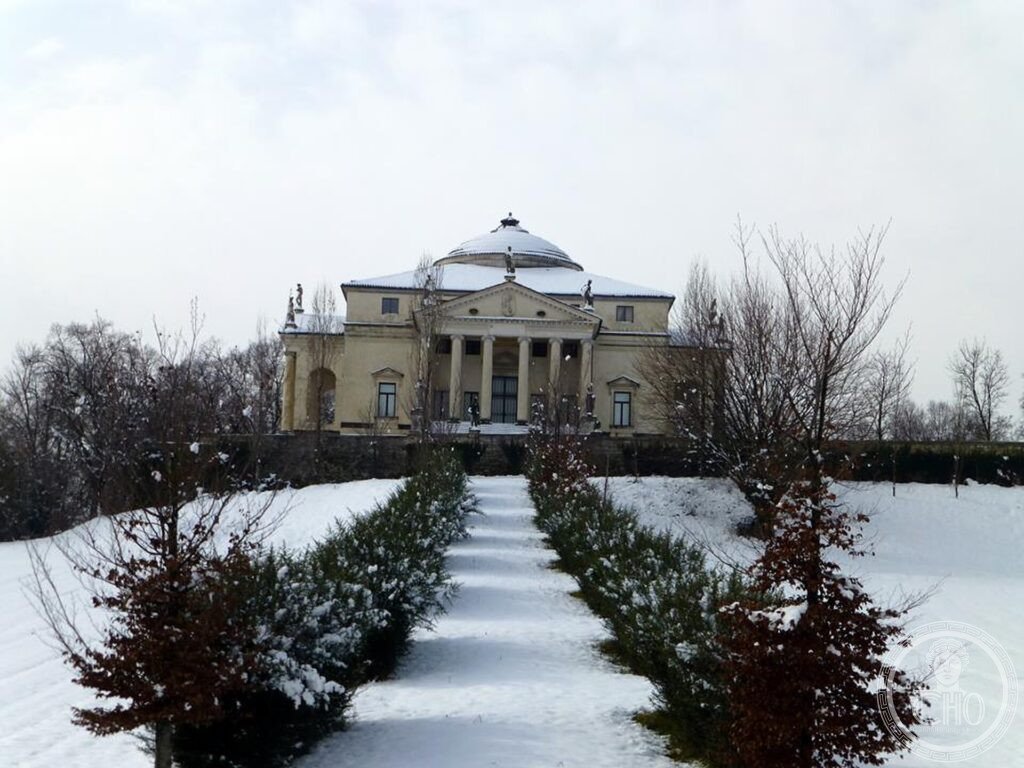
Villa Almerico-Capra “La Rotonda”. Designed by Andrea Palladio from 1566 and the single most imitated building in the history of Western architecture. Is not a farmhouse or a working country estate but something new in the history of architecture: a house of pleasure, designed for contemplation, with four identical classical porticoes opening onto the landscape, a central domed rotunda for the owner’s enjoyment, and no agricultural function whatsoever, built on a hilltop outside Vicenza specifically for the views in all four directions.
At a glance
Villa Almerico-Capra “La Rotonda” (Vicenza; UNESCO 1994, enlarged 1996, ref. 712 — inscribed as one of “The City of Vicenza and the Palladian Villas of the Veneto”) is the only Palladian villa with a perfectly symmetrical plan: a cube surmounted by a hemispherical dome, with four identical pedimented porticoes with six Ionic columns on each of the four facades. The villa was commissioned by the prelate Paolo Almerico (1514-1589), a Canon of the Vatican who retired to his native Vicenza. It was purchased by the Capra family in 1591 and completed by Scamozzi (who added the dome). The WHC Outstanding Universal Value recognizes Palladio’s work in Vicenza and the Veneto countryside as having “had a lasting and worldwide influence, not only in Europe but above all in America and Britain, where the Palladian style became the dominant architectural form in the 18th century.”.
Key facts
- Il prototipo della Villa Palladiana: La Rotonda embodies the theoretical principles Palladio described in “I Quattro Libri dell’Architettura” (1570): the villa as a building in dialogue with nature (the four porticoes frame the landscape in each direction). The use of classical temple forms (the pedimented portico) applied to domestic architecture. The villa as a “machine for seeing”. The dome and the central rotunda are not functional spaces but observation platforms and reception halls designed to display the 360-degree view of the Berici Hills and the plain of Vicenza. No Palladian villa before La Rotonda had used four equal porticoes on all four sides.
- Il prototipo dell’architettura neoclassica mondiale: La Rotonda has been directly imitated more than any other building in history (excluding generic temple forms): the most famous derivatives include Chiswick House (London, 1729, Lord Burlington), Mereworth Castle (Kent, 1723, Colen Campbell), Forlì Cathedral (1841), Stowe House (Buckinghamshire, 1680-1779), Monticello (Virginia, Thomas Jefferson, 1772-1809 — Jefferson was an explicit student of Palladio and described La Rotonda in his travel notes), the United States Capitol building portico, numerous Russian palace estates (18th century), and hundreds of country houses in Britain, Ireland, and the American colonies. The Villa Rotonda’s influence on architectural history is incalculable.
- Palladio e la Rotonda: Andrea Palladio (1508-1580) designed La Rotonda in 1566 and began construction the same year, but the dome was not started during his lifetime (he died in 1580). The dome was completed by his disciple Vincenzo Scamozzi (1552-1616) between 1591 and 1606. Scamozzi raised the dome slightly above Palladio’s original specification (the first tension between “the Palladio intended” and “the Scamozzi built” that has continued to divide architectural historians). The original Palladio drawings survive in the Royal Institute of British Architects (RIBA) collection in London.
- UNESCO: 1994 (Vicenza enlarged to include villas 1996), rif. 712.
- GPS: 45.4344, 11.5706. Google Maps (Villa La Rotonda, Vicenza).
History
La Rotonda was commissioned by Paolo Almerico (1514-1589), a Canon of the Capitolo Vaticano (Chapter of St. Peter’s Basilica) who retired to his native Vicenza in 1565 after 26 years of service at the Vatican (he was also a referendary, dealing with legal disputes addressed to the Pope). He commissioned Palladio in 1566 to design a “house of pleasure” (not a working farm estate — Almerico had no agricultural ambitions) on a hill he had purchased outside the Porta Monte. When Almerico died in 1589, the villa was purchased by the Capra brothers (from 1591), who commissioned Scamozzi to complete the dome. The family gave the villa its double name (Almerico-Capra). The villa remained in private ownership until 1912, when the Valmarana family (the current owners) purchased it. It has been in private ownership ever since, with restricted public access. The ground floor is now a museum of Palladio’s original drawings and the Scamozzi modifications.
What you see
La Rotonda is accessible via a gravel driveway from the SP247 road south of Vicenza (clearly signed from the city centre). The visit: exterior (the four identical porticoes are fully accessible at all times — walk around the entire building to compare the four facades; the south facade is the most photogenic with the cypress-lined approach and the Berici Hills behind; morning light on the east facade, afternoon on the west). Interior (open on specific days and times — see below; the central rotunda has a circular floor plan with painted frescoes by Alessandro Maganza (1600s) and Anselmo Canera (1550s); the dome ceiling has an oculus identical to the Pantheon’s, originally open but now glazed; the first-floor loggia rooms have the original stucco decoration; the basement museum has Palladio’s original drawings).
Gallery
Practical information
- Villa La Rotonda: Via della Rotonda 45, Vicenza. Exterior grounds: open Tue-Sun 10:00-12:00 and 15:00-18:00 (March-November), closed Monday and November-February. Interior: open Wed and Sat 10:00-12:00 (March-November only). Admission: exterior ~€5, interior ~€10. No booking required (small capacity, arrive early on summer Wednesdays and Saturdays). Photography permitted exterior. Interior photography restricted. The villa is still a private residence (Valmarana family). No commercial photography without written permission.
- Attenzione: Opening hours change significantly between seasons and are sometimes altered for private events. Always verify at villalarotonda.it before visiting. The interior is open very rarely and well worth the planning required to arrive on the correct day.
Getting there
Villa La Rotonda, Vicenza (VI), Veneto. GPS 45.4344, 11.5706. By foot from Vicenza centre: 25 min walk from Piazza dei Signori via Via G. Fogazzaro. Via San Marco. Via Riviera. Via della Rotonda. By bus: SVTBUS line 8 from Vicenza station to Villa Valmarana/La Rotonda stop (4 min). By car: from Vicenza, Via Riviera Berica south. Via della Rotonda (signed; parking in the unpaved field 300m from the villa, free). Vicenza is served by Trenitalia from Venice (45 min), Verona (30 min), Padova (15 min).
Nearby
- Villa Valmarana “ai Nani”. 200 m north-west. The 17th-century country villa with the extraordinary Giambattista Tiepolo fresco cycle (1757) in the main building and the frescoes by Giandomenico Tiepolo in the foresteria. The most important Tiepolo painted interior in the Veneto.
- Monte Berico, Santuario. 500 m north. The 17th-century sanctuary on the hilltop above Vicenza with panoramic views of the city and the Berici Hills. The refectory has Veronese’s “Supper of Saint Gregory the Great” (1572). One of Veronese’s last great banquet paintings.
- Piazza dei Signori (Vicenza centre). 2 km north. The urban heart of Palladian Vicenza, with the Basilica Palladiana (1549-1617) and the Loggia del Capitaniato (1571, Palladio). The essential Palladio urban works, UNESCO-listed together with La Rotonda.
Sources
- UNESCO: whc.unesco.org/en/list/712.
- Wikipedia EN: Villa Almerico-Capra.
- Palladio, Andrea: I Quattro Libri dell’Architettura, Venezia: Domenico de’ Franceschi, 1570 (facsimile: Milano: Hoepli, 1945).
- Tavernor, Robert: Palladio and Palladianism, London: Thames & Hudson, 1991.
- Villa La Rotonda: villalarotonda.it.
Find it on the map
See this place and what’s around it →📷 Become a Cultural Heritage Online photographer
Share your photos of places: they stay published under your name as the author. The more they're seen, the more you get noticed — and soon a contest will reward the most appreciated photos.
Log in or sign up free to add a photoIs this page about you?
This page is read by travellers and heritage enthusiasts who find it on Google. Tell us how you are connected to this place and we will take it from there.