

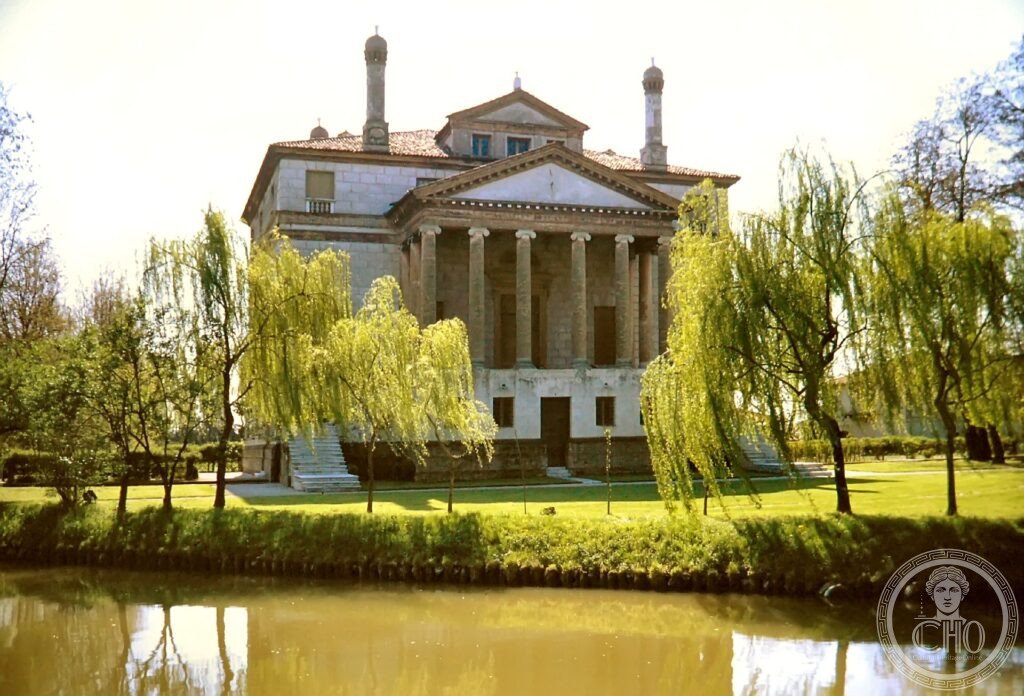
Villa Foscari “La Malcontenta” — built around 1559 by Palladio for the patrician brothers Nicolò and Luigi Foscari on the Brenta canal, and the only Palladian villa directly accessible by water — is the most Roman of all the villas in the Veneto countryside: its massive six-column Ionic portico, the rusticated basement that turns the building into a podium in the classical tradition, and the cross-vaulted central hall that evokes the frigidarium of the Roman thermal baths make the Malcontenta feel like a transported fragment of ancient Rome placed in the Veneto flatlands.
At a glance
Villa Foscari “La Malcontenta” (commune of Mira, province of Venice, Veneto; UNESCO 1996, ref. 712) is situated directly on the Riviera del Brenta — the navigable waterway that connects Venice to Padua and was lined by aristocratic villas from the 15th to the 18th century. Unlike most Palladian villas (which sit on hillsides and command agricultural landscapes), La Malcontenta sits at water level on the flat Brenta plain, accessible by boat from Venice as well as by road. Palladio designed a high basement (the rusticated podium that gives the building its monumental character) to raise the living floor above the flood level of the Brenta; the thermal baths cross-vault plan (in which the central atrium has barrel vaults crossing at right angles) makes the central hall one of the grandest domestic interiors in the Veneto, while the six Ionic columns of the portico constitute the most monumental of any Palladian villa entrance.
Key facts
- The “Hexastyle Ionic Portico” (6 columns): The six-column Ionic portico of La Malcontenta is the largest and most monumental of all Palladio’s villa porticoes: six Ionic columns (with volute capitals) on a high rusticated podium, supporting a massive triangular pediment — the composition is closer to a Roman temple front than to any domestic building of the 16th century; Palladio explicitly cited the “Temple of Fortuna Virilis” in Rome (the Portunus Temple, 1st century BCE) as the model; the podium basement (rusticated masonry, with thermal-window openings) lifts the entire portico 3.5 m above ground, making the building visible from a distance across the flat Brenta plain.
- The “T”-shaped plan of the Roman baths: The central hall of La Malcontenta is a “T”-shaped space with barrel vaults crossing at right angles in the Roman thermal bath (frigidarium) tradition — the first use of this structural type in a domestic building; the cross-vaults are decorated by Battista Franco (the frescoes of the lunettes, 1560) and Giovanni Battista Zelotti (the ceiling frescoes and the wall mythological scenes, 1560); the total fresco programme is less ambitious than Villa Barbaro’s but more architecturally integrated — the painted pilasters and cornices reinforce the actual architectural articulation of the space rather than contradicting it.
- “La Malcontenta”: The popular name of the villa has generated at least four competing legends, none of which is documented: (1) a Foscari noblewoman who misbehaved was imprisoned in the villa as a punishment and expressed her unhappiness (malcontentezza); (2) the working-class residents of the Malcontenta area near Venice were discontented with their living conditions; (3) a medieval tradition of naming river ferry crossings (malcontenti = dissatisfied travellers); (4) a geographic reference to the “Comune della Malcontenta” existing before the Foscari villa was built; historians of the Veneto generally prefer the geographic explanation.
- UNESCO: 1996 (added to the Vicenza inscription), ref. 712.
- GPS: 45.4375, 12.0620 — Google Maps (Villa Foscari La Malcontenta, Mira).
History
Villa Foscari was commissioned by the brothers Niccolò and Luigi Foscari (members of an important Venetian patrician family — the Foscari doge Francesco Foscari, 1373-1457, was the protagonist of Verdi’s opera “I Due Foscari”) around 1559. The fresco cycle was painted by Battista Franco (the lunette figures) and Giovanni Battista Zelotti (the ceiling and walls) in 1560. The villa was used as a summer residence by the Foscari family until the late 18th century; it was sold out of the family in the 1790s and suffered significant neglect through the 19th and early 20th centuries (it was used as housing for refugees during World War I). It was purchased by Bertie Landsberg, an English aesthete, in 1926, who carried out a sensitive restoration and used it as a literary salon (Aldous Huxley was a frequent guest); it passed to its current owners (Valmarana family, the same family as La Rotonda) in 1973. The villa is now maintained as a museum and events venue.
What you see
La Malcontenta is reached by road from Mira (signed) or by boat from Venice (the Riviera del Brenta boat tour from Venice, May-October, makes a stop at the villa; this is the most atmospheric approach — arriving by water as the Foscari would have). The visit takes 45 min and is guided only. The exterior, the six-column portico seen from the gravel forecourt, is the essential image; walk around to the garden side for the secondary facade with the thermal window, Palladio’s most dramatic window form, an arched opening flanked by two rectangular openings in a Venetian-arch arrangement. The central hall is the most powerful interior: the cross-vault above, the Franco and Zelotti frescoes in the lunettes, and the proportional relationship between the column axis and the vault springing. The secondary rooms hold the fresco mythological cycles, less well preserved but still substantial; the painted architectural borders reinforce the room proportions. The basement, the rusticated podium, contains a habitable lower floor, semi-subterranean, which was used as servants’ quarters and a wine cellar, accessible in summer.
Gallery
Practical information
- Villa Foscari La Malcontenta: Via dei Turisti 9, 30034 Mira (VE); open Tue and Sat 09:00-12:00 (May-October only); admission ~€10 (includes guided tour in Italian; English-language tours by pre-arrangement only). Very limited opening hours — verify at lamalcontenta.com before visiting. The most convenient way to visit is via the “Battello del Brenta” boat tour from Venice or Padova (May-October, full-day round trip; stops at La Malcontenta, Villa Pisani, and other Brenta villas; bookings via Burchiello di Strà; ~€40 per person).
- Riviera del Brenta: La Malcontenta is one of approximately 80 surviving villas on the 30-km stretch of the Brenta between Venice and Padua; the most famous others open to the public are Villa Pisani (Stra, with the Napoleon labyrinth), Villa Widmann (Mira), and the Museo del Novecento di Villa Ferretti (Mira).
Getting there
Villa Foscari La Malcontenta, Mira (VE), Veneto. GPS 45.4375, 12.0620. By boat (recommended): the Battello del Brenta (Padova-Venice round trip, April-November, Tuesdays, Thursdays, Saturdays) stops at La Malcontenta; or by private water taxi from Venice (~1h). By car: from Venice (Mestre), SS11 toward Padova for 12 km → Mira → Via dei Turisti (signed from Via della Riviera); parking at the villa (free). By public transport: ACTV bus 53E from Venezia Piazzale Roma to Mira (40 min), then 3 km walk/taxi on Via della Riviera. No train station nearby.
Nearby
- Villa Pisani, Stra — 12 km west; the 18th-century Venetian summer palace of the Pisani family (later of Napoleon, then the House of Savoy); the most spectacular of the Brenta villas, with 114 rooms and the famous labyrinth in the park (the largest hedge labyrinth in Italy — Napoleon reputedly entered it and got lost); now a national museum.
- Venezia, Piazza San Marco — 24 km east; the core of the UNESCO Venice inscription (1987, ref. 394) — St. Mark’s Basilica (9th-14th century, gold Byzantine mosaics), the Doge’s Palace (Gothic, 1340-1424), the Campanile (reconstructed 1902), the Procuratie Vecchie and Nuove (16th century); the waterway approach from La Malcontenta terminates here.
- Padova, Cappella degli Scrovegni — 18 km west; (UNESCO 2021, ref. 1621); Giotto’s complete fresco cycle (1304-1306) in a single chapel, depicting the Life of the Virgin and the Life of Christ — the birth of Western painting as an independent art form.
Sources
- UNESCO: whc.unesco.org/en/list/712..
- Wikipedia EN: Villa Foscari..
- Ackerman, James: Palladio’s Villas, New York: New York University Press, 1967.
- La Malcontenta: lamalcontenta.com..
Find it on the map
See this place and what’s around it →📷 Become a Cultural Heritage Online photographer
Share your photos of places: they stay published under your name as the author. The more they're seen, the more you get noticed — and soon a contest will reward the most appreciated photos.
Log in or sign up free to add a photoIs this page about you?
This page is read by travellers and heritage enthusiasts who find it on Google. Tell us how you are connected to this place and we will take it from there.