
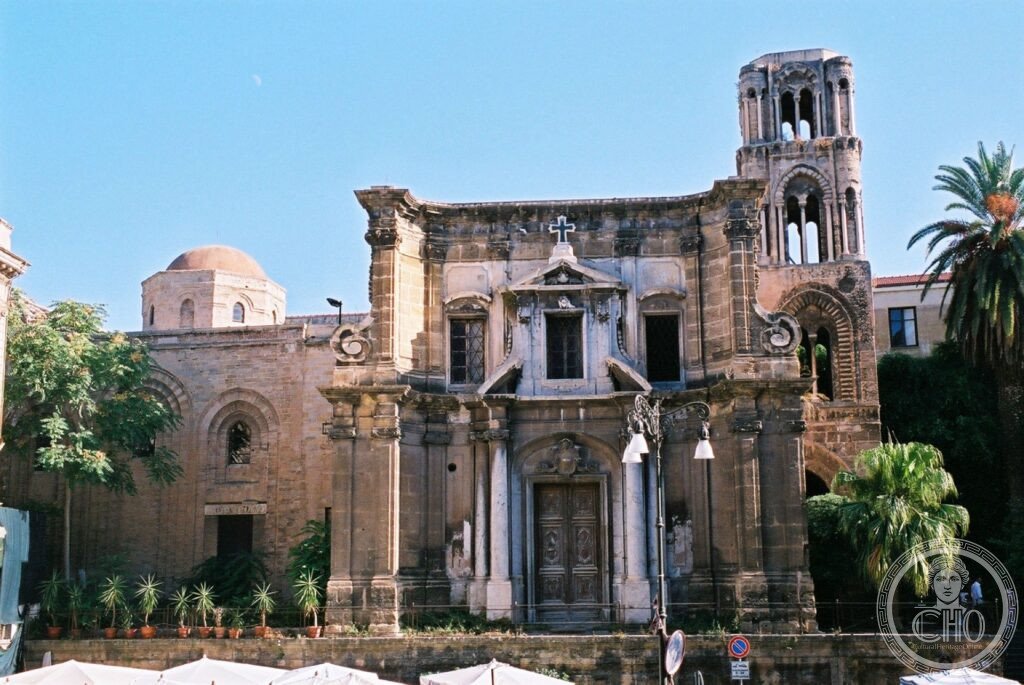
Santa Maria dell’Ammiraglio (La Martorana) — the church founded in 1143 by George of Antioch, Norman admiral of Roger II, on the model of a Byzantine palatine church — contains the most important cycle of Byzantine mosaics in Italy outside Ravenna and the only authentic 12th-century portrait of a Norman king: the mosaic showing Christ placing the crown directly on Roger II’s head, a image of political theology that asserts the divine right of the Norman king in the most unambiguous possible visual language.
At a glance
Santa Maria dell’Ammiraglio (Palermo, Sicily; UNESCO 2015, ref. 1487 — one of the nine components of the Arab-Norman Palermo inscription) is a Greek Orthodox-rite (then Roman Catholic since the 13th century) church founded in 1143 by Giorgio d’Antiochia (George of Antioch), the “emir of emirs” and “archon of archons” (the dual title — Arabic “emir” + Greek “archon” — itself a demonstration of the multicultural Norman court) and admiral of the fleet of Roger II. The church was built explicitly on the model of a Byzantine imperial palatine church (the typological model is the Nea Ekklesia of Constantinople, the private chapel of the Byzantine emperors): octagonal plan with a central dome supported on four columns, Greek-cross nave, and complete coverage of the interior walls and vault with gold mosaic — an explicit statement that the Norman king of Sicily was the equal of the Byzantine Emperor in wealth, power, and religious legitimacy.
Key facts
- L’Incoronazione di Ruggero II (mosaico, XII sec.): The single most important object in La Martorana is the mosaic on the right wall of the narthex showing Roger II being crowned by Christ: the king stands under the figure of Christ, who places a large jeweled crown directly on Roger’s head; Roger is dressed in Byzantine imperial regalia (the loros, the dalmatic, the imperial shoes) and identified by an inscription in Greek (“Rogerios rex” = “King Roger”); the mosaic is the only surviving contemporary portrait of Roger II (all other representations are later) and the political message is explicit — Roger’s authority derives not from the Pope (who had crowned him in 1130) but directly from Christ; the composition deliberately copies Byzantine imperial coronation mosaics (the Hagia Sophia mosaic of Constantine IX Monomachos, 1042) to assert Norman kings as the direct heirs of the Byzantine emperors
- La committente: Giorgio d’Antiochia: George of Antioch (Giorgio d’Antiochia, ca. 1080-1151/52) was the most powerful figure in the Norman Kingdom of Sicily after the king himself: born in Antioch (Syria) of Greek Byzantine origin, he served as an Arab-speaking general in Tunisia (under the Zirid dynasty) before entering Norman service; he became Admiral of Sicily in 1132 and led the Norman fleet to its greatest victories (the capture of Mahdia in Tunisia, 1148; the raid on Constantinople itself, 1149); he founded La Martorana as his personal church and mausoleum; his own mosaic in the narthex (the “Founder’s Portrait”) shows him prostrating himself before the Virgin Mary — a pose of extreme Byzantine humility that mirrors Roger II’s standing pose before Christ
- I mosaici della cupola: The main dome of La Martorana (12 m diameter) has a complete mosaic cycle in the Byzantine tradition: at the apex, Christ Pantocrator (omnipotent) in a blue mandorla; below, four Archangels; in the drum, 12 Apostles seated; in the arches, Evangelists and Church Fathers; on the walls of the nave, scenes from the Life of the Virgin Mary; the mosaic technique (gold tesserae with colored glass and stone, set at slightly varying angles to catch the light) is identical to the Byzantine mosaics of Hagia Sophia and Chora Church in Constantinople — the craftsmen were almost certainly brought directly from Constantinople, as no Italian workshop had this technical capacity in the mid-12th century
- UNESCO: 2015, rif. 1487
- GPS: 38.1133, 13.3617 — Google Maps (La Martorana, Piazza Bellini)
History
Santa Maria dell’Ammiraglio was founded in 1143 by George of Antioch (who also founded the companion church of San Cataldo in the same piazza, though San Cataldo was completed after his death); George was buried in his church in 1151/52. The church was given in 1193 by William II’s widow Constance of Hauteville to a community of Benedictine nuns (the Monache dell’Ammiraglio, hence the popular name “La Martorana” from the founding abbess, Eloisa Martorana); the nuns made significant changes to the interior in the 16th-17th centuries (adding Baroque frescoes and plasterwork in the 3-nave addition, destroying some original mosaic panels in the process). The church was assigned to the Albanian (Greek-rite) community of Palermo in the 17th century and remains under the Greek Catholic (Albanian) rite today. Major restoration of the mosaic cycle was carried out between 1929 and 1985.
What you see
La Martorana is a small church but one of the most densely meaningful in Italy: allow 30-45 minutes for a focused visit. The essential sequence: enter from the Via Maqueda entrance (through the Baroque vestibule, the 16th-17th century addition) into the narthex — on the right wall, the “Coronation of Roger II” mosaic (examine at close range: the crown, the Byzantine imperial regalia, the Greek inscription); on the left wall, the “George of Antioch prostrating before the Virgin” (the founder’s own image); pass through to the original 12th-century church body — the four columns supporting the dome, the complete gold mosaic cycle rising to Christ Pantocrator at the crown (the light is better in the morning, when the south windows illuminate the mosaics); the Norman bell tower (exterior, accessible by stairs in fair condition) gives a view over Piazza Bellini and the red domes of San Cataldo. Outside: the campanile (1148, the oldest Norman bell tower in Palermo) on the south flank is the best surviving Norman tower in the city.
Gallery
Practical information
- Santa Maria dell’Ammiraglio / La Martorana: Piazza Bellini 3, Palermo; open Mon-Sat 08:30-13:00 and 15:30-17:30, Sun 08:30-13:30; admission ~€2 (donation/ticket); photography is permitted in the main church but restricted during services. The church is still in active liturgical use (Greek Catholic rite) — Sunday morning services (08:45-10:30) use the Byzantine liturgical chant and are open to visitors who respect the sacred space. The church is 5 min walk from Palazzo dei Normanni/Cappella Palatina (via Via Maqueda).
- San Cataldo: Immediately adjacent in Piazza Bellini (the church with three red domes, built 1154 by Maio of Bari, William I’s chancellor); currently managed as an exhibition space by the Order of the Knights of the Holy Sepulchre; often open with temporary exhibitions; the bare interior has no decoration but the three red domes (the sister-domes of San Giovanni degli Eremiti) are visible from inside in their full scale.
Getting there
La Martorana, Palermo (PA). GPS 38.1133, 13.3617 — Piazza Bellini. 5 min walk from Cappella Palatina (via Via Maqueda south); 10 min walk from Palermo Cathedral (via Corso Vittorio Emanuele east to Via Maqueda then south); 2 min walk from the Mercato della Vucciria entrance on Via Maqueda. The church is in the heart of the historic centre pedestrian zone (no vehicles on Via Maqueda between Piazza Quattro Canti and Piazza Verdi).
Nearby
- San Cataldo — immediately adjacent in Piazza Bellini; built 1154 by Maio of Bari (Chancellor of William I); the three red domes are later than San Giovanni degli Eremiti (1132) but the same building type; the interior is bare Norman masonry, visible once the exhibition opens
- Mercato della Vucciria — 500 m north-east; the oldest market of Palermo (14th century), now primarily a night-time aperitivo and street food destination (daytime the stalls sell fish and produce; after 19:00 the piazza fills with outdoor eating and drinking — the most famous night market atmosphere in Sicily)
- Quattro Canti (Piazza Vigliena) — 250 m north on Via Maqueda; the Baroque piazza built in 1608-1620 by the Spanish Viceroy, at the intersection of Via Maqueda and Corso Vittorio Emanuele — the symbolic centre of Palermo’s 17th-century urban design
Sources
- UNESCO: whc.unesco.org/en/list/1487
- Wikipedia EN: Martorana
- Demus, Otto: The Mosaics of Norman Sicily, London: Routledge & Kegan Paul, 1950
- Fondazione Federico II: federicosecondo.org
Find it on the map
See this place and what’s around it →📷 Become a Cultural Heritage Online photographer
Share your photos of places: they stay published under your name as the author. The more they're seen, the more you get noticed — and soon a contest will reward the most appreciated photos.
Log in or sign up free to add a photoIs this page about you?
This page is read by travellers and heritage enthusiasts who find it on Google. Tell us how you are connected to this place and we will take it from there.