
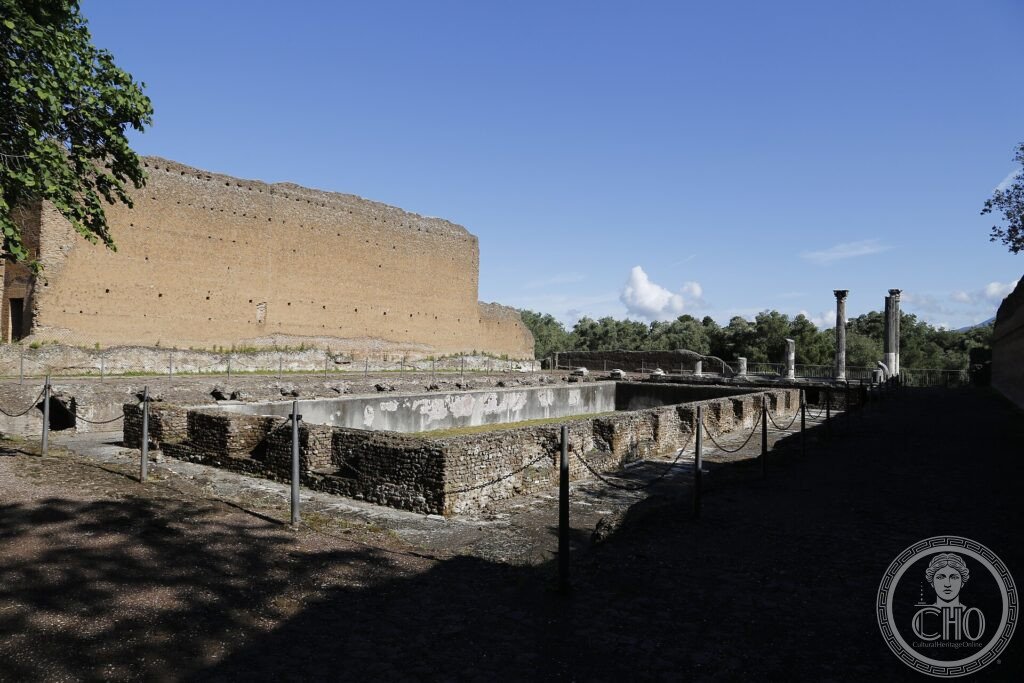
Villa Adriana — the 120-hectare imperial palace complex built between 118 and 134 CE by the Emperor Hadrian on the travertine plateau below Tivoli, with more than 30 distinct buildings each inspired by a site of the Graeco-Roman world that Hadrian had visited in his continuous military campaigns — is not a Roman villa in any conventional sense but a private microcosm: a physical encyclopedia of the civilizations that Rome had absorbed, built at a scale that consumed more marble, more engineering skill, and more artistic talent than any private commission in the history of Rome.
At a glance
Villa Adriana (province of Rome, Lazio; UNESCO 1999, ref. 907) is among the largest and most architecturally complex residential complexes in the ancient world: it covers approximately 120 hectares (comparable in area to the historic centre of Pompeii) on the travertine plateau 28 km east of Rome, between the Tiburtine hills and the Campagna Romana. Emperor Hadrian (Publius Aelius Hadrianus, 76-138 CE, emperor 117-138 CE) abandoned the traditional Palatine Hill palaces as his primary residence and built Villa Adriana as his permanent headquarters from 118 CE onward; he died at Baiae in 138 CE but spent the last decade of his reign primarily at the villa. The WHC Outstanding Universal Value recognizes: (1) the architectural innovation of the villa’s buildings (which introduced or perfected techniques — concrete shell domes, opus incertum vault construction, radially symmetric “pumpkin” domes — that prefigure Byzantine and Renaissance architecture); and (2) the encyclopedic cultural scope of the programme (the explicit references to specific sites in Athens, Alexandria, the Vale of Tempe, and the Nile delta constitute the first example in Western architecture of “architectural citation” — a building that commemorates other buildings).
Key facts
- Il Canopo (119 m × 18 m): The Canopus is the most celebrated element of Villa Adriana: a long rectangular pool (119 m × 18 m) surrounded by a colonnaded portico and carved statues (Caryatids, Sileni, Satyrs, and river gods, all copies of originals now in the Museo Nazionale Romano); at the south end, a curved dining exedra (the Serapeum) with a semi-domed concrete vault (the earliest surviving example of this architectural form in the ancient world); Hadrian named this structure after the Canopic canal near Alexandria in Egypt, where the god Serapis was worshipped — implying that the dining exedra functioned as a Serapeum during the Emperor’s Egyptian-themed ceremonial banquets.
- Il Teatro Marittimo: The “Maritime Theatre” is one of the most unusual structures in the Roman world: a small circular island (32 m diameter), surrounded by a ring moat and a circular colonnade, connected to the mainland by two wooden drawbridges; the island contained a tiny self-contained villa (living room, studio, bath suite) with no entrance other than the drawbridges; scholars believe it was Hadrian’s personal retreat — a space where the Emperor could work, think, and rest in complete isolation from the rest of the court; the drawbridges could be raised to make the island literally unreachable.
- Adriano e il mondo greco-egiziano: Hadrian is the only Roman emperor who was as culturally Greek as he was Roman: he learned Greek as a child (his primary language for philosophy and poetry), served as eponymous archon of Athens (the highest civic office), funded the completion of the Olympieion (Temple of Zeus in Athens, begun 515 BCE, completed by Hadrian in 132 CE — 646 years after its foundation), created the Panhellenion (a pan-Greek congress at Athens), and wore a beard (the first clean-shaven emperor since Augustus — Hadrian’s beard-wearing was a deliberate cultural statement of philhellenism that was imitated by every subsequent emperor for 150 years).
- UNESCO: 1999, rif. 907.
- GPS: 41.9415, 12.7757 — Google Maps (Villa Adriana, Tivoli).
History
Villa Adriana was built between 118 and 134 CE in multiple phases; Hadrian himself supervised some of the building design (he was an amateur architect — the Pantheon in Rome is generally attributed to his supervision, though he worked with professional architects). After Hadrian’s death (138 CE), the villa passed to successive emperors and continued to be used as a secondary imperial residence; it was still in partial use in the 5th century CE. After the fall of the Western Roman Empire (476 CE), the villa was progressively stripped of its marble, mosaics, and decorative elements for reuse in medieval and Renaissance buildings in Rome and Tivoli (the main source of marble for several medieval Roman churches). The first archaeological study was conducted by Pirro Ligorio in the 16th century (who also designed the Villa d’Este gardens in Tivoli, 1 km away — the two sites are co-managed today); the systematic excavation and publication by Piranese (whose 18th-century engravings circulated throughout Europe and made the villa internationally known to architects) preceded the formal excavations by the Italian state from 1870 onward.
What you see
Villa Adriana is an archaeological park of 40 hectares (the full 120-hectare zone includes undeveloped land and farmland; approximately 40 hectares are excavated and open). Allow 3 hours minimum; a full day is needed for the serious visitor. The site map (available at the entrance, essential) marks approximately 20 numbered monuments. The essential circuit: the Teatro Marittimo (the small circular island-villa — the most intimate and unusual structure) → the Terme (thermal bath complex, one of the largest surviving Roman bath buildings in the Lazio region) → the Canopo (the long pool with the Serapeum exedra — the most photogenic element, morning or late afternoon light) → the Terrazza di Tempe (the long terrace garden modelled on the Vale of Tempe in Greece) → the Cento Camerelle (the 100 vaulted substructures of the service quarters — a 3D underground grid that supported the main residential level above) → the Piazza d’Oro (the largest peristyle court in the villa, 52 × 116 m). The Antiquarium museum (at the villa entrance) displays the original mosaic floors, portrait busts, and architectural fragments found during excavation.
Gallery
Practical information
- Villa Adriana: Largo Marguerite Yourcenar 1, Tivoli (RM); open daily (except January 1 and December 25) from 09:00 until 1 hour before sunset; admission ~€10 (full), free under 18 EU; combined ticket with Villa d’Este (UNESCO 2001, 1 km away in Tivoli town centre) available at the ticket office (~€17). No pre-booking required; the site is large enough that it never feels overcrowded even on busy days. Audio guide ~€5 (recommended — the site markers alone do not convey the complexity of the buildings). Note: the site has limited shade and rough travertine ground; suitable footwear and water essential May-September.
- Marguerite Yourcenar: The Belgian novelist Marguerite Yourcenar (1903-1987) set her 1951 novel “Mémoires d’Hadrien” (the imaginary autobiography of the emperor written in the first person in his old age) partly at Villa Adriana; the novel is the most complete literary portrait of Hadrian and makes the visit to the villa an unusually rich literary experience — a copy of the book read before the visit transforms the ruins into inhabited spaces.
Getting there
Villa Adriana, Tivoli (RM), Lazio. GPS 41.9415, 12.7757. By public transport from Rome: take the COTRAL bus from Ponte Mammolo (metro line B) to Tivoli Villa Adriana (direct service, 1h10, every 30-60 min); alight at the Villa Adriana stop. Or take the train (Trenitalia) from Roma Termini to Tivoli (35-50 min, frequent) and then CAT bus 4 or 4X from Tivoli station to Villa Adriana (5 min). By car: from Rome, Via Tiburtina (SS5, 28 km, 40 min without traffic); or A24 exit Vicovaro-Mandela then SS5 (more reliable timing). Parking at the villa (paid, ~€4/day). Tivoli Villa d’Este (UNESCO 2001) is 1 km from Villa Adriana and can be combined in a full day.
Nearby
- Villa d’Este, Tivoli — 1 km; (UNESCO 2001, ref.1025); Pirro Ligorio’s Renaissance garden (1550-1572) for Cardinal Ippolito II d’Este, the greatest hydraulic garden in the Western world: 500 fountains, 220 basins, 60 waterfalls, all fed by gravity from the Aniene river without pumps; the “Rometta” (miniature Rome) fountain and the Fontana dell’Ovato are the masterpieces.
- Hadrian’s Mausoleum (Castel Sant’Angelo), Roma — 28 km west; the drum-shaped mausoleum built by Hadrian for himself and his dynasty (completed 139 CE, 1 year after his death); converted to a papal fortress in the medieval period; now a museum of the castle’s 2,000 years of history.
- Palestrina (Praeneste) — 25 km south; the ancient Latin city with the colossal Sanctuary of Fortuna Primigenia (2nd century BCE, the largest sanctuary in Republican Rome), built on a hillside in 6 terraces; the mosaic of the Nile in flood (1st century BCE) is in the Barberini Palace/Museo Nazionale Prenestino on the site.
Sources
- UNESCO: whc.unesco.org/en/list/907.
- Wikipedia EN: Hadrian’s Villa.
- Yourcenar, Marguerite: Mémoires d’Hadrien, Paris: Gallimard, 1951.
- Parco Archeologico di Villa Adriana: villadriana.beniculturali.it.
Find it on the map
See this place and what’s around it →📷 Become a Cultural Heritage Online photographer
Share your photos of places: they stay published under your name as the author. The more they're seen, the more you get noticed — and soon a contest will reward the most appreciated photos.
Log in or sign up free to add a photo