
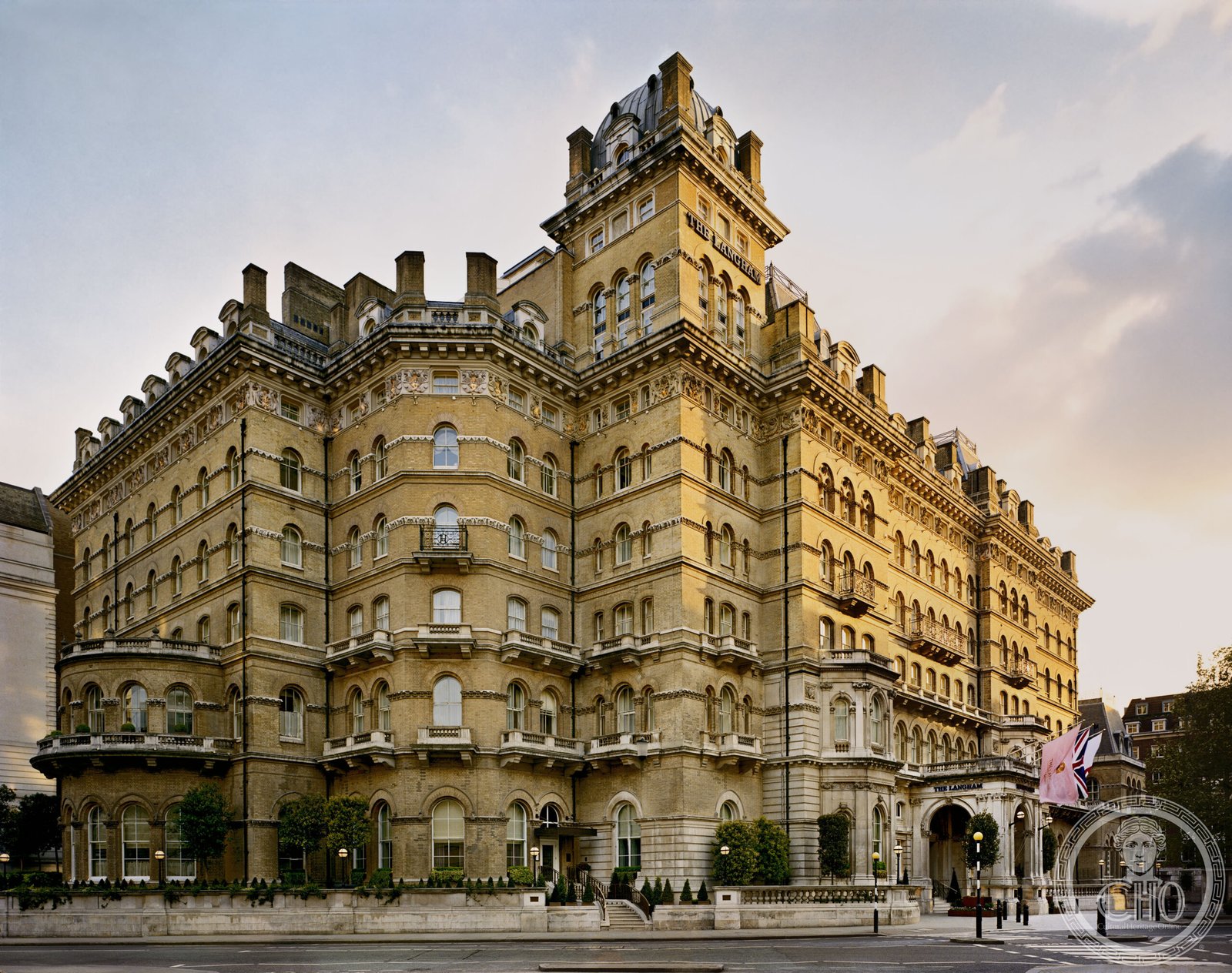
When the Langham opened in June 1865 it was the largest and most modern hotel in Europe — a building that invented the Grand Hotel as an urban institution, setting the standard for every luxury hotel that followed.
At a glance
The Langham opened on 10 June 1865 at the top of Regent Street, directly opposite the BBC’s current Broadcasting House, as the first purpose-built Grand Hotel in London — and, with 600 rooms, the largest hotel in Europe. Its architect John Giles designed it in the Italian Renaissance Revival style favoured for prestige civic buildings of the 1860s; the interiors, fitted out at a cost of £300,000, established the vocabulary of the Grand Hotel — marble halls, a dining room for 500, electric lifts, and en-suite bathrooms — that all subsequent luxury hotels would imitate. Arthur Conan Doyle set the first meeting of Sherlock Holmes and Dr. Watson at the Langham.
Key facts
- Opened: 10 June 1865; architect John Giles
- Style: Italian Renaissance Revival — the largest hotel in Europe at opening
- Address: 1c Portland Place, Marylebone, London W1B 1JA, United Kingdom
- GPS: 51.5178, -0.1435
- Status: Langham Hotels International; five-star; heritage-protected (Grade II listed)
- Literary connection: Arthur Conan Doyle set Holmes-Watson scenes here; Oscar Wilde and Mark Twain were regular guests
History
The opening night dinner of 10 June 1865 was attended by the Prince of Wales (later Edward VII), the Prime Minister Lord Palmerston, and 2,000 guests — the most publicised hotel opening in British history to that date. The Langham’s innovations were immediately influential: it was the first London hotel to offer en-suite bathrooms (hydraulically supplied), the first to install electric lighting throughout, and one of the first to use hydraulic lifts. The concept of the grand hotel lobby as a public social space — demonstrated at the Langham — was adopted by every major hotel built in Britain, Europe, and North America in the following decades.
Arthur Conan Doyle set Sherlock Holmes’s initial meeting with Dr. Watson in “A Study in Scarlet” (1887) at a dinner at the Langham; he returned the hotel to the Holmes canon in “The Sign of Four” (1890) and “A Scandal in Bohemia” (1891). Oscar Wilde and Lord Alfred Douglas used the hotel during the 1890s; Mark Twain stayed during his lecture tours of Britain. During the First World War the building was converted to a military hospital; in the Second World War it served as the headquarters of the Polish government-in-exile and later as BBC offices. The Langham was restored to hotel use in 1991.
What you see
John Giles’s design is a restrained Italian Renaissance Revival composition in brick and Portland stone — seven storeys with a central projecting bay and a roofline of small mansards. The scale, for 1865, was overwhelming: the building’s mass dominated the top of Regent Street and confirmed Portland Place as the grandest residential street in London. The original interiors have been replaced through successive modernisations, but the lobby’s marble columns and the Palm Court (reconstructed in the 1990s) maintain the hotel’s Edwardian character.
Practical information
The hotel faces Regent Street at the junction with Portland Place; BBC Broadcasting House is directly opposite. Oxford Circus Underground station is 3 minutes on foot. The Wallace Collection (the most underrated great museum in London) is 10 minutes on foot. Regent’s Park is a 15-minute walk north.
Find it on the map
See this place and what’s around it →📷 Become a Cultural Heritage Online photographer
Share your photos of places: they stay published under your name as the author. The more they're seen, the more you get noticed — and soon a contest will reward the most appreciated photos.
Log in or sign up free to add a photoIs this page about you?
This page is read by travellers and heritage enthusiasts who find it on Google. Tell us how you are connected to this place and we will take it from there.