
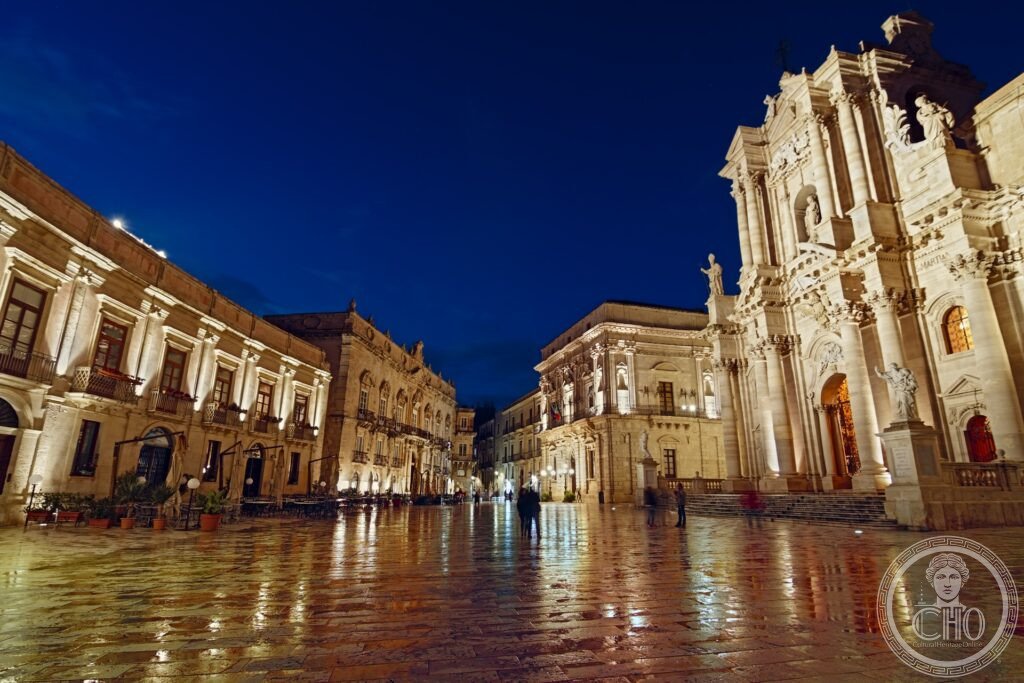
Syracuse — founded in 734 BCE by Corinthian colonists on a coastal island (Ortygia) opposite the mainland of southeastern Sicily, grown by the 5th century BCE into the most powerful city in the Western Mediterranean (surpassing Athens in population and Carthage in military power), destroyed and rebuilt, besieged twice unsuccessfully (the Athenian expedition of 415-413 BCE, the greatest military failure in Athenian history), and accumulated 2,700 years of continuous urban history into the 45 hectares of Ortygia and the 120 hectares of the ancient city — is the site in Sicily where Western history most tangibly concentrates into stone.
At a glance
Syracuse (province of Siracusa, Sicilia; UNESCO 2005, ref. 1200 — inscribed jointly with the Rocky Necropolis of Pantalica) is an extremely diverse serial inscription covering 5 zones: the ancient city (the Neapolis archaeological park, 120 hectares, with the Greek theatre, the Roman amphitheater, the Altar of Hiero II, and the Latomia dei Cappuccini); the island of Ortygia (45 hectares, the historic centre, with the Cathedral/Temple of Athena, the Fountain of Arethusa, and the baroque urban fabric); the Epipoli plateau (the ancient defensive walls of Dionysius I, 399-396 BCE, 27 km long — the longest ancient defensive perimeter in the Mediterranean); the Castello Eurialo (the largest surviving Greek military fortress in the world, 402-397 BCE); and the Necropolis of Pantalica (the 9th-7th century BCE rock-cut tomb necropolis in the Anapo valley, 50 km inland, with approximately 5,000 tombs). The WHC Outstanding Universal Value recognizes the extraordinary density of overlapping historical periods: from the Sicel Bronze Age through the Greek, Roman, Byzantine, Arab, Norman, and Baroque Sicilian periods.
Key facts
- Il Teatro Greco (V sec. a.C., 61 file, 14.000 posti): The Greek theatre of Syracuse is the largest surviving Greek theatre in Sicily and one of the largest in the ancient world: it has 61 rows of seats (the cavea) cut directly into the rock of the limestone hill (the Temenites Hill), with a capacity of approximately 14,000 spectators; it was built in the early 5th century BCE (the performances of Aeschylus’s plays “Persians” and “Women of Etna” were given their world premiere here, in 472 and 476 BCE respectively, with Aeschylus present); it was used for theatrical performances in antiquity, then converted by the Romans into an arena (the centre was excavated to create a gladiatorial space); it is used today for the annual INDA theatre festival (Instituto Nazionale del Dramma Antico), which stages Greek tragedies and comedies each May-June in the original space
- La Latomia dei Cappuccini e l’Orecchio di Dionisio: The Latomia dei Cappuccini is a series of ancient quarries (latomie) cut into the Temenites hill next to the theatre; the largest quarry space (25 m wide × 65 m long × 23 m high, with a vaulted ceiling formed by the remaining rock of the hill) was named “Orecchio di Dionisio” (Ear of Dionysius) by the painter Caravaggio in 1586 (the first documented use of this name) for its extraordinary acoustic properties: a whisper at the far end can be heard at the entrance 65 m away; the name implies that Dionysius I used it to overhear the conversations of his political prisoners held in the quarry; the actual origin of the name and its acoustic use are not documented historically but the acoustic effect is real
- Il Duomo di Siracusa (tempio di Atena, V sec. a.C.): The Cathedral of Syracuse is one of the most extraordinary architectural palimpsests in the world: the building is the Doric temple of Athena (begun in the early 5th century BCE, possibly after the Syracusan naval victory over the Carthaginians at Himera in 480 BCE); in the 7th century CE, the Bishop Zosimus converted it to a Christian church by walling in the spaces between the existing Doric columns (which remain in place, visible in the side walls of the nave) and adding new Christian fabric; in the Arab period (878-1085 CE), it served as a mosque; in the Norman period, it was reconverted to a Christian church; the present Baroque facade (1728-1754) was added after an earthquake destroyed the previous facade in 1693; the 12 original Doric columns (diameter 2 m, height 8.5 m) of the original Greek temple are structurally part of the current Christian church
- UNESCO: 2005, rif. 1200
- GPS: 37.0700, 15.2866 — Google Maps (Piazza del Duomo, Ortigia, Siracusa)
History
Syracuse was founded in 734 BCE by Corinthian colonists (tradition names Archias of Corinth as the oikist — founder); the settlement was initially limited to Ortygia, the coastal island, and expanded to the mainland over the 7th-6th centuries BCE. The city’s golden age was the 5th-4th century BCE under the tyrants Gelon (who defeated the Carthaginians at Himera in 480 BCE), Dionysius I (who built the Eurialo fortress and the great defensive walls of Epipoli, 405-397 BCE, and established Syracusan hegemony over all of Sicily and much of southern Italy), and later Timoleon and Agathocles. The Athenian Expedition of 415-413 BCE — the disastrous attempt by Athens to conquer Syracuse, described by Thucydides in Books 6-7 of his History — ended with the complete destruction of the Athenian fleet in the Great Harbour (the largest naval engagement of the 5th century BCE) and the capture and death of the entire Athenian army (approximately 7,000 men) in the Latomia dei Cappuccini quarries (used as prison camps). Roman conquest came in 212 BCE (after a 2-year siege during which Archimedes invented the catapult, the heat ray, and the mechanical claw); Cicero served as quaestor in Sicily in 75 BCE and visited the tomb of Archimedes near the Agrigentina gate.
What you see
The Syracuse visit is naturally divided into two zones: the ancient city (Parco Archeologico della Neapolis, accessible from Via Teocrito, 4 km from Ortygia) and the island of Ortygia (the historic centre, accessible by the bridge from Piazza Pancali). The Parco Archeologico (allow 2-3 hours): the Greek Theatre (the main monument — enter at 09:00 to see it without crowds; stand at the back row for the full sense of scale); the Latomia del Paradiso (the garden quarry with the Orecchio di Dionisio) immediately adjacent; the Ara di Ierone II (the Altar of Hiero II, 3rd century BCE, only the base survives — but at 198 m long it is the largest altar in the ancient world); the Roman amphitheatre (1st century CE, partially preserved, the second-largest in Sicily after Catania). Ortigia (allow 2-3 hours): Piazza del Duomo (the Cathedral/Temple of Athena, the curved Baroque palaces, the Palazzo Beneventano); the Fonte Aretusa (the legendary freshwater spring on the sea — the spring of Arethusa where the river Alpheus from the Peloponnese was supposed to surface after flowing underground); the fish market (Mercato di Ortigia, morning only — the most vivid Mediterranean food market in southeastern Sicily).
Gallery
Practical information
- Parco Archeologico della Neapolis: Via Teocrito 66, Siracusa; open daily 09:00-19:00 (summer), 09:00-17:00 (winter); admission ~€13 (full), ~€7 (reduced 18-25); combined ticket with Museo Archeologico Regionale Paolo Orsi (the best Sicilian Greek art collection) is available (~€15). The Greek Theatre is used for the INDA Theatre Festival (May-June, 50-60 performances per season; tickets 20-80€, booking at inda.eu/teatro-greco — the most dramatic way to experience the theatre is to see a Greek tragedy performed in its original 2,500-year-old space).
- Ortigia: The island is a ZTL (closed to non-resident vehicles); park on the mainland (Molo Sant’Antonio or Talete) and cross by foot (5 min). The Piazza del Duomo is the heart of Ortigia (also the setting for the final scene of Andrea Camilleri’s Inspector Montalbano novels); the duomo interior is free and open daily 08:00-19:00. The market is open Monday-Saturday morning at Via Trento/Via Nizza.
Getting there
Siracusa (SR), Sicilia. GPS 37.0700, 15.2866 (Piazza del Duomo, Ortigia). By train: Trenitalia from Catania to Siracusa (1h20, every 1-2h; Catania is the regional rail hub — connected to Messina and Palermo by InterCity); from Rome, overnight train Intercity to Siracusa (~12h) or fly to Catania Fontanarossa (CTA) airport + train to Siracusa. By car: from Catania, A18 south → SS114 to Siracusa (65 km, 1h); from Palermo, A19 → A18 south (240 km, 2h30). The Parco Archeologico is 4 km from Ortigia — by city bus (line 5 or AST circular from Piazza della Posta), or by taxi (~€8).
Nearby
- Noto — 30 km south-west; (CHO card: Noto UNESCO 2002); the “Capital of Sicilian Baroque,” rebuilt entirely after the 1693 earthquake on a new grid plan, with the most architecturally coherent Baroque urban fabric in Sicily (Corso Vittorio Emanuele, Duomo di San Nicolò)
- Necropoli Rupestre di Pantalica — 50 km north-west; the second component of the UNESCO inscription (ref.1200); a Bronze/Iron Age necropolis (13th-7th century BCE) with approximately 5,000 rock-cut tombs in the canyon walls of the Anapo valley — the most atmospheric prehistoric landscape in Sicily
- Agrigento e la Valle dei Templi — 120 km south-west; (UNESCO 1997, ref.831); the best-preserved Greek temple complex in the world outside Greece: the Temple of Concordia (450 BCE) is the best-preserved Greek Doric temple after the Hephaisteon in Athens
Sources
- UNESCO: whc.unesco.org/en/list/1200
- Wikipedia EN: Syracuse, Sicily
- Thucydides, History of the Peloponnesian War, Books VI-VII (on the Athenian Expedition, 415-413 BCE)
- Parco Archeologico di Siracusa: parcoarcheologicosirracusa.it
Gallery
Find it on the map
See this place and what’s around it →
📷 Become a Cultural Heritage Online photographer
Share your photos of places: they stay published under your name as the author. The more they're seen, the more you get noticed — and soon a contest will reward the most appreciated photos.
Log in or sign up free to add a photo