
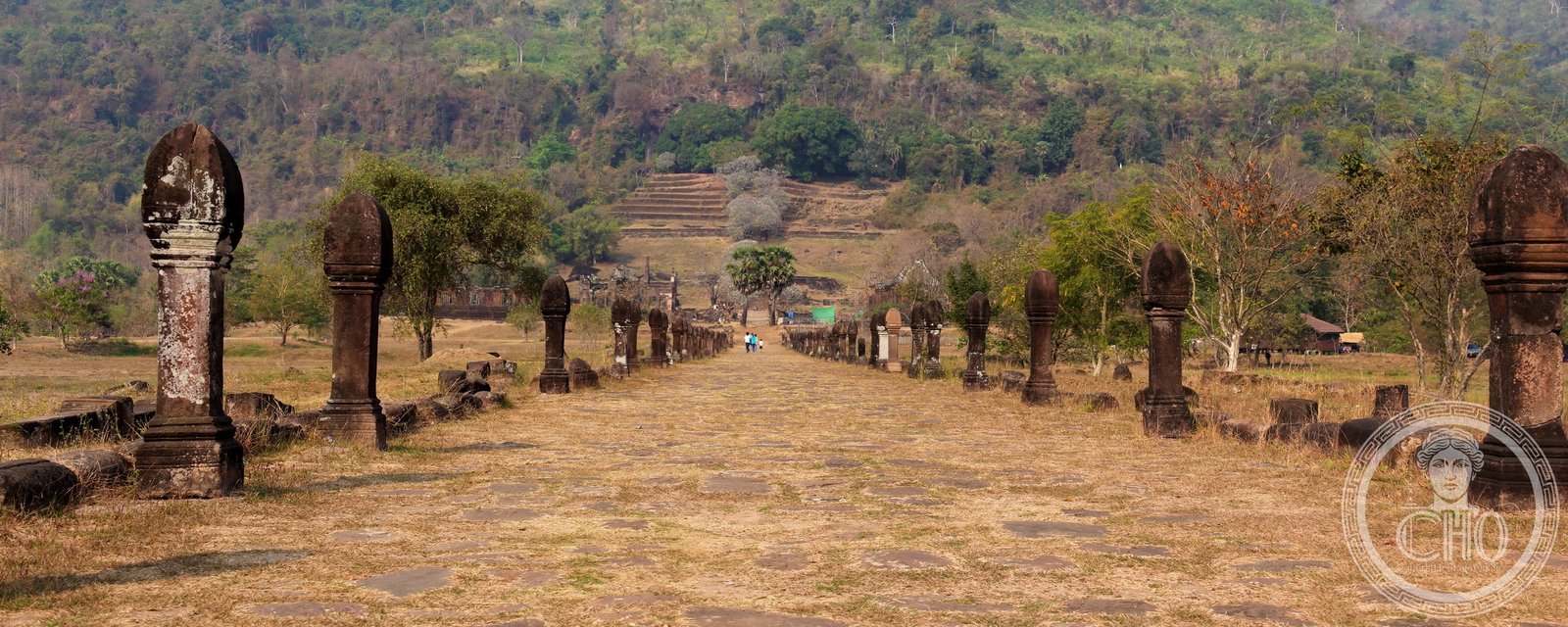
A thousand-year axis of sacred geometry: from the Mekong River to the mountain of the linga, Vat Phou is the most serene and undervisited of all the great Khmer sites — and it predates Angkor Wat by centuries.
At a glance
Vat Phou is a Hindu-Buddhist mountain temple complex built on the slopes of Phu Kao (the mountain of the linga) in what is now Champasak Province, southern Laos. Together with the associated ancient settlements and their surrounding landscape, it was inscribed as a UNESCO World Heritage Site in 2001. The complex was active from approximately the 5th to the 13th century CE, built by the successive civilisations of Funan, Chenla, and the Khmer Empire — making it one of the oldest surviving religious sites in Southeast Asia. Today it remains an active Buddhist pilgrimage destination.
Key facts
- UNESCO inscription: 2001 (World Heritage Site)
- Period of construction: 5th–13th century CE (Funan, Chenla, and Khmer periods)
- Sacred mountain: Phu Kao, 1,416 metres above sea level
- Main axis: 1.4 km processional way from the Mekong riverbank to the mountain shrine
- Religion: Originally Shaivite Hindu; later Buddhist (still active)
- Location: Champasak Province, southern Laos, on the west bank of the Mekong
- Annual festival: Boun Wat Phou (February full moon), one of the most important in Laos
- Predates Angkor Wat: Yes — construction began roughly 500 years before Angkor Wat
History
The site’s sacred significance predates any surviving architecture. Phu Kao was venerated as a sacred mountain in the Shaivite tradition because a natural spring near its summit was interpreted as a cosmic pairing of the mountain’s phallic form (linga) with the spring’s yoni — the fundamental creative duality of Shiva worship.
The earliest known occupation dates to the Funan kingdom (1st–6th century CE), which controlled the lower Mekong and established the first major trade networks in mainland Southeast Asia. The Chenla kingdom (6th–9th century CE) built significantly at Vat Phou, and the site shows clear architectural evolution across several centuries. At its peak under the Khmer Empire (9th–13th century CE), Vat Phou was a major religious complex visited by pilgrims from across the empire.
The site includes the ruins of two ancient cities — Champassak and Muang Khua — as well as extensive irrigation works and field systems, demonstrating that the entire landscape from the Mekong to Phu Kao was designed as a unified ritual geography. When the Khmer Empire declined in the 13th century, Vat Phou was never entirely abandoned: Theravada Buddhism replaced Hinduism, and the site was adapted rather than deserted, which is why it remains an active pilgrimage site today.
What you see
The experience of Vat Phou is inseparable from its landscape. The 1.4-kilometre processional axis runs perfectly straight from two large rectangular ceremonial ponds (representing the primordial ocean) through a sequence of ceremonial gates (gopura), up a grand stairway flanked by naga (serpent) balustrades, past ruined palaces and libraries, to the central mountain shrine.
The shrine itself is built directly against the rock face of Phu Kao, making the mountain the temple’s rear wall. Inside, a Shiva linga stands near the miraculous spring that has been the site’s sacred heart for over a millennium. The carved reliefs on the lintels and columns — depicting scenes from Hindu mythology, celestial dancers (apsara), and floral motifs — are among the finest examples of Khmer decorative art outside Cambodia.
The palaces on either side of the main causeway, once believed to have housed male and female pilgrims separately, are now largely collapsed but hauntingly beautiful in their semi-ruined state. Enormous sandstone blocks lie where they fell centuries ago, draped in moss and frangipani trees.
Practical information
- Entry fee: Approximately 50,000 LAK per person (subject to change)
- Opening hours: Daily, approximately 08:00–17:00
- Best time to visit: November to February (cool dry season); avoid April–October monsoon
- Guided tours: Available from Champasak town and Pakse; local guides strongly recommended for context
- Physical access: Significant stairway climbing required to reach the upper shrine; not suitable for visitors with limited mobility
- Photography: Permitted throughout; tripods discouraged inside shrines
- Festival timing: Boun Wat Phou (February full moon) brings large crowds and is the best time to witness living tradition
Getting there
The nearest major hub is Pakse (Pakxe), the provincial capital of Champasak Province, served by domestic flights from Vientiane and Luang Prabang. From Pakse, Champasak town is approximately 40 km south, reached by road (1 hour) and then a short boat crossing of the Mekong. Vat Phou is 10 km further south of Champasak town by tuk-tuk or bicycle. Most visitors combine the site with the 4,000 Islands (Si Phan Don) further south on the Mekong, making Champasak a natural stop on a southern Laos itinerary.
Nearby
- Champasak town — the old royal capital of the Champasak Kingdom, with colonial-era architecture and a relaxed atmosphere on the Mekong bank
- Si Phan Don (4,000 Islands) — approximately 100 km south; the broad southern Mekong with Irrawaddy dolphins, waterfalls, and island life
- Don Khone and Khon Phapheng Falls — the largest waterfall by volume in Southeast Asia, on the Laos–Cambodia border
- Angkor Wat (Cambodia) — approximately 400 km south-east; the great Khmer imperial capital that shares the same architectural and religious tradition as Vat Phou
Sources
- UNESCO World Heritage List — whc.unesco.org/en/list/481
- Wikipedia — Vat Phou
- Champasak Provincial Tourism Authority
Find it on the map
See this place and what’s around it →📷 Become a Cultural Heritage Online photographer
Share your photos of places: they stay published under your name as the author. The more they're seen, the more you get noticed — and soon a contest will reward the most appreciated photos.
Log in or sign up free to add a photo