

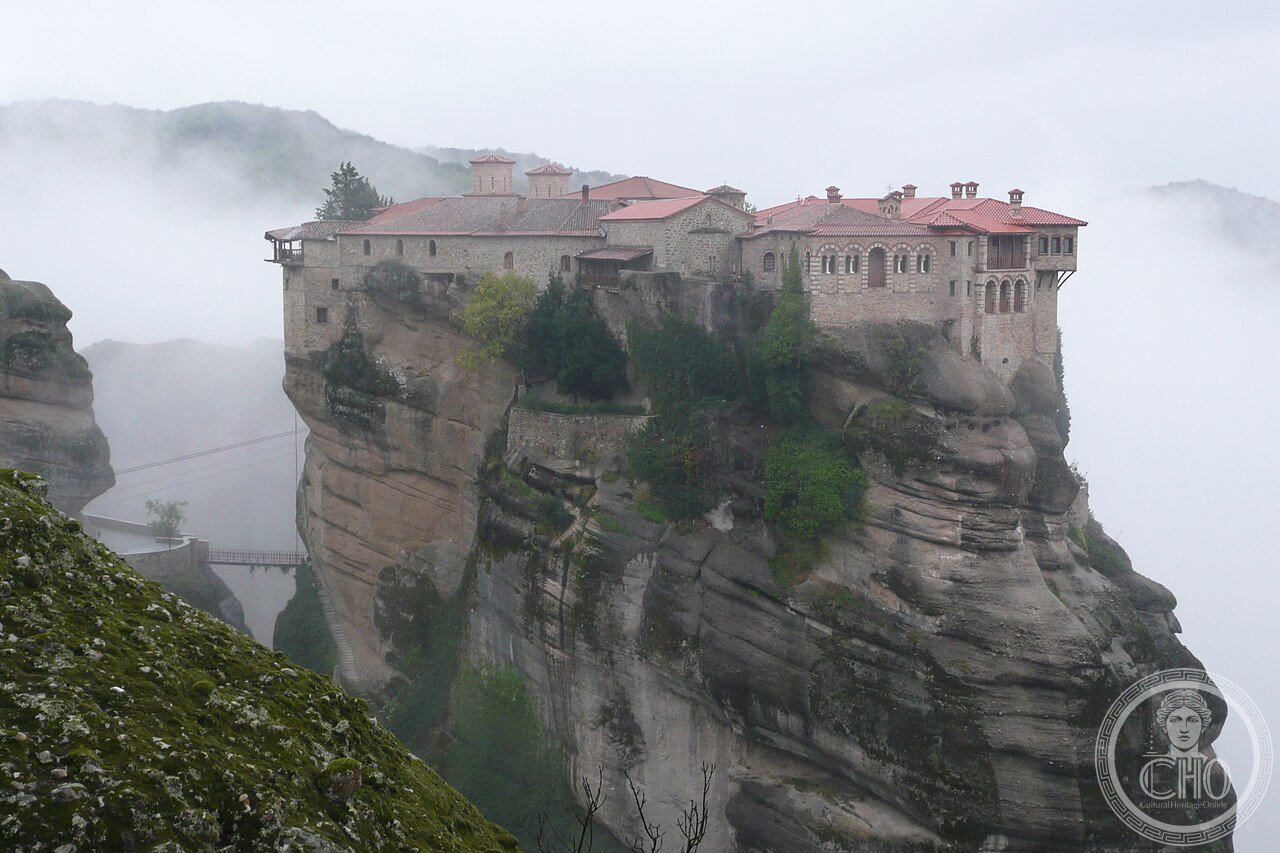
Around 1350 the hermit Varlaam climbed the steep rock alone and built there three churches and a cell. On his death the site lay abandoned for some two centuries, until two brothers from Ioannina, Theophanes and Nectarios Apsaras, spent whole years hauling up by hand, with ropes and winches, every building stone and even a giant oak barrel for collecting rainwater, still kept on the rock.
About Varlaam Monastery
Varlaam Monastery takes its name from the hermit-anchorite Varlaam, who around 1350 scaled the steep rock at Meteora, accompanied by a small number of fellow monks, and built three churches, a cell for himself, and a water cistern. After Varlaam’s death in the early 15th century, the site fell into abandonment, and the 14th-century chapel he had dedicated to the Three Hierarchs gradually deteriorated over roughly two centuries of neglect. The monastery’s substantial modern history begins in the early 16th century, when two brothers from Ioannina, Theophanes and Nektarios Apsaras — descendants of an old Byzantine noble family — settled on the abandoned rock and devoted years of sustained effort to its restoration. In 1518 they fundamentally renovated the chapel of the Three Hierarchs, built on the site of Varlaam’s original foundation; in 1536 they constructed the tower housing the monastery’s windlass and net system, still preserved today, used to haul both people and building materials up the sheer rock face; and between 1541 and 1544 they built the monastery’s main church, dedicated to All Saints, its frescoes attributed to the noted 16th-century painter Frangos Katelanos. Among the materials the brothers and their helpers hauled up piece by piece was a massive oak barrel, still preserved on the rock today, used to collect and store rainwater for the community. The monastery’s treasury and museum today display Byzantine-era vestments and religious icons dating from the Renaissance period. Since 1988, Varlaam has been part of the UNESCO World Heritage Site covering the six surviving monasteries of Meteora.
Key facts
- c. 1350: hermit Varlaam settles the rock, building three churches, a cell, and a cistern
- Early 15th century-early 16th century: site abandoned for roughly two centuries following Varlaam’s death
- 1518: brothers Theophanes and Nektarios Apsaras renovate the chapel of the Three Hierarchs
- 1536: the windlass tower, with its rope-and-net hoisting system, is built
- 1541-1544: the main church of All Saints is built, with frescoes attributed to Frangos Katelanos
- Water supply: a large 16th-century oak barrel, hauled up piece by piece, preserved on site today
- 1988: Varlaam joins the UNESCO World Heritage Site of Meteora’s six surviving monasteries
History
The nearly two-century gap between Varlaam’s death and the Apsaras brothers’ 16th-century restoration illustrates how precarious the survival of even a well-established Meteora hermitage could be without a continuous line of resident monks to maintain it — the site’s extreme physical inaccessibility, an asset for security, became a liability for institutional continuity once its founding community dispersed. The sheer physical labour the Apsaras brothers and their helpers invested in hauling every stone, timber, and the giant water-storage barrel up the rock face by rope and windlass over years of sustained effort represents one of the most vivid surviving illustrations of just how much manual endurance the entire Meteora monastic building programme demanded, centuries before any mechanised assistance existed.
The brothers’ own background as descendants of an old Byzantine noble family connects Varlaam’s 16th-century refoundation to the broader post-Byzantine pattern of aristocratic families redirecting inherited status and resources into religious patronage under Ottoman rule, using monastic restoration as a means of preserving cultural and religious continuity even after the political collapse of the Byzantine state itself.
What you see
The main church of All Saints, built 1541-1544, preserves frescoes attributed to the 16th-century painter Frangos Katelanos. The windlass tower, built in 1536, still holds its historic rope-and-net hoisting apparatus, a striking physical reminder of how the monastery’s builders once moved people and materials up the rock. The large 16th-century oak barrel used for rainwater storage remains on display on the monastery’s terrace, alongside the treasury and museum housing Byzantine vestments and Renaissance-era icons.
Practical information
- Opening hours: open to visitors on a scheduled basis with seasonal variation; check current hours before visiting; admission fee applies; modest dress required
- Address: Ιερά Μονή Βαρλαάμ, E4, 422 00 Kalambaka, Greece
Getting there
Varlaam Monastery is reachable by car or on foot from Kalambaka, in the Thessaly region, along the road connecting the Meteora monasteries. GPS: 39.7251° N, 21.6298° E.
Nearby
- Great Meteoron Monastery — the largest and oldest of the six surviving Meteora monasteries, close by
- Monastery of the Holy Trinity — another of the six active monasteries, within the same rock cluster
- Kalambaka — the town at the base of the Meteora rocks
Sources
- VisitMeteora.travel — “Varlaam Monastery Meteora: History, Views & Visitor Guide” (visitmeteora.travel)
- Kalampaka.com — “Holy Monastery of Varlaam” (kalampaka.com)
- Greeka.com — “Varlaam Monastery in Meteora, Greece” (greeka.com)
Find it on the map
See this place and what’s around it →📷 Become a Cultural Heritage Online photographer
Share your photos of places: they stay published under your name as the author. The more they're seen, the more you get noticed — and soon a contest will reward the most appreciated photos.
Log in or sign up free to add a photo