

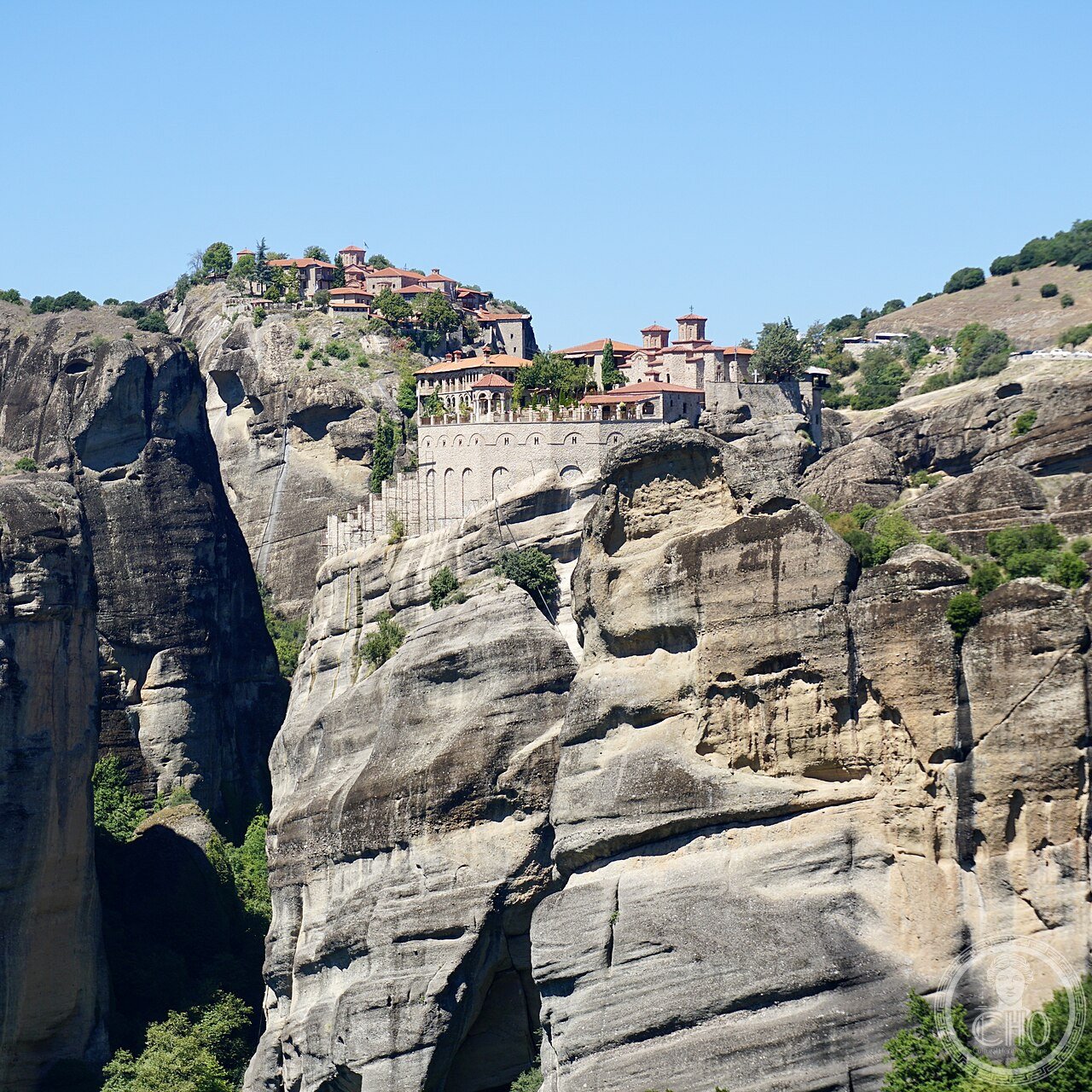
Around 1372–1373, at just twenty-two, John Uroš Palaiologos, the Serbian-Greek ruler of Thessaly, gave up the throne to become a monk under the name of Ioasaph. The holy founder Athanasios chose him as his successor at the head of the monastery built on the highest rock of Meteora; Ioasaph stayed there some fifty years, until his death in 1422–23, enlarging the building his predecessor had named “Meteoron” — suspended between heaven and earth.
About Great Meteoron Monastery
Great Meteoron, also known as the Monastery of the Transfiguration, was founded in the mid-14th century by the monk Athanasios Koinovitis, who settled around 1340 on the Rock of Stagoi together with his elder, Gregory, before occupying the tallest and broadest pinnacle in the entire Meteora complex, which he named “Meteoron” — the rock suspended between heaven and earth. There, Athanasios established a monastic community modelled on the cenobitic practices of Mount Athos, governed by a typikon (monastic rule) he drew up himself, building a first church dedicated to the Panagia Meteoritissa and later a katholikon, or main church, dedicated to the Transfiguration of Christ the Saviour. The Serbian ruler of Thessaly, Symeon Uroš Palaiologos, played a decisive role in the monastery’s early development, providing funding as early as 1356 for construction of the Transfiguration katholikon. Around 1372-1373, Symeon’s own son, John Uroš Palaiologos, at just twenty-two years old, renounced his rule over Thessaly and was tonsured a monk, taking the name Joasaph; Athanasios himself appointed the former ruler as his successor at Great Meteoron. Joasaph remained at the monastery for approximately fifty years, until his death in 1422-1423, and in 1387-1388 rebuilt Athanasios’s original church into a considerably grander structure, its twelve-sided dome rising some 24 metres and its interior later decorated with frescoes attributed to the painter Theophanis, depicting the persecution of early Christians under Rome. As the oldest and largest of Meteora’s monasteries, Great Meteoron today preserves an extensive museum and library alongside its katholikon, and remains part of the joint UNESCO World Heritage inscription covering Meteora’s six surviving monasteries since 1988.
Key facts
- c. 1340: founded by the monk Athanasios Koinovitis on Meteora’s highest and broadest rock pinnacle
- 1356: Serbian ruler Symeon Uroš Palaiologos funds construction of the Transfiguration katholikon
- 1372-1373: John Uroš Palaiologos, aged 22, abdicates as ruler of Thessaly to become the monk Joasaph
- Joasaph’s tenure: approximately 50 years at Great Meteoron, until his death in 1422-1423
- 1387-1388: Joasaph rebuilds the katholikon into a much larger structure, dome 24 metres high
- Frescoes: attributed to the painter Theophanis, depicting Roman persecution of early Christians
- Today: the largest and oldest of Meteora’s six surviving monasteries; UNESCO World Heritage since 1988
History
John Uroš Palaiologos’s decision to abdicate as ruler of Thessaly at just twenty-two to become the monk Joasaph, and then to spend roughly half a century leading Great Meteoron, represents one of the most striking individual instances anywhere in Meteora’s history of secular royal power being voluntarily and permanently exchanged for monastic life — a choice that directly shaped the physical development of the monastery he came to lead, since his own 1387-1388 rebuilding of the katholikon transformed Athanasios’s original modest church into the much grander structure that still stands today. The sustained material support Great Meteoron received from the Serbian-ruled Thessalian court, both under Symeon Uroš and then through his son’s own decades-long personal leadership of the community, gave the monastery a level of continuous royal patronage unusual even among Meteora’s other foundations.
As the site Athanasios specifically chose and named “Meteoron” — suspended between heaven and earth — Great Meteoron’s role as the namesake and, in time, the largest and most prominent of the entire monastic complex situates it at the symbolic centre of the wider Meteora settlement, even as five other monastic communities eventually developed on neighbouring pinnacles across the same dramatic landscape.
What you see
The katholikon, rebuilt by Joasaph in 1387-1388 with a twelve-sided dome rising approximately 24 metres, holds frescoes attributed to the painter Theophanis depicting scenes of early Christian persecution under Roman rule. As the oldest and largest monastery at Meteora, Great Meteoron preserves an extensive museum and library documenting the site’s own history and the broader monastic culture of the region, alongside the church itself and surrounding monastic buildings perched on the highest rock pinnacle in the entire complex.
Practical information
- Opening hours: open to visitors on a scheduled basis with seasonal variation; check current hours before visiting; admission fee applies; modest dress required
- Address: Great Meteoron Monastery, E4, 422 00 Kalambaka, Greece
Getting there
Great Meteoron is reachable by car or on foot from Kalambaka, in the Thessaly region, along the road connecting the Meteora monasteries. GPS: 39.7264° N, 21.6265° E.
Nearby
- Varlaam Monastery — another of the six active Meteora monasteries, close by
- Monastery of the Holy Trinity — a further active monastery within the same rock cluster
- Kalambaka — the town at the base of the Meteora rocks
Sources
- Holy Monastery of Great Meteoron — official site, “History – Name” (meteoromonastery.gr)
- OrthodoxWiki — “Great Meteoron Monastery (Meteora)” (orthodoxwiki.org)
- VisitMeteora.travel — “Great Meteoron Monastery Meteora: History, Visitor Guide” (visitmeteora.travel)
Find it on the map
See this place and what’s around it →📷 Become a Cultural Heritage Online photographer
Share your photos of places: they stay published under your name as the author. The more they're seen, the more you get noticed — and soon a contest will reward the most appreciated photos.
Log in or sign up free to add a photo