

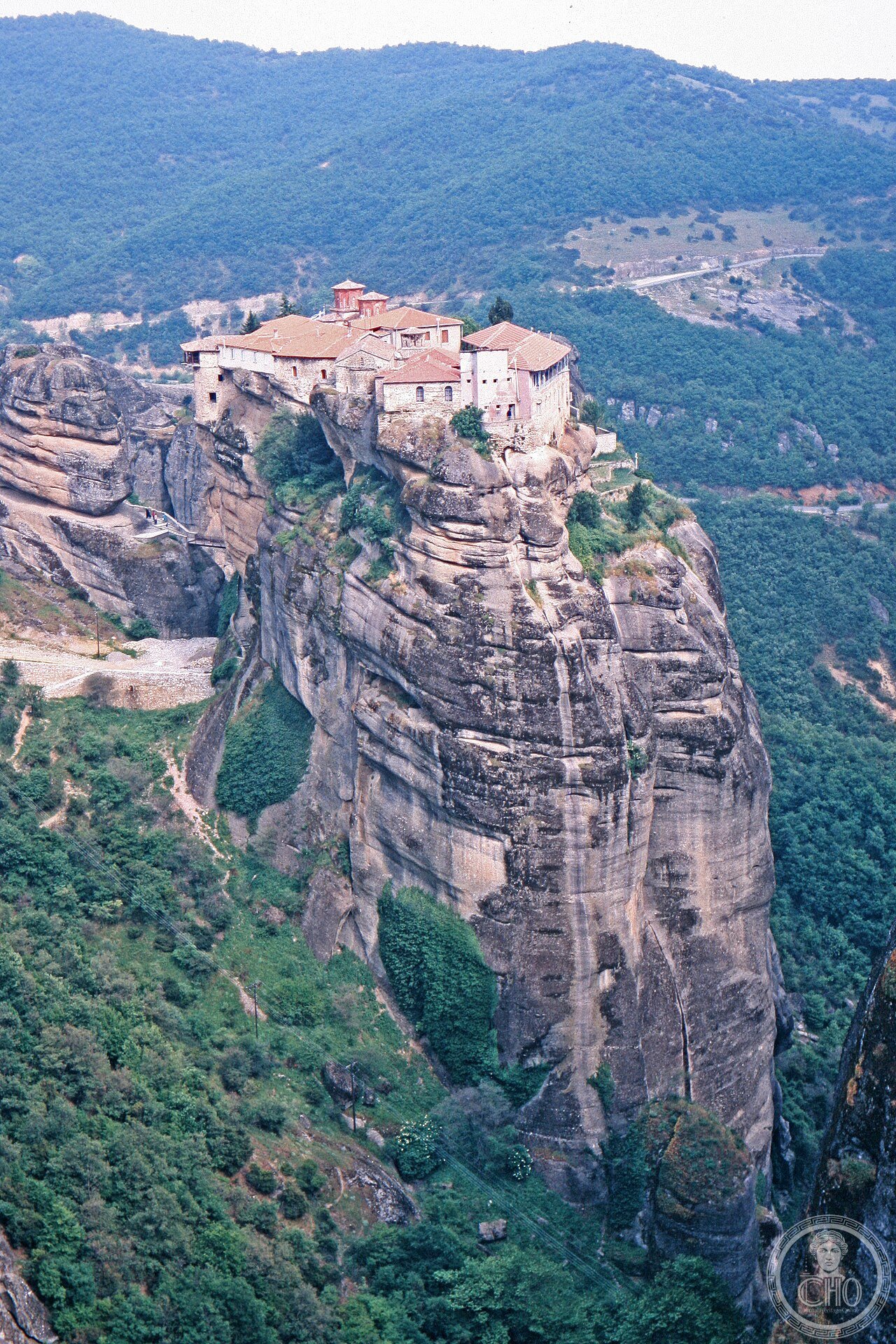
For generations the only way to reach the monastery, perched on a rock pinnacle more than 400 metres high, was to be hauled up in a net or to climb removable rung ladders, drawn up every night to protect the monks. Only in 1925 was a stairway of 140 steps cut into the rock completed. In 1981 its unmistakable silhouette became the set for the finale of the 007 film “For Your Eyes Only” — but the monks objected so firmly that the crew could film only the exterior.
About the Monastery of the Holy Trinity
According to local tradition, the Monastery of the Holy Trinity was founded in 1438 by a monk named Dometius, though this account is not historically confirmed; the site is documented from at least 1362, in records associated with the Serbian ruler Symeon Uroš Palaiologos. The monastery’s church, dedicated to the Holy Trinity, bears an inscription dating its construction to 1475-1476. One of 24 monasteries originally built at Meteora — of which only six remain active today — the monastery sits atop a rocky pinnacle over 400 metres high, among the tallest and most dramatically situated of the entire complex. For centuries, the only way to reach it was by climbing removable wooden ladders lashed together, or being hauled up in a net by a rope-and-windlass system, both of which could be withdrawn each night to protect the community from raiders; access remained this precarious well into the 20th century. It was only in 1925 that the local bishop, working with the monastic community, completed a stone staircase of 140 steps cut directly into the rock, finally giving the monastery secure and permanent access. Inside, the cruciform church, its dome supported by two columns, received its frescoes in 1741, while a treasury chamber (skeuophylakion) was added in 1684, its narthex vault completed in 1689 and further embellished in 1692. The monastery gained wider international recognition in 1981, when its exterior featured in the climactic sequence of the James Bond film “For Your Eyes Only,” in which Bond scales the cliff to confront the villain — though the monks of Meteora, having initially had permission granted by the Greek Ministry of Culture, firmly opposed filming inside their monastery, restricting the production to exterior shots only. Since 1988, the six surviving monasteries of Meteora, including the Holy Trinity, have together held UNESCO World Heritage status.
Key facts
- Earliest record: 1362, in documents of Serbian ruler Symeon Uroš Palaiologos
- Legendary founder: the monk Dometius, traditionally dated to 1438
- Church construction: 1475-1476, per inscription
- Original access: removable rope ladders and net-and-windlass hoists, retracted nightly
- 1925: a 140-step stone staircase, cut into the rock, finally provides secure access
- 1684-1692: treasury chamber built and its narthex vault completed and embellished
- 1741: the main church receives its frescoes
- 1981: exterior featured in the James Bond film “For Your Eyes Only”; interior filming refused by the monks
- 1988: Meteora’s six surviving monasteries jointly inscribed as a UNESCO World Heritage Site
History
The monastery’s centuries-long reliance on removable ladders and net hoists as its only means of access reflects the defensive logic underlying Meteora’s entire monastic settlement pattern: communities deliberately built their houses atop otherwise inaccessible rock pinnacles specifically to place themselves beyond the reach of raiders and invading armies, accepting profound daily inconvenience in exchange for genuine physical security, a trade-off that persisted in practice until the 1925 staircase finally resolved it. The monks’ 1981 refusal to allow James Bond film crews inside their church, even after formal governmental permission had already been secured, illustrates how monastic communities at Meteora have continued to assert control over their own sacred spaces even as the site’s dramatic visual profile made it an increasingly attractive backdrop for international popular culture.
The reduction from an original 24 monasteries at Meteora to just six surviving active communities today, all jointly protected under a single 1988 UNESCO inscription, situates the Holy Trinity Monastery among a small surviving remnant of what was once a far larger monastic settlement, its own continued active use giving it particular significance as a living link to Meteora’s fuller medieval and early modern monastic landscape.
What you see
The cruciform church, its dome resting on two supporting columns, holds frescoes added in 1741, alongside a treasury chamber built in 1684 with a narthex vault completed in 1689 and enhanced in 1692. The 140 rock-cut steps leading up to the monastery, completed in 1925, remain the principal means of access today, replacing the earlier system of removable ladders and net hoists. The monastery’s position atop its pinnacle offers sweeping views across the entire Meteora rock formation and the town of Kalambaka below.
Practical information
- Opening hours: open to visitors on a scheduled basis with seasonal variation; check current hours before visiting; admission fee applies; modest dress required
- Address: Moni Agias Triados, Trinity Trail, 422 00 Kalambaka, Greece
Getting there
The Monastery of the Holy Trinity is reachable on foot from Kalambaka (approximately 3 kilometres along a marked trail) in the Thessaly region. GPS: 39.7133° N, 21.6355° E.
Nearby
- Great Meteoron Monastery — the largest and oldest of the six surviving Meteora monasteries
- Varlaam Monastery — another of the six active monasteries, within the same rock cluster
- Kalambaka — approximately 3 km away; the town at the base of the Meteora rocks
Sources
- Wikipedia — “Monastery of the Holy Trinity, Meteora” (en.wikipedia.org)
- VisitMeteora.travel — “Monastery of Holy Trinity (Agia Triada)” (visitmeteora.travel)
- OrthodoxWiki — “Holy Trinity Monastery (Meteora)” (orthodoxwiki.org)
Find it on the map
See this place and what’s around it →📷 Become a Cultural Heritage Online photographer
Share your photos of places: they stay published under your name as the author. The more they're seen, the more you get noticed — and soon a contest will reward the most appreciated photos.
Log in or sign up free to add a photo