

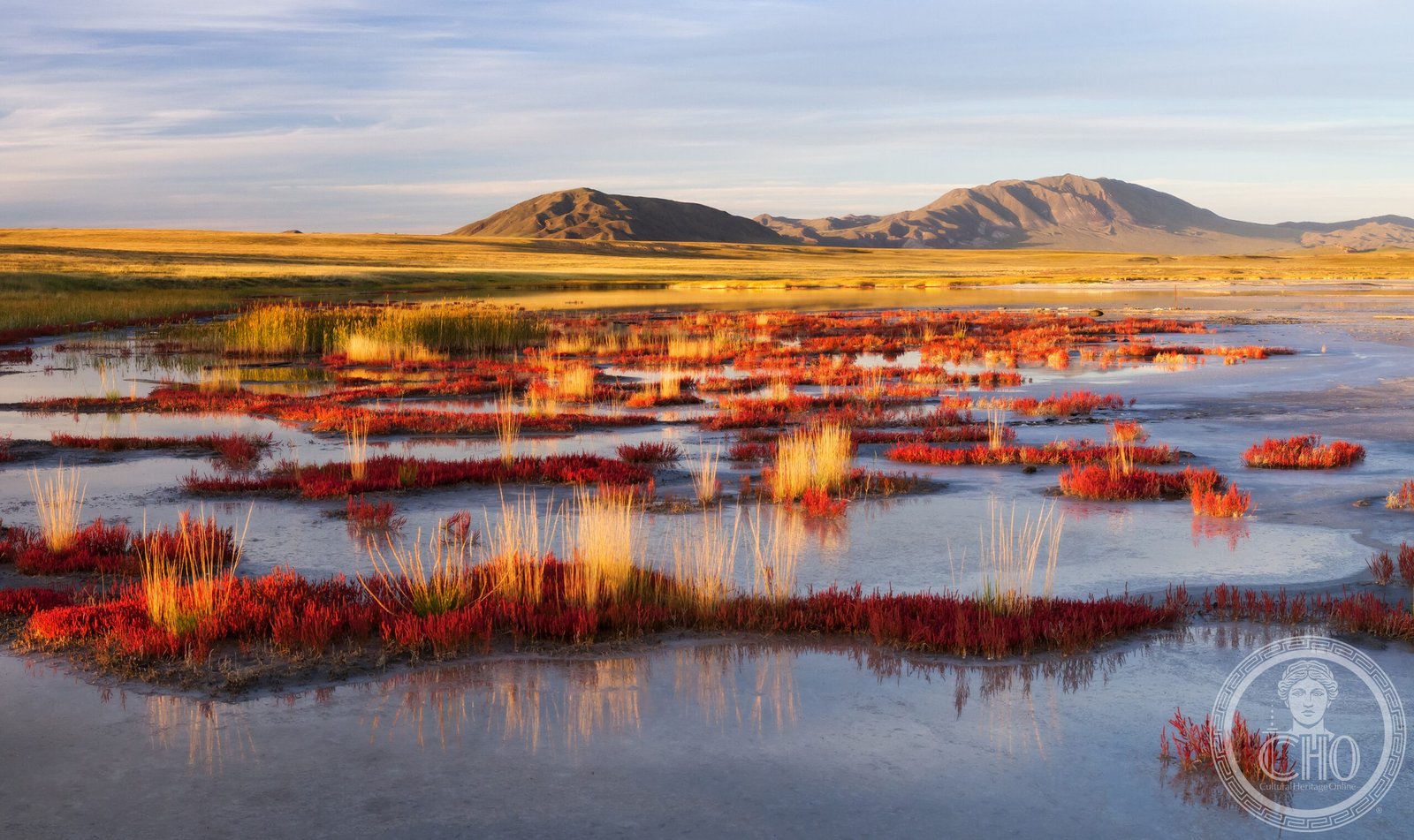
A Crossroads of Biomes
The Uvs Nuur Basin — known in Russian as the Ubsunur Hollow — straddles the border of Russia’s Tuva Republic and western Mongolia, forming one of Central Asia’s most remarkable natural laboratories. An enclosed drainage basin roughly 700 kilometres long and 160 wide, it contains desert, semi-desert, steppe, taiga, and alpine tundra within a single watershed, all organised around the shallow, hypersaline Lake Uvs Nuur. UNESCO inscribed the site in 2003 as a natural World Heritage property of outstanding universal value.
Lake Uvs Nuur: A Living Paleo-Climate Record
Lake Uvs Nuur is one of the largest lakes in Central Asia by surface area (approximately 3,350 square kilometres) yet remarkably shallow, averaging only 6 metres deep. Its salinity — roughly three times that of seawater — reflects thousands of years of evaporation in a closed basin with no outlet. Sediment cores extracted from the lake floor preserve a detailed record of climate oscillations spanning the past 500,000 years, offering palaeoclimatologists an archive of Pleistocene and Holocene environmental change in the heart of the Eurasian continent.
The Mosaic of Ecosystems
The basin’s ecosystems range from the Gobi-Altai desert in the south — where dunes stabilised by sparse saxaul groves give way to gravel plains — to taiga forest on northern slopes where larch and Siberian pine shelter elk and bear. Between these extremes lie vast dry steppes grazed by huge herds of Mongolian gazelle and argali wild sheep, and alpine meadows above the treeline that host snow leopard, ibex, and marmot. This vertical and horizontal stacking of biomes in a single enclosed watershed is exceptionally rare at this scale.
Significance for Migratory Birds
The wetlands fringing Lake Uvs Nuur form a critical node on the Central Asian Flyway, with hundreds of thousands of waterfowl and shorebirds resting and breeding here during summer. The lake supports globally significant populations of white-naped crane, bar-headed goose, ruddy shelduck, and several gull species. Flamingos occasionally appear, driven north by unusual weather patterns, marking the lake as a biogeographic crossroads between Central Asian and South Asian avifaunas. Raptors — including steppe eagle, pallid harrier, and Saker falcon — concentrate along the lake shores in migration.
Large Mammals of the Steppe and Mountain
Snow leopards patrol the rocky scarps of the Tannu-Ola and Tsagan-Shhibetu ranges enclosing the basin. The argali — the world’s largest wild sheep, with spiralling horns spanning over a metre — grazes the mountain meadows in herds that once numbered in the thousands; their population has declined due to poaching and competition with domestic livestock but the basin remains one of their strongholds. Siberian ibex occupies the cliff faces, while grey wolf and corsac fox range across the open steppe in pursuit of gazelle and ground squirrel.
Human Presence: Tuvan and Mongolian Herders
The basin has been inhabited since the Palaeolithic. Bronze Age petroglyphs, Scythian burial mounds (kurgans), and Turkic stone figures (balbal) dot the landscape, testifying to nomadic cultures that exploited the seasonal abundance of the steppe for millennia. Today Tuvan and Mongolian herders continue a transhumant lifestyle, moving yurt camps between summer pastures on mountain slopes and winter quarters on the protected steppe floor. Traditional ecological knowledge about water sources, pasture cycles, and wildlife behaviour accumulated over generations informs modern conservation management.
Transboundary Conservation
The Uvs Nuur Basin is one of UNESCO’s early transboundary natural heritage sites, spanning components in Russia (managed by the Ubsunur Hollow State Nature Biosphere Reserve) and Mongolia (Uvs Nuur State Protected Areas). Cross-border coordination has been tested by different institutional frameworks, funding realities, and enforcement capacities on the two sides of the border, but shared interest in snow leopard and argali protection has driven practical cooperation including joint scientific surveys and anti-poaching patrols.
UNESCO Recognition and Scientific Value
The Uvs Nuur Basin was inscribed on the UNESCO World Heritage List in 2003 under natural criteria (ii) and (iv), recognised for its exceptional illustration of ongoing ecological and biological evolution and for its importance as a habitat for globally threatened species. The lake sediment record, the juxtaposition of extreme ecosystems, and the intact populations of snow leopard, argali, and white-naped crane together make the basin one of the most scientifically significant natural areas in Central Asia.
Find it on the map
See this place and what’s around it →
📷 Become a Cultural Heritage Online photographer
Share your photos of places: they stay published under your name as the author. The more they're seen, the more you get noticed — and soon a contest will reward the most appreciated photos.
Log in or sign up free to add a photo