

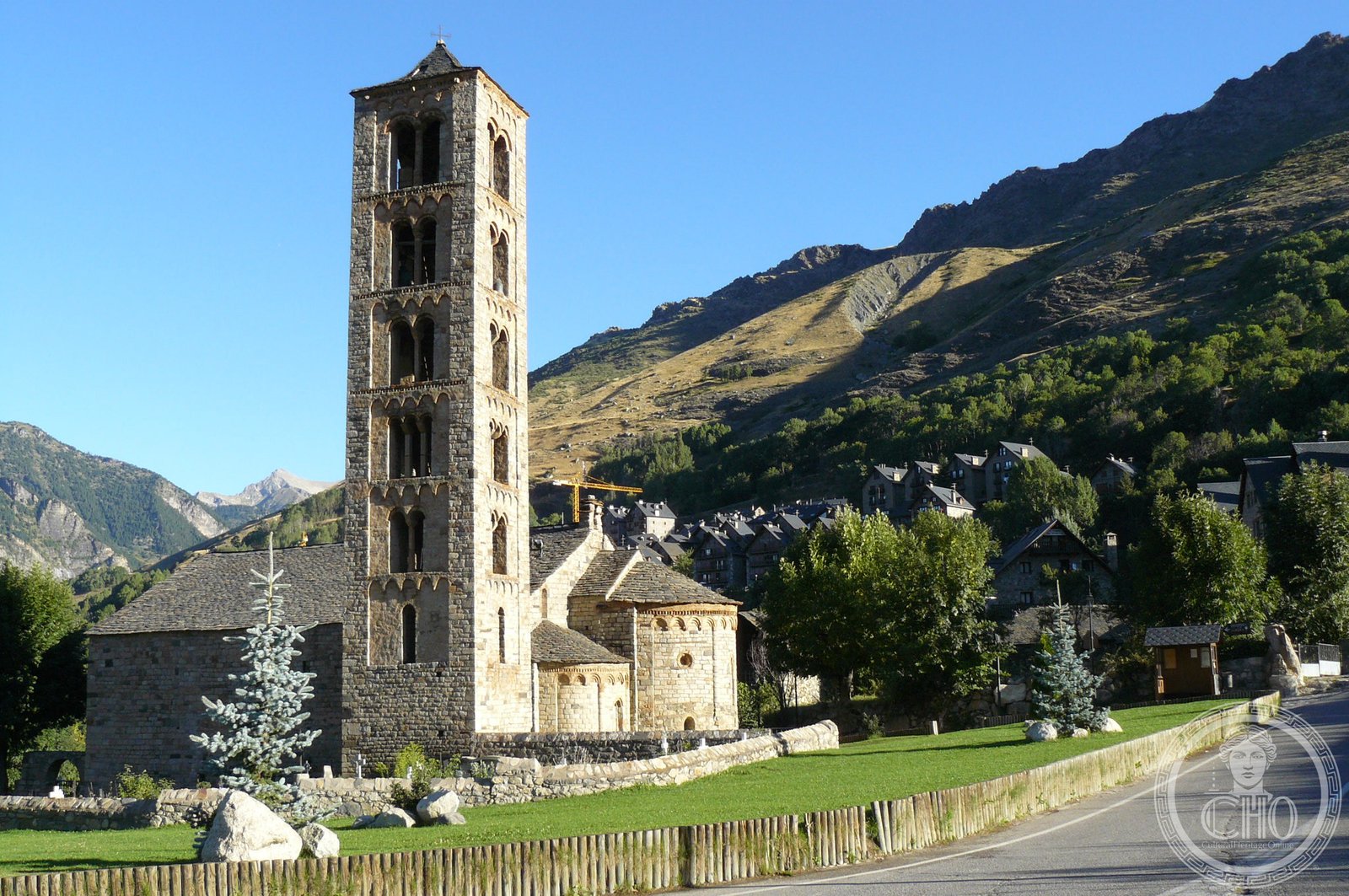
Romanesque Jewels in the High Pyrenees
The Vall de Boí, a remote mountain valley in the Alta Ribagorca comarca of Catalonia, harbours the densest concentration of Romanesque churches in Europe. Nine churches and a hermitage — including Sant Climent de Taüll, Santa Maria de Taüll, Sant Joan de Boi, and Santa Eulalia d’Erill-la-Vall — were built in a burst of ecclesiastical activity between approximately 1020 and 1150. UNESCO inscribed the Catalan Romanesque Churches of the Vall de Boí in 2000 as an outstanding example of 11th- and 12th-century Romanesque religious architecture.
Architecture and the Lombard Masters
The churches of Boí share a distinctive architectural vocabulary imported from Lombardy in northern Italy: tall, slender free-standing bell towers with lesene (flat pilaster strips) and blind arcading, ashlar masonry of exceptional precision, and single or triple apses. The master builders who erected these churches — known collectively as the Lombard masters — brought techniques and decorative repertoires developed in the Po Valley and spread them across Catalonia, Aragon, and southern France in the early 11th century. The Boí towers are among the finest surviving examples of this Lombard influence in the Iberian Peninsula.
The Frescoes: A Lost World Recovered
The interior walls of the Boí churches were originally covered with Romanesque frescoes of extraordinary quality, depicting Christ in Majesty, the apostles, episodes from the New Testament, and scenes from the lives of the saints. By the early 20th century many frescoes were at risk from humidity and neglect. Between 1919 and 1923 the Junta de Museus de Catalunya authorised the detachment and transfer of the most significant cycles to Barcelona for preservation. The Pantocrator of Sant Climent de Taüll — Christ in a mandorla surrounded by the symbols of the four evangelists — is now the defining masterwork of the Museu Nacional d’Art de Catalunya.
Sant Climent de Taüll
Consecrated in 1123 by Bishop Ramon Guillem of Roda, Sant Climent de Taüll is the best preserved and most celebrated of the Boí churches. Its six-storey bell tower, soaring 32 metres above the village, is the archetype of Lombard Romanesque in Catalonia. The interior has been equipped with a digital recreation of the original fresco cycle, projecting full-colour reproductions of the lost paintings onto the bare stone apses — allowing visitors to experience the church as its 12th-century congregation would have seen it, without removing the originals from their protected museum environment.
Santa Maria de Taüll and the Sculptural Programme
Consecrated on the day following Sant Climent in 1123, Santa Maria de Taüll stands at the upper end of the village and retains fragments of its original fresco cycle including a celebrated Virgin and Child composition. The church has a wider nave than Sant Climent and three apses, creating a basilical plan typical of Lombard influence. Together the two Taüll churches represent the apogee of Romanesque art in the Pyrenean region and have been the subject of intensive art-historical study since their rediscovery by scholars in the late 19th century.
The Valley as Cultural Landscape
The Vall de Boí is not merely a collection of individual monuments but a coherent medieval cultural landscape in which village, church, agricultural terrace, and transhumance route form an integrated whole. The villages — Boi, Taüll, Erill-la-Vall, Barruera, Coll, Durro, and Cardet — retain their historic stone construction and compact urban morphology. The churches served as the spiritual anchors for communities whose economy depended on summer alpine pastures and winter valley agriculture, a rhythm of life that has shaped the physical landscape for a thousand years.
Conservation and Visitor Experience
The churches are managed by the Centre del Romanic de la Vall de Boi, which coordinates conservation, interpretation, and visitor access across all nine sites. The dramatic reconstruction of the Sant Climent frescoes using video mapping technology has become a model for heritage sites worldwide seeking to communicate the original chromatic richness of medieval interiors without compromising authenticity. The valley is accessible by road from the town of El Pont de Suert; the Aiguestortes i Estany de Sant Maurici National Park adjoins the valley to the east, offering a natural complement to the cultural itinerary.
UNESCO Recognition
The Catalan Romanesque Churches of the Vall de Boí were inscribed on the UNESCO World Heritage List in 2000 under criteria (ii) and (iv), recognised as an outstanding example of Romanesque religious architecture that played an important role in the dissemination of Lombard architectural and decorative techniques throughout the Iberian Peninsula in the 11th and 12th centuries. The tower of Sant Climent de Taüll has become one of the iconic images of Catalan cultural identity.
Find it on the map
See this place and what’s around it →📷 Become a Cultural Heritage Online photographer
Share your photos of places: they stay published under your name as the author. The more they're seen, the more you get noticed — and soon a contest will reward the most appreciated photos.
Log in or sign up free to add a photoIs this page about you?
This page is read by travellers and heritage enthusiasts who find it on Google. Tell us how you are connected to this place and we will take it from there.