

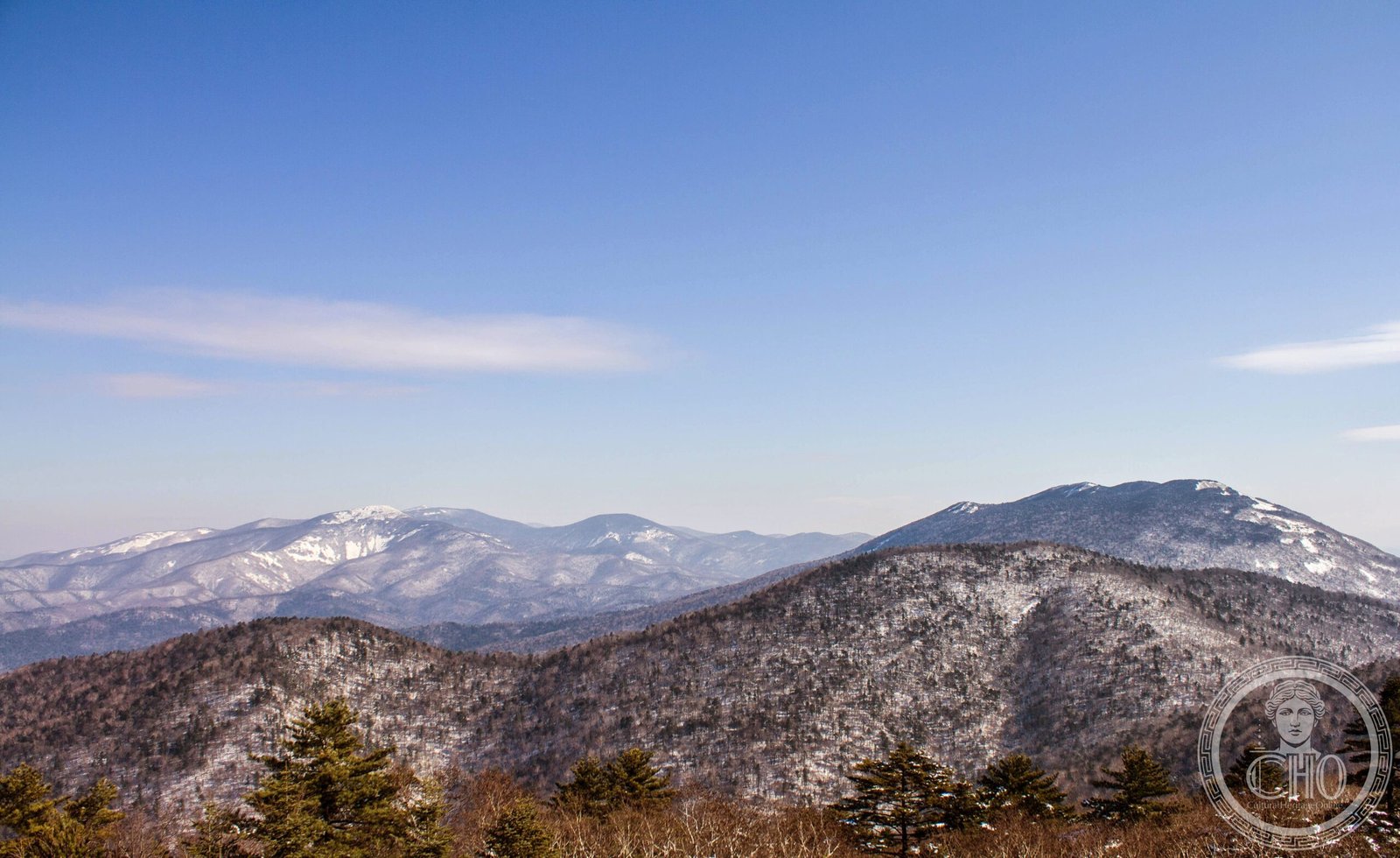
The Last Stronghold of the Amur Tiger
The Sikhote-Alin Biosphere Reserve in Primorsky Krai, Russian Far East, shelters the world’s last viable wild population of the Amur tiger (Panthera tigris altaica), also known as the Siberian tiger. When the reserve was established in 1935 fewer than forty individuals survived; today, thanks to decades of strict protection, roughly 500 tigers roam the broader Sikhote-Alin landscape. UNESCO inscribed the site in 2001 as a natural World Heritage property of outstanding universal value.
Geography of the Mountain Range
The Sikhote-Alin range runs approximately 1,200 kilometres along the Russian Pacific coast, separating the Ussuri River basin from the Sea of Japan. The inscribed core zone covers some 400,000 hectares of rugged ridges, river valleys, and coastal cliffs. Elevations range from sea level at the coast to over 1,500 metres on the highest peaks, generating a mosaic of microclimates that supports extraordinary biodiversity. The meeting of warm Tsushima ocean currents and cold continental air masses creates conditions unique among temperate forests worldwide.
A Primordial Temperate Forest
Sikhote-Alin is widely regarded as one of the least disturbed temperate forests remaining on Earth. Korean pines tower over 30 metres, draped in wild grape and Amur cork oak understorey. The convergence of northern boreal taiga and southern broadleaf flora — a relict of Tertiary forest assemblages — produces an extraordinary species overlap: reindeer share valleys with leopard cats, Manchurian wapiti browse alongside roe deer, and brown bears roam the same ridges as Amur leopards.
Flagship Species Beyond the Tiger
While the Amur tiger dominates international attention, Sikhote-Alin hosts an equally remarkable cast of large mammals. The Amur leopard — the world’s rarest big cat, with a wild population counted in the dozens — occupies the southern fringes of the range. Brown bears, Himalayan black bears, lynx, wolverine, sable, and the red deer-like Manchurian wapiti all maintain viable populations here. The rivers run with cherry salmon, Siberian taimen, and Amur sturgeon, supporting both wildlife and local communities dependent on subsistence fishing.
Avian Diversity and Migratory Pathways
The Sikhote-Alin coast lies on the East Asian-Australasian Flyway, one of the world’s busiest bird migration corridors. The reserve and adjacent coastal wetlands provide critical stopover habitat for hundreds of thousands of shorebirds, geese, and cranes. Scaly-sided merganser, Blakiston’s fish owl — the world’s largest owl — and the Japanese white-naped crane all breed in the reserve. Winter brings Steller’s sea eagle and white-tailed eagle to the ice-free river mouths in spectacular concentrations.
Conservation History and Ongoing Challenges
The reserve was founded in 1935 specifically to protect the Amur tiger at its lowest ebb. Soviet-era enforcement was strict: poaching carried criminal penalties and the population slowly recovered. The collapse of the Soviet Union in 1991 triggered a poaching crisis as economic hardship drove illegal hunting and the Chinese traditional medicine market created demand for tiger bones and organs. International partnerships — notably with the Wildlife Conservation Society and WWF — helped stabilise enforcement and fund anti-poaching brigades through the 1990s and 2000s.
Scientific Research and Monitoring
Sikhote-Alin has been a hub for large-carnivore research since the pioneering work of Soviet ecologist Lev Kaplanov in the 1940s. Modern camera-trap grids, GPS-collared tigers, and genetic sampling allow researchers to track individual animals and estimate population dynamics with high precision. Long-term datasets spanning over 80 years make this one of the most comprehensively studied tiger populations in existence, providing baselines for conservation programmes across the species’ remaining range in India, Sumatra, and the Russian Far East.
UNESCO Recognition and Ecotourism
The Sikhote-Alin Biosphere Reserve was inscribed on the UNESCO World Heritage List in 2001 under natural criteria (x) for its exceptional importance in the in-situ conservation of biological diversity, specifically the Amur tiger. The reserve headquarters at Terney, roughly 700 kilometres northeast of Vladivostok, receives a modest but growing stream of ecotourists attracted by the chance to see tiger tracks in fresh snow, Blakiston’s fish owl, and some of the most pristine temperate forest on the planet.
Find it on the map
See this place and what’s around it →📷 Become a Cultural Heritage Online photographer
Share your photos of places: they stay published under your name as the author. The more they're seen, the more you get noticed — and soon a contest will reward the most appreciated photos.
Log in or sign up free to add a photo