
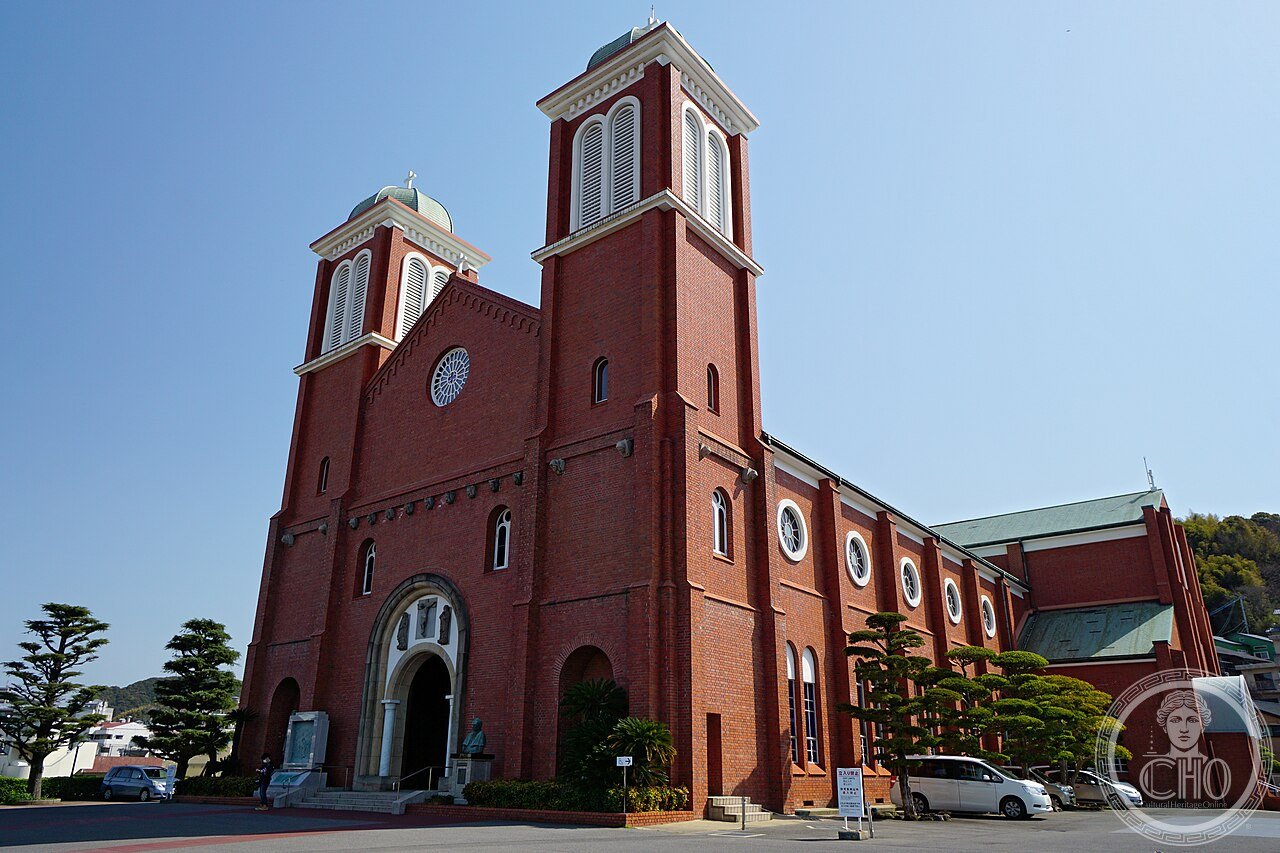
At Nagasaki, in Japan, Urakami Cathedral was built by the local Catholic community, descended from the “hidden Christians” who had practised the Catholic faith in secret for more than 250 years after Christianity was banned in 1614. In 1865 some inhabitants of Urakami revealed themselves to the French priest Bernard Petitjean in the church of Oura, setting off a new and very harsh persecution, the “Urakami Yoban Kuzure”: more than 3,600 villagers were deported to other feudal domains, and around 650 died in exile before religious freedom was finally granted in 1873. Back home, the faithful of Urakami built the new cathedral with their own hands and means, begun in 1895 and completed in 1925, on the ground once used to interrogate and torture Christians: on its completion it was described as the largest Catholic structure in Asia-Pacific. On 9 August 1945 the Nagasaki atomic bomb exploded about 500 metres from the cathedral, destroying it almost completely: of some 12,000 Catholics living in Urakami, an estimated 8,500 died, including two priests who were hearing confessions inside the building at that moment. The cathedral was rebuilt in reinforced concrete and completed in October 1959, after a heated debate between those who wanted the ruins preserved as a memorial and the Catholic community, which chose instead to rebuild on the same site as a symbol of endurance. Some remains, including a fallen bell tower, are still kept at the Nagasaki Peace Park.
About Urakami Cathedral
Urakami Cathedral, in Nagasaki, Japan, was built by the local Catholic community, descendants of “Hidden Christians” who had secretly practised Catholicism for more than 250 years following the 1614 ban on Christianity in Japan. In 1865, villagers from Urakami revealed themselves to the French priest Bernard Petitjean at Nagasaki’s Oura Church, an event that triggered fresh, severe persecution known as the Urakami Yoban Kuzure: more than 3,600 villagers were exiled to other feudal domains, and roughly 650 died in exile before religious freedom was finally granted in 1873. Returning home, the Urakami faithful built the new cathedral with their own labour and resources, construction beginning in 1895 and completing in 1925, on land once used to interrogate and torture Christians; upon completion it was widely described as the largest Catholic structure in the Asia-Pacific region. On 9 August 1945, the atomic bomb detonated over Nagasaki approximately 500 metres from the cathedral, almost completely destroying it; of roughly 12,000 Catholics then living in Urakami, an estimated 8,500 were killed, including two priests who were hearing confessions inside the cathedral at the moment of the blast. The cathedral was rebuilt in reinforced concrete and completed in October 1959, following genuine debate between those who wished to preserve the bombed ruins as a permanent memorial and the Catholic community, which chose instead to rebuild on the original site as a symbol of endurance. Some remnants, including a collapsed bell tower, are preserved today near Nagasaki’s Peace Park, a short walk from the cathedral.
Key facts
- 1614: Christianity banned in Japan, beginning over 250 years of secret Hidden Christian practice
- 1865-1873: Urakami Christians revealed, persecuted (Urakami Yoban Kuzure), then granted religious freedom
- 1895-1925: the original cathedral built by the returned Catholic community
- 9 August 1945: the atomic bomb detonates roughly 500 metres away, destroying the cathedral and killing an estimated 8,500 of Urakami’s 12,000 Catholics
- 1959: the cathedral rebuilt in reinforced concrete on the original site
- Preserved remnants, including a fallen belfry, displayed near Nagasaki Peace Park
History
Urakami Cathedral’s history spans two of the most extreme trials faced by any Christian community in modern history: over 250 years of clandestine religious practice under threat of death, followed by renewed persecution after discovery in the 1860s, and finally near-total destruction and mass loss of life in the 1945 atomic bombing. The community’s decision to rebuild directly on the bombed site, rather than accept the city’s offer to preserve the ruins elsewhere, reflects a deliberate choice to treat survival and continuity, rather than memorialised destruction, as the defining response to catastrophe.
What you see
The rebuilt cathedral, completed in reinforced concrete in 1959, echoes the Romanesque brick design of the original 1925 structure, its twin towers rising above the Urakami district. Preserved fragments of the bombed original — including a collapsed belfry weighing roughly 50 tonnes, wall remnants, and statue fragments — are displayed on the cathedral grounds and nearby at Nagasaki’s Peace Park and Atomic Bomb Museum, forming a quiet counterpoint to the rebuilt church.
Practical information
- Opening hours: generally open daily with seasonal variation; free admission; check current hours before visiting
- Address: Motoo-machi, Nagasaki, Japan
Getting there
Urakami Cathedral stands in the Urakami district of Nagasaki, a short walk from Nagasaki Peace Park and the Atomic Bomb Museum. GPS: 32.7761° N, 129.8683° E.
Nearby
- Nagasaki Peace Park — memorial park including the atomic bomb hypocenter, a short walk away
- Nagasaki Atomic Bomb Museum — museum documenting the 1945 bombing, nearby
- Oura Church — the church where the Hidden Christians of Urakami first revealed themselves in 1865, elsewhere in Nagasaki
Sources
- Wikipedia — “Immaculate Conception Cathedral, Nagasaki” (en.wikipedia.org)
- Wikipedia — “Urakami Yoban Kuzure” (en.wikipedia.org)
- Nagasaki Peace — official Nagasaki city peace and atomic bombing history site (nagasakipeace.jp)
Find it on the map
See this place and what’s around it →📷 Become a Cultural Heritage Online photographer
Share your photos of places: they stay published under your name as the author. The more they're seen, the more you get noticed — and soon a contest will reward the most appreciated photos.
Log in or sign up free to add a photo