
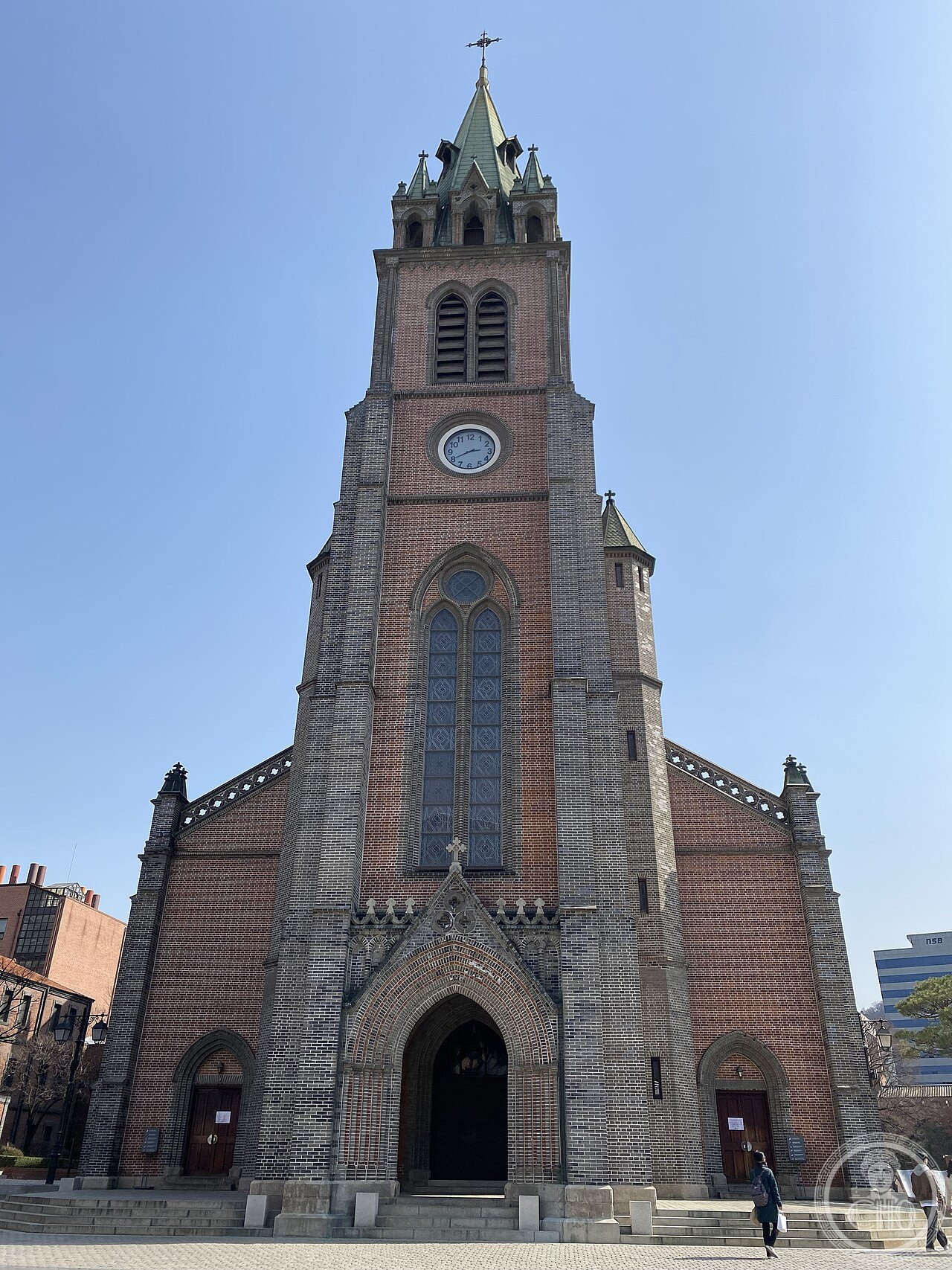
In the Myeongdong district of Seoul, the first stone of the cathedral was laid on 5 August 1892. The building, the first in Gothic style in Korea, was consecrated on 29 May 1898. It was designed by the French priest Eugène Coste and built with some twenty different types of red and grey brick, fired locally. The ground it stands on was already bound up with the history of Korean Catholicism: in 1785 a group of early converts gathered in secret in the house of the believer Kim Beom-u, on that same hill, then called «Bell Hill». After the cathedral was finished, the relics of nine martyrs of the persecutions of 1839 and 1866, among them Bishop Laurent Imbert and the priests Jacques Chastan and Pierre Maubant, were laid in the crypt. They bear witness to one of the most harshly persecuted Catholic communities in history, from which come the 103 Korean martyrs canonised by Pope John Paul II in 1984. Almost a century later the cathedral took on a new symbolic role. On 10 June 1987, after the death under torture of the student Park Jong-chul, hundreds of demonstrators fleeing the police found shelter inside the building, beginning a sit-in that Cardinal Kim Su-hwan protected in person, placing himself between the police and the students: a key episode of the June democratic uprising that led to the democratisation of South Korea.
About Myeongdong Cathedral
Myeongdong Cathedral, in the Myeongdong district of Seoul, had its cornerstone laid on 5 August 1892 and was consecrated on 29 May 1898, becoming Korea’s first Gothic Revival building, designed by the French priest Eugène Coste and built using roughly twenty types of locally fired red and grey brick. The site carried deep significance for Korean Catholicism even before construction began: in 1785, an early group of converts gathered secretly to worship in the house of the believer Kim Beom-u on the same hill, then known as “Bell Hill.” Following the cathedral’s completion, the relics of nine martyrs from the persecutions of 1839 and 1866 — including Bishop Laurent Imbert and the priests Jacques Chastan and Pierre Maubant — were placed in the cathedral’s crypt, honouring a Catholic community that endured some of the most severe persecution suffered by Christians anywhere in the world during the 18th and 19th centuries, a history that produced the 103 Korean martyrs canonised by Pope John Paul II in 1984. Nearly a century after its consecration, the cathedral took on a new symbolic role: on 10 June 1987, following the torture-death of student Park Jong-chul, hundreds of protesters fleeing police took refuge inside the building, beginning a sit-in that Cardinal Kim Su-hwan personally protected, standing between police and the students — a pivotal episode in the June Democratic Struggle that helped bring about South Korea’s transition to democracy. The cathedral remains the seat of the Archdiocese of Seoul and one of the city’s most significant historic landmarks, formally designated National Registered Historic Site No. 258 in 1977.
Key facts
- 1892-1898: construction, Korea’s first Gothic Revival building.
- 1785: early Catholic converts gather secretly on the same hill, at the house of Kim Beom-u.
- Crypt: holds the relics of nine martyrs from the 1839 and 1866 persecutions.
- 1984: Pope John Paul II canonises 103 Korean martyrs, honouring the same persecuted community.
- 10 June 1987: the cathedral shelters student protesters during the June Democratic Struggle.
- 1977: designated National Registered Historic Site No. 258.
History
Myeongdong Cathedral’s foundation on a site already tied to Korea’s earliest, clandestine Catholic congregations connects the building directly to the long, often violently suppressed history of Korean Catholicism, a persecution so severe across the 1801, 1839 and 1866 crackdowns that it produced one of the largest groups of canonised martyrs from any single national Catholic community. Nearly a century later, the cathedral’s role sheltering student protesters during the 1987 June Democratic Struggle added an entirely new layer of national significance, transforming a 19th-century religious monument into one of the defining physical symbols of South Korea’s modern democratic transition.
What you see
The cathedral’s red and grey brick Gothic Revival facade, one of the earliest brick buildings constructed in Korea, rises in a cruciform plan with ribbed vaulting inside and a bell tower reaching roughly 45 metres. Beneath the main altar, the crypt holds the relics of nine Catholic martyrs from Korea’s 19th-century persecutions, a quiet counterpoint to the building’s prominent role in the country’s 20th-century political history.
Practical information
- Opening hours: generally open daily with seasonal variation; free admission; check current hours before visiting.
- Address: Myeongdong-gil, Jung-gu, Seoul, South Korea.
Getting there
Myeongdong Cathedral stands in the Myeongdong shopping district of central Seoul, easily reached via Myeongdong subway station. GPS: 37.5633° N, 126.9873° E.
Nearby
- Myeongdong shopping district — Seoul’s famous commercial and pedestrian district, surrounding the cathedral.
- Namsan Seoul Tower — the city’s iconic hilltop tower, a short distance away.
- Deoksugung Palace — historic royal palace, a walk away.
Sources
- Wikipedia — “Myeongdong Cathedral” (en.wikipedia.org).
- Wikipedia — “June Democratic Struggle” (en.wikipedia.org).
- Korea.net — official Republic of Korea government news site.
Find it on the map
See this place and what’s around it →📷 Become a Cultural Heritage Online photographer
Share your photos of places: they stay published under your name as the author. The more they're seen, the more you get noticed — and soon a contest will reward the most appreciated photos.
Log in or sign up free to add a photo