

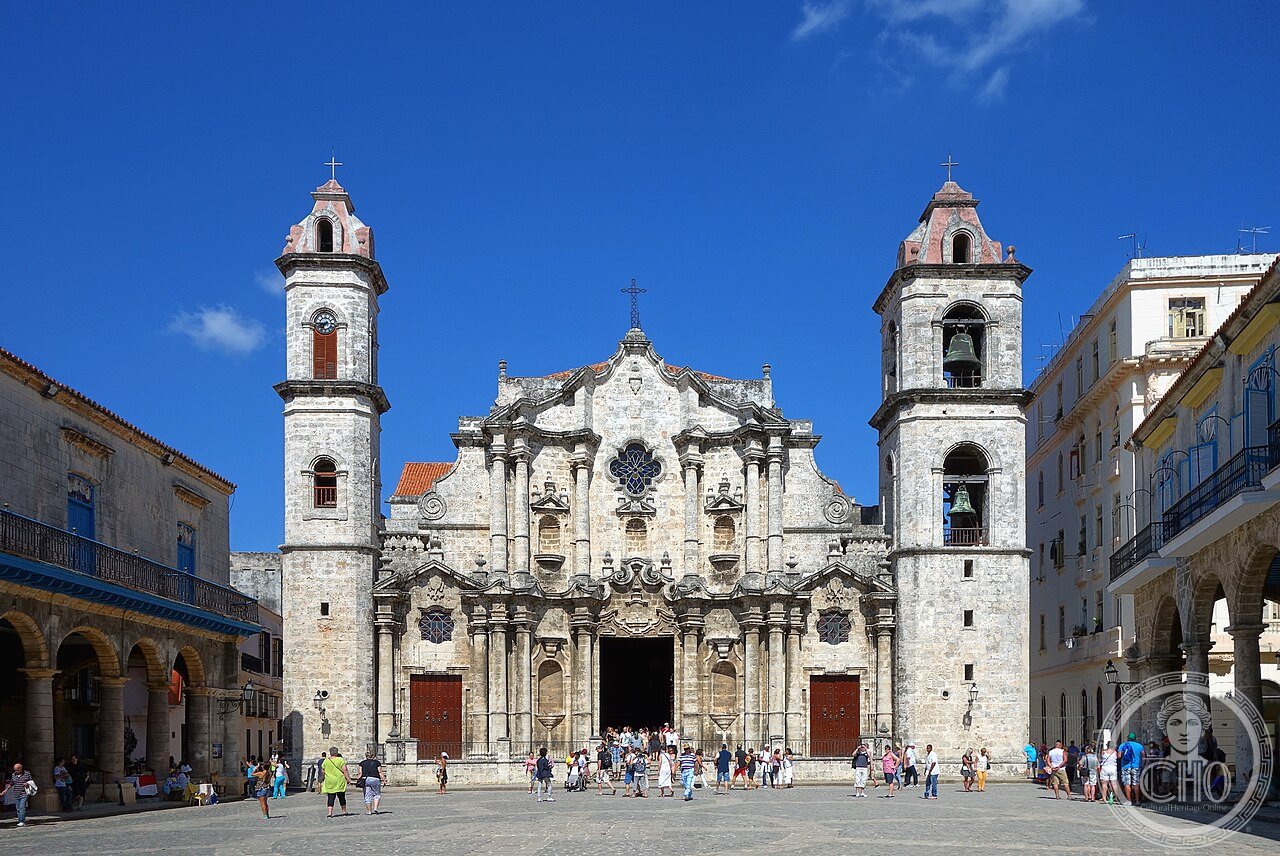
On the Plaza de la Catedral, in the heart of Old Havana, the Jesuits began building the cathedral in 1748, on the site of an earlier building; the work went on, after the Jesuit order was expelled from Spanish territories in 1767, under the direction of the secular clergy, until its completion in 1777 and consecration in 1782. The building formally became an episcopal seat in the second half of the 1780s, though the sources do not agree on the exact year. Built of coral stone blocks, the cathedral is considered the most famous example of Cuban Baroque, known above all for its asymmetrical facade with two bell towers of different height: the Cuban writer Alejo Carpentier described it as “music set in stone”. Between 1795 and 1796, after Spain ceded Santo Domingo to France, what were believed to be the remains of Christopher Columbus were moved here from the cathedral of Santo Domingo, staying in Havana until 1898, when, after Cuban independence, they were moved again, this time to Seville, where they rest today. The authenticity of those remains is still disputed, since Santo Domingo also claims to hold the admiral’s true remains. Since 1982 the cathedral has been part of the UNESCO World Heritage of Old Havana and its fortifications.
About Havana Cathedral
Havana Cathedral, on the Plaza de la Catedral in the heart of Old Havana, began construction under the Jesuit order in 1748, on the site of an earlier building; work continued, following the 1767 expulsion of the Jesuits from Spanish territories, under secular clergy direction, reaching completion in 1777 and consecration in 1782. The building formally became a cathedral, seat of its own diocese, in the late 1780s, though sources disagree on the exact year. Built of coral stone, the cathedral stands as the most celebrated example of Cuban Baroque architecture, renowned above all for its distinctive asymmetrical facade, framed by two bell towers of unequal height and design — a feature that inspired the Cuban writer Alejo Carpentier’s frequently cited description of the building as “music turned to stone.” Between 1795 and 1796, following Spain’s cession of Santo Domingo to France, what were believed to be the remains of Christopher Columbus were transferred here from Santo Domingo Cathedral, remaining in Havana until 1898, when, following Cuban independence, they were moved once again, this time to Seville, Spain, where they rest today. The authenticity of those remains stays genuinely disputed, since Santo Domingo Cathedral also claims to hold the admiral’s true remains, and a 2024 DNA study on the Seville remains, while widely reported as confirmatory, has not settled the matter to universal scholarly satisfaction. Since 1982, Havana Cathedral has formed part of the UNESCO World Heritage Site “Old Havana and its Fortification System,” and it remains today the seat of the Archdiocese of San Cristóbal de La Habana and one of the city’s most visited landmarks.
Key facts
- 1748-1777: construction, begun by the Jesuit order and completed after their 1767 expulsion
- 1782: consecration; formal cathedral status followed in the late 1780s
- Asymmetrical facade with two unequal bell towers, the cathedral’s defining feature
- 1795/96-1898: the cathedral holds what were believed to be Christopher Columbus’s remains
- 1898: the remains relocated to Seville, Spain, following Cuban independence
- 1982: the cathedral becomes part of the UNESCO World Heritage Site “Old Havana and its Fortification System”
History
Havana Cathedral’s transition from Jesuit church to diocesan cathedral, completed only after the sweeping 1767 expulsion of the Jesuit order from the Spanish empire, reflects the broader political upheavals that shaped Catholic institutional life across colonial Spanish America in the 18th century. Its century-long role as the resting place of remains believed to be Christopher Columbus’s placed the cathedral, for a time, at the centre of one of the most enduring disputed legacies in the history of the Americas, a controversy that persists between Havana’s former custodianship, Santo Domingo’s ongoing claim, and Seville’s current possession.
What you see
The cathedral’s coral stone facade, a leading example of Cuban Baroque architecture, is framed by two visibly unequal bell towers, its asymmetry standing in deliberate contrast to the more formal symmetry typical of contemporary Spanish colonial church design. The building faces onto the Plaza de la Catedral, one of Old Havana’s five principal historic squares, surrounded by colonial-era palaces and mansions that together form one of the best-preserved ensembles of Spanish colonial urban architecture in the Caribbean.
Practical information
- Opening hours: generally open daily with seasonal variation; admission fee may apply; check current hours before visiting
- Address: Plaza de la Catedral, Old Havana, Cuba
Getting there
Havana Cathedral stands on the Plaza de la Catedral in the heart of Old Havana, easily reached on foot within the historic district. GPS: 23.1382° N, 82.3511° W.
Nearby
- Plaza de la Catedral — the historic square directly in front of the cathedral
- Palacio del Conde Lombillo — colonial-era mansion on the same square
- Plaza Vieja — another of Old Havana’s historic squares, a short walk away
Sources
- Wikipedia — “Havana Cathedral” (en.wikipedia.org)
- UNESCO World Heritage Centre — “Old Havana and its Fortification System” (whc.unesco.org)
- Lonely Planet — “Catedral de la Habana” (lonelyplanet.com)
Find it on the map
See this place and what’s around it →📷 Become a Cultural Heritage Online photographer
Share your photos of places: they stay published under your name as the author. The more they're seen, the more you get noticed — and soon a contest will reward the most appreciated photos.
Log in or sign up free to add a photo