

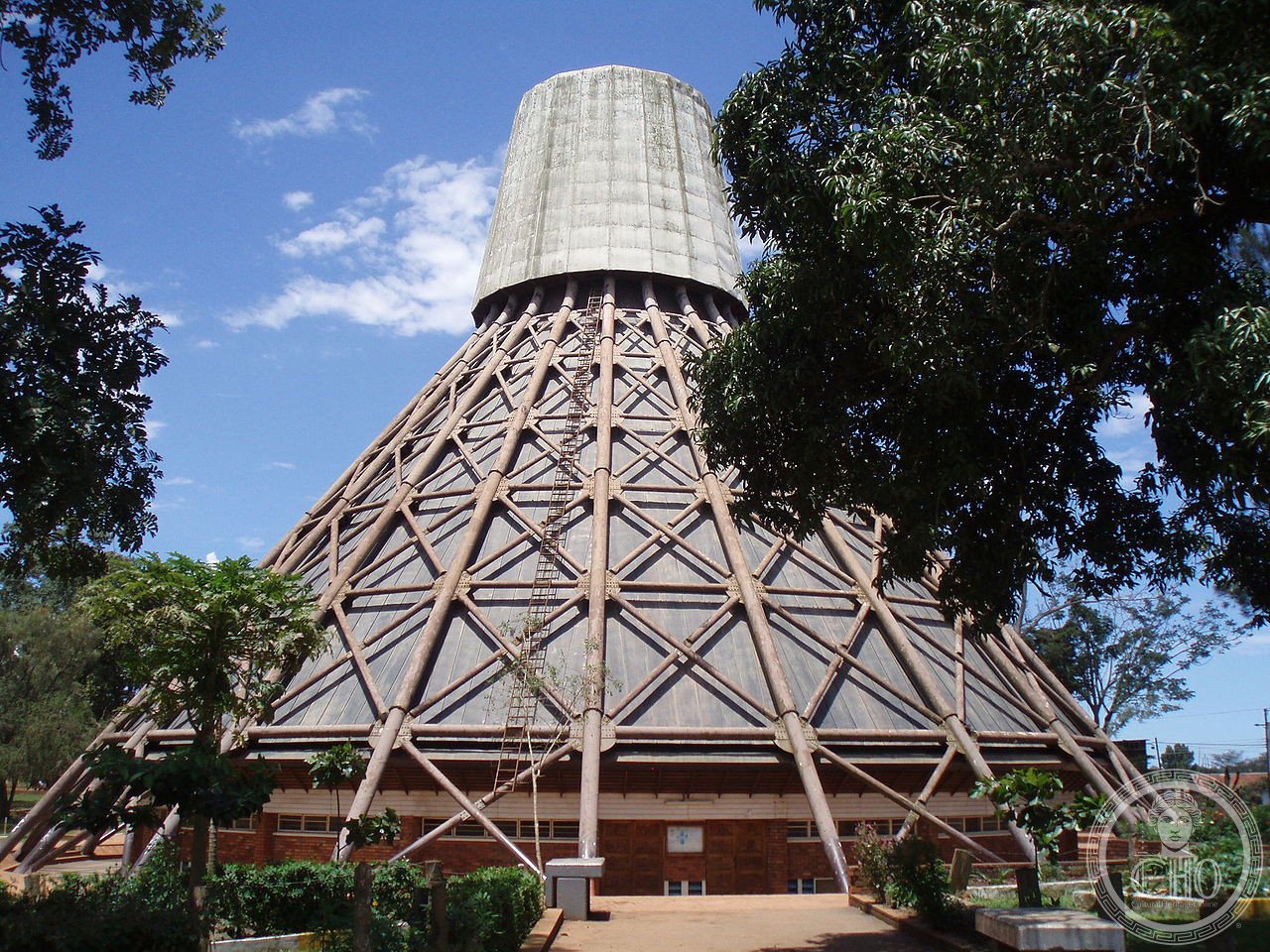
At Namugongo, on the north-eastern edge of Kampala, in Uganda, the Basilica of the Uganda Martyrs stands where, between 1885 and 1887, King (Kabaka) Mwanga II of Buganda had 45 young Christian converts of his court executed. They were 22 Catholics and 23 Anglicans, and they had refused to renounce their faith. The high point was the great mass execution of 3 June 1886 at Namugongo, where several converts were burned alive; how many died there that day exactly varies from source to source and cannot be stated with certainty. The Catholic martyrs were beatified in 1920 by Pope Benedict XV and canonised on 18 October 1964 by Pope Paul VI, becoming the first saints of sub-Saharan Africa. The 23 Anglican martyrs are venerated by the Church of Uganda and by the Anglican Communion, though without a process of canonisation comparable to the Catholic one. The Catholic basilica has a distinctive circular plan, some 42 metres across, inspired by the traditional Baganda hut, with a conical roof and 22 pillars for the 22 Catholic martyrs. It was designed by the architect Justus Dahinden and built between the mid Sixties and the mid Seventies of the twentieth century: the sources do not agree on the exact start and finish, giving variously 1965-1968 or 1967-1975. Pope John Paul II raised it to the rank of minor basilica during his visit of 7 February 1993, and it is administered today by the Catholic archdiocese of Kampala. Three popes have come here on pilgrimage. Paul VI came on 2 August 1969, five years after canonising the martyrs, and consecrated the altar of the still unfinished shrine. John Paul II came in 1993. Francis came on 27-28 November 2015, for the fiftieth anniversary of the canonisation, and also visited the nearby Anglican shrine of the martyrs, kneeling at the so-called «torture tree» and speaking, together with the Anglican archbishop Stanley Ntagali, of an «ecumenism of blood». The Anglican shrine, run separately by the Church of Uganda, stands a short way from the Catholic basilica. Every year, on 3 June, Martyrs’ Day draws pilgrims on foot from all over Uganda and from neighbouring countries: a Ugandan government report counted around 690,000 pilgrims in 2024, while estimates for later years vary widely from source to source. The site is not on Uganda’s UNESCO Tentative List, but it is officially recorded among the country’s national cultural sites.
About the Basilica of the Uganda Martyrs
In Namugongo, on the northeastern edge of Kampala, Uganda, the Basilica of the Uganda Martyrs stands on the site where, between 1885 and 1887, King (Kabaka) Mwanga II of Buganda had 45 young Christian converts from his royal court executed — 22 Catholic and 23 Anglican — for refusing to renounce their faith. The defining moment was the mass execution of 3 June 1886 at Namugongo, where a number of converts were burned alive; sources disagree on exactly how many died at Namugongo specifically that day, and no single figure can be stated with certainty. The Catholic martyrs were beatified in 1920 by Pope Benedict XV and canonized on 18 October 1964 by Pope Paul VI, becoming the first canonized saints of sub-Saharan Africa; the 23 Anglican martyrs are venerated by the Church of Uganda and the wider Anglican Communion, though without a comparable formal canonization process.
Key facts
- 1885-1887: 45 young Christian converts executed on the orders of King Mwanga II of Buganda.
- 3 June 1886: the principal mass burning takes place at Namugongo.
- 1920: the Catholic martyrs beatified by Pope Benedict XV.
- 18 October 1964: canonized by Pope Paul VI — the first sub-Saharan African saints.
- Built mid-1960s to mid-1970s (exact dates disputed between sources), circular in plan, 22 pillars for the 22 Catholic martyrs.
- 1993: elevated to minor basilica status by Pope John Paul II.
- Visited by three popes: Paul VI (1969), John Paul II (1993), Francis (2015).
History
Built on the ground where dozens of young converts chose execution over renouncing their new faith, the Basilica of the Uganda Martyrs commemorates a persecution that, within less than 80 years, produced the first canonized saints of sub-Saharan Africa. Its history since then — three papal visits and an annual pilgrimage drawing hundreds of thousands of people each 3 June — has made it one of the most significant sites of Catholic and Anglican pilgrimage in Africa.
What you see
The basilica’s circular plan and conical roof, designed by architect Justus Dahinden, deliberately echo the form of a traditional Baganda hut, rising from a base roughly 42 metres in diameter to seat around 1,000 worshippers. Twenty-two pillars supporting the structure represent the 22 canonized Catholic martyrs, while a short distance away the separate Anglican Martyrs’ Shrine, run by the Church of Uganda, honors the 23 Anglican martyrs at a related but administratively distinct site.
Practical information
- Opening hours: generally open daily outside services; check current hours, especially around 3 June pilgrimage dates.
- Address: Namugongo, Kira Municipality, Wakiso District, Uganda, northeast of central Kampala.
Getting there
The basilica lies in Namugongo, roughly 12-17 km northeast of central Kampala depending on route, reachable by car or public transport. GPS: 0°23′07″N, 32°39′05″E.
Nearby
- Anglican Martyrs’ Shrine, Namugongo — the separate Church of Uganda shrine honoring the 23 Anglican martyrs.
Sources
- Wikipedia — “Uganda Martyrs” and “Basilica of the Uganda Martyrs, Namugongo” (en.wikipedia.org).
- Uganda Martyrs Shrine — official site (ugandamartyrsshrine.org.ug).
- Vatican.va — homilies of Paul VI (1969), John Paul II (1993) and Francis (2015) at Namugongo.
Find it on the map
See this place and what’s around it →📷 Become a Cultural Heritage Online photographer
Share your photos of places: they stay published under your name as the author. The more they're seen, the more you get noticed — and soon a contest will reward the most appreciated photos.
Log in or sign up free to add a photo