
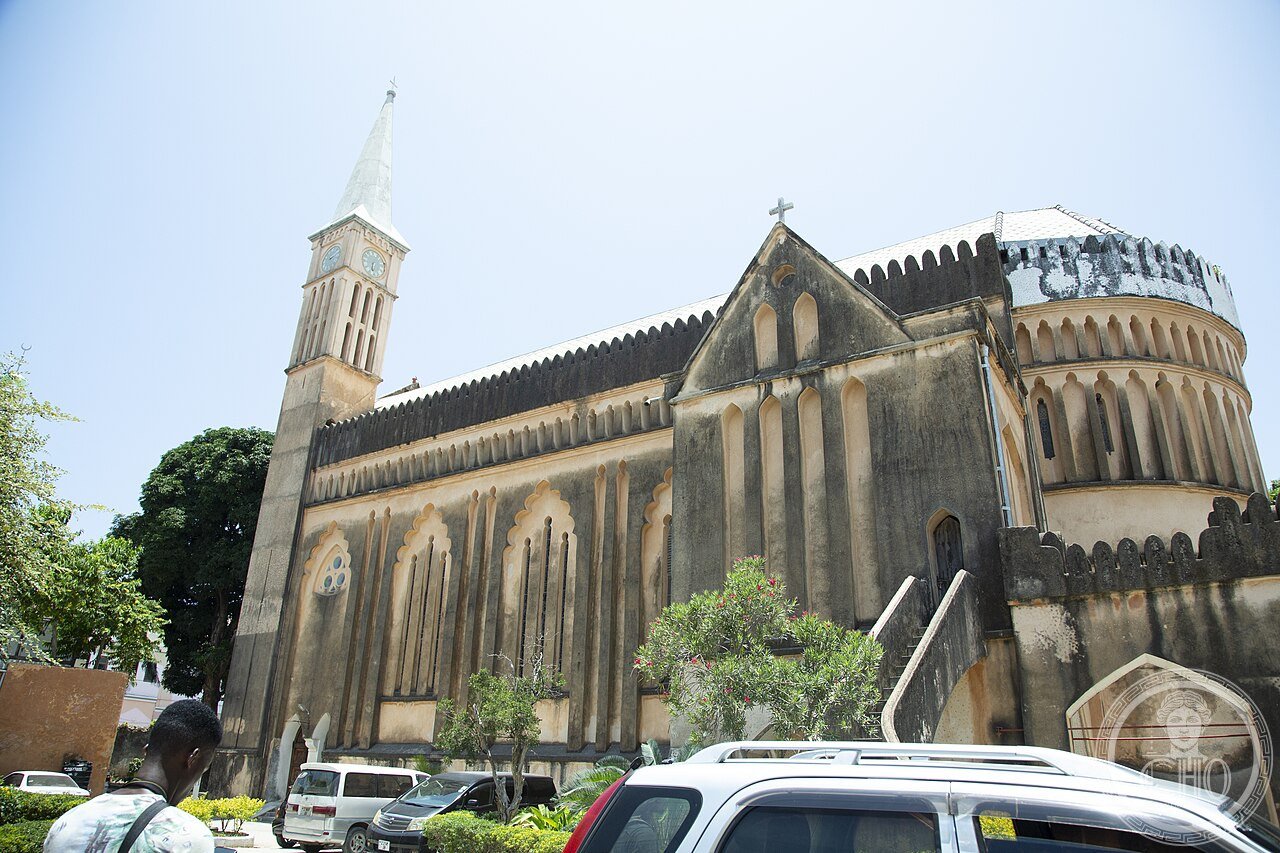
In Stone Town, the historic capital of Zanzibar, in Tanzania, Christ Church Cathedral stands on the site of East Africa’s largest slave market. The market was closed as an open market in 1873, following the decree of Sultan Barghash banning the trade, which was tied to a treaty negotiated with Britain, the Frere Treaty of 5 June 1873. The Universities Mission to Central Africa (UMCA) bought the site that same year. The foundation stone was laid on Christmas Day 1873 and the cathedral opened for worship on Christmas Day 1879, after some six years of work carried out under the inspiration of Bishop Edward Steere, third Anglican bishop of Zanzibar, who is credited with the unusual concrete barrel-vault roof. Some sources give a separate formal consecration as late as 1903, but that date is not confirmed by more than one source and should be treated as uncertain. Steere died shortly before the building was finished and, according to a tradition reported by some sources, is buried behind the altar. The cathedral is built of local coral stone, in a style that joins English perpendicular Gothic to decorative details of Islamic inspiration. It has a rose window and stained glass, a choir ceiling made of mangrove poles (boriti) in the traditional Swahili building technique, and an outer plaster of marble dust in the local technique known as «neeru». According to local and church tradition the high altar was placed exactly where the whipping post of the market stood, and a circle of white marble surrounded by red marble is said to mark the spot. It should be said plainly that this is a traditional siting and a deliberate act of religious commemoration by the builders, not a verified archaeological reconstruction of the exact position of the original post. Inside there is also a wooden cross, kept as a relic, which tradition holds was made from the wood of the Chitambo tree in Zambia, under which the heart of the explorer and missionary David Livingstone was buried in 1873. It is an association handed down with devotion, but no source consulted provides certain documentation of its provenance. Beneath the cathedral are the underground cells once used to hold enslaved people, open today to visitors as part of a commemorative route. Between 2013 and 2016 a major restoration, carried out by the Anglican diocese of Zanzibar together with World Monuments Fund Britain and financed in part by a contribution from the European Union and by funds from the United States embassy for cultural preservation, stabilised the walls and the roof and restored the rose window. In June 2016 the cathedral opened an exhibition centre devoted to the history of the slave trade in East Africa. It remains the active seat of the Anglican diocese of Zanzibar, reorganised in 2001 after a period of weakening that followed the Zanzibar revolution of 1964. It stands inside the UNESCO World Heritage site «Stone Town of Zanzibar», inscribed in 2000 as a historic urban ensemble, of which the cathedral is one of the most significant buildings but not a separate inscription.
About Christ Church Cathedral
In Stone Town, the historic capital of Zanzibar, Tanzania, Christ Church Cathedral stands on the site of East Africa’s largest slave market, closed as an open market in 1873 following Sultan Barghash’s decree banning the trade, tied to a treaty negotiated with Britain (the Frere Treaty, 5 June 1873); the Universities Mission to Central Africa (UMCA) purchased the site that same year. The foundation stone was laid on Christmas Day 1873, and the cathedral opened for worship on Christmas Day 1879, after roughly six years of construction carried out under the inspiration of Bishop Edward Steere, third Anglican bishop of Zanzibar, credited with the unusual concrete barrel-vault roof design; some sources cite a separate, formal consecration as late as 1903, though that date is not confirmed by more than one source and should be treated as uncertain. Steere died shortly before the building’s completion and, according to tradition reported by some sources, is buried behind the altar.
Key facts
- 1873: the open slave market on the site is closed following Sultan Barghash’s decree; the foundation stone is laid on Christmas Day.
- 1879: the cathedral opens for worship on Christmas Day.
- Bishop Edward Steere inspires the design, including its unusual concrete barrel-vault roof.
- The high altar stands, by long tradition, on or near the site of the market’s former whipping post.
- A wooden cross inside is traditionally said to be carved from the tree at Chitambo, Zambia, linked to David Livingstone.
- 2013-2016: major restoration with the World Monuments Fund Britain, EU and US funding support.
- 2000: the cathedral stands within the UNESCO-inscribed Stone Town of Zanzibar historic urban ensemble.
History
Built directly on the ground where East Africa’s largest slave market once stood, and completed just years after the formal closure of that market, Christ Church Cathedral was conceived from the outset as an act of religious and moral reckoning by its Anglican builders. The preserved underground holding cells beneath the building, and the 2016 opening of a dedicated slave-trade heritage exhibit on site, continue that same commemorative purpose into the present day, situating the cathedral as much as a memorial as a place of worship.
What you see
Built of local coral stone in a style blending English Perpendicular Gothic with Islamic decorative details, the cathedral’s most distinctive feature is its concrete barrel-vault roof, unusual for the region and period, alongside a stained-glass rose window, a choir ceiling built from traditional Swahili mangrove-pole (boriti) construction, and exterior plasterwork finished in the local “neeru” technique using crushed marble dust. Inside, a marble circle near the high altar marks, by tradition, the former site of the market’s whipping post, while the wooden cross linked to David Livingstone hangs as one of the cathedral’s most visited relics.
Practical information
- Opening hours: generally open daily to visitors outside services, including access to the underground slave-trade heritage exhibit; check current hours before visiting.
- Address: Mkunazini Road, Stone Town, Zanzibar City, Zanzibar, Tanzania.
Getting there
The cathedral stands on Mkunazini Road in the heart of Stone Town, easily reached on foot from anywhere in the historic quarter. GPS: 6°09′46″S, 39°11′33″E.
Nearby
- Slave Memorial sculpture — a monument to enslaved people in the square adjoining the cathedral.
- Stone Town historic quarter — the wider UNESCO World Heritage urban ensemble surrounding the cathedral.
Sources
- Wikipedia — “Christ Church, Zanzibar” (en.wikipedia.org).
- The Commonwealth Heritage Forum — “Christ Church Cathedral, Stone Town, Zanzibar”
- Episcopal News Service (2016) — “Zanzibar’s Christ Church Cathedral opens slave-trade heritage center”
- UNESCO World Heritage Centre — “Stone Town of Zanzibar” (whc.unesco.org).
Find it on the map
See this place and what’s around it →📷 Become a Cultural Heritage Online photographer
Share your photos of places: they stay published under your name as the author. The more they're seen, the more you get noticed — and soon a contest will reward the most appreciated photos.
Log in or sign up free to add a photo