

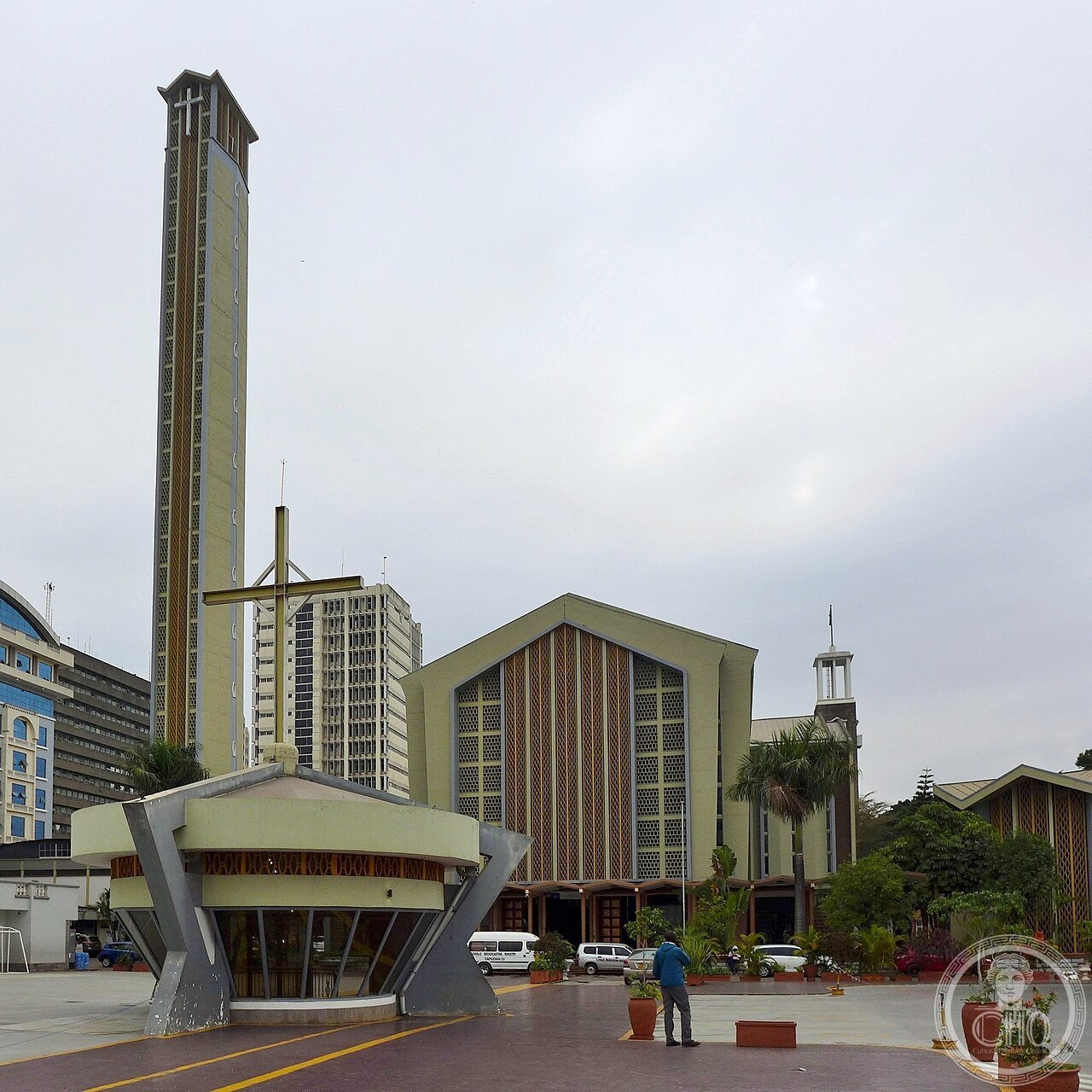
In Nairobi, Kenya, the origins of the Cathedral Basilica of the Holy Family trace to a mission church built in 1904 by Brother Josaphat of the Holy Ghost Fathers (Spiritans), intended to serve Catholic workers on the railway then under construction, and reputed to be Nairobi’s first stone building. The present building’s foundation stone was laid on 29 June 1960 by Archbishop John Joseph McCarthy, first Archbishop of Nairobi, with construction resuming after the slowdown caused by the Mau Mau-era State of Emergency (declared in October 1952 and ending in January 1960). The new cathedral was blessed and opened for worship on 6 July 1963, the same year as Kenyan independence, achieved that December. The architect was Dorothy Hughes (1910-1987), of the United Kingdom, East Africa’s first female architect, of the firm Hughes & Polinghorne, while construction was carried out by the British firm Mowlem. The building, in modernist style, has a single, slender bell tower, not two as sometimes wrongly reported, alongside a low, broad church body on a fan-shaped plan, with abstract, non-figurative stained glass framed in stainless steel, Carrara marble details, eight side chapels and two main halls. The sources do not agree on the exact capacity, given variously as between 3,000 and 4,000 seats. The archdiocese of Nairobi was erected on 25 March 1953, making the Holy Family the archdiocesan cathedral already in the earlier building. The present church was raised to the rank of minor basilica by a pontifical decree of 15 February 1982, signed by the then Cardinal Secretary of State Agostino Casaroli, and formally dedicated on 26 December 1982. Pope John Paul II went there on several occasions, including his first trip to Africa in May 1980 and the visit of 16 August 1985 for the 43rd International Eucharistic Congress held in Nairobi. No visits by Paul VI, who died in 1978, are confirmed, nor a specific stop by Pope Francis at the basilica during his November 2015 trip to Kenya, whose documented Nairobi itinerary does not include it. Today the basilica is the seat of the Catholic archdiocese of Nairobi, led by Archbishop Philip Arnold Subira Anyolo, appointed in 2021. No formal status as a Kenyan national monument is documented in the sources consulted.
About the Cathedral Basilica of the Holy Family
In Nairobi, Kenya, the origins of the Cathedral Basilica of the Holy Family trace to a mission church built in 1904 by Brother Josaphat of the Holy Ghost Fathers (Spiritans), intended to serve Catholic workers on the railway then under construction, and reputed to be Nairobi’s first stone building. The present building’s foundation stone was laid on 29 June 1960 by Archbishop John Joseph McCarthy, first Archbishop of Nairobi, with construction resuming momentum after the Mau Mau-era State of Emergency (declared October 1952) ended in January 1960. The new cathedral was blessed and opened on 6 July 1963, the same year Kenya achieved independence that December. The architect was Dorothy Hughes (1910–1987), East Africa’s first female architect, of the firm Hughes & Polinghorne, with construction carried out by the British firm Mowlem.
Key facts
- 1904: a mission church on the site serves railway workers, reputedly Nairobi’s first stone building.
- 29 June 1960: foundation stone of the present building laid by Archbishop John Joseph McCarthy.
- 6 July 1963: the new cathedral opens, the same year as Kenyan independence.
- Architect Dorothy Hughes, East Africa’s first female architect.
- 15 February 1982: elevated to minor basilica status by papal decree.
- 1980 and 1985: visited by Pope John Paul II, including for the 1985 International Eucharistic Congress.
History
Rising from a modest 1904 mission church built for railway laborers to a modernist cathedral opened in the very year of Kenyan independence, the Holy Family Basilica’s construction timeline is itself woven into the country’s transition from colonial rule, its funding delayed and then resumed as the Mau Mau-era Emergency drew to a close. Its elevation to minor basilica status two decades later, and repeated papal visits in the 1980s, cemented its place as the central church of Kenyan Catholicism.
What you see
A single tall, slender bell tower rises beside a low, fan-shaped nave in a distinctly modernist idiom for its 1960s construction, its abstract, non-figurative stained glass set in stainless-steel frames rather than traditional leaded tracery. Carrara marble detailing, eight side chapels, and two main halls give the interior a scale suited to one of East Africa’s largest Catholic congregations.
Practical information
- Opening hours: generally open daily outside services; check current hours before visiting.
- Address: Koinange Street / City Hall Way, Nairobi CBD, Kenya.
Getting there
The basilica stands in central Nairobi near City Square, within easy walking distance of the city’s main government and commercial district. GPS: 1°17′14″S, 36°49′13″E.
Nearby
- Nairobi City Hall — a short walk away in the central government district.
Sources
- Wikipedia — “Cathedral Basilica of the Holy Family, Nairobi” and “Dorothy Hughes (architect)” (en.wikipedia.org).
- GCatholic.org — church record and basilica decree date.
- Vatican.va — John Paul II arrival address, Nairobi, 16 August 1985.
Find it on the map
See this place and what’s around it →📷 Become a Cultural Heritage Online photographer
Share your photos of places: they stay published under your name as the author. The more they're seen, the more you get noticed — and soon a contest will reward the most appreciated photos.
Log in or sign up free to add a photo