
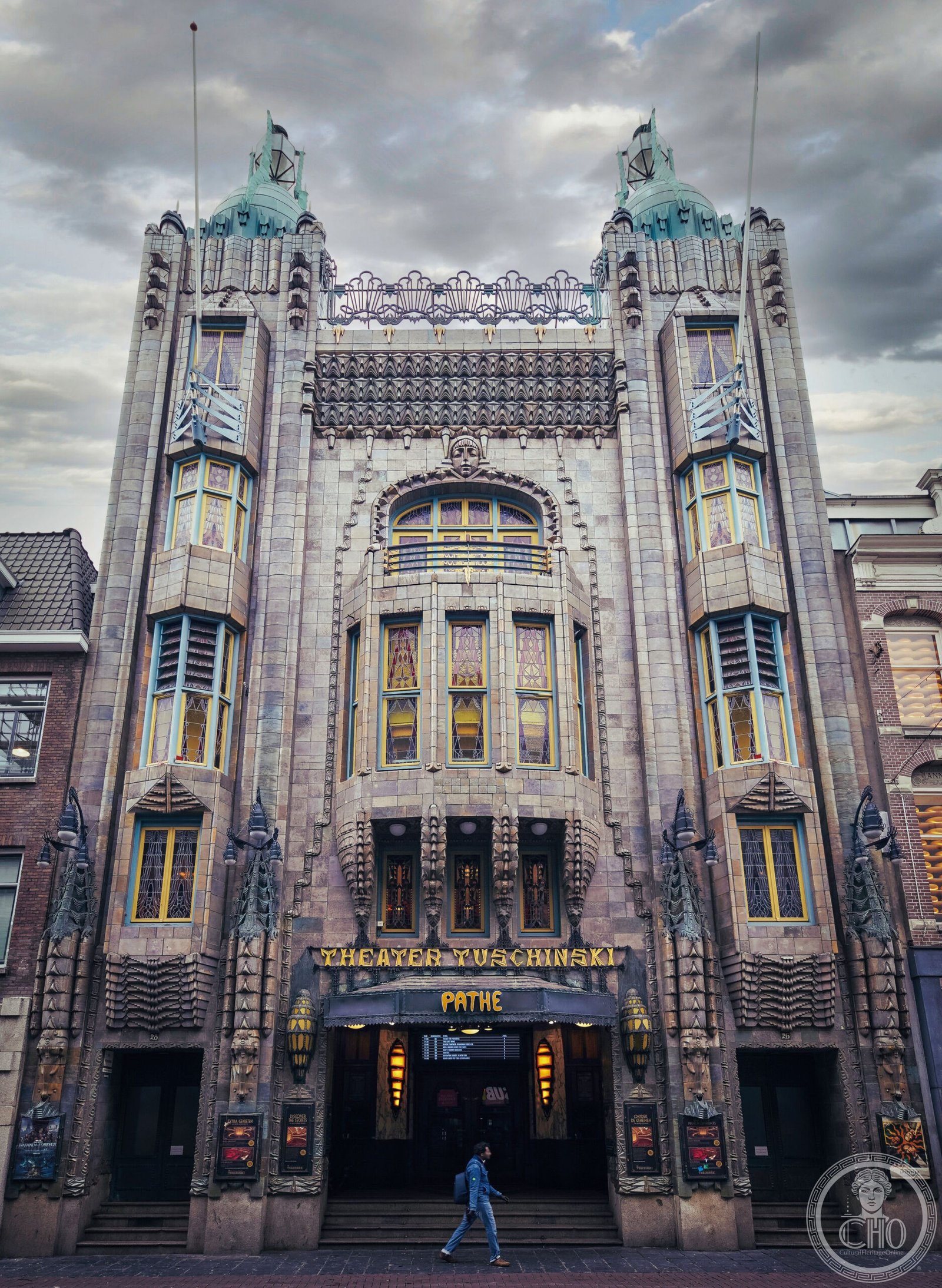
A picture palace built as a deliberate fantasy, where Amsterdam School brickwork, Art Deco and Jugendstil collide in one extravagant interior.
At a glance
The Tuschinski opened in 1921 on the narrow Reguliersbreestraat, the dream of the Polish-born cinema impresario Abraham Icek Tuschinski. Designed by Hijman Louis de Jong, it fuses the brick expressionism of the Amsterdam School with Art Deco and Jugendstil ornament, and remains one of the most lavish early cinemas in Europe. The twin-towered façade, the hand-knotted carpet, the murals and the great organ have all been restored, and the building still works as a cinema, run today by Pathé. In 2021, on its centenary, it received royal status as the Koninklijk Theater Tuschinski.
Key facts
- Architect: Hijman Louis de Jong
- Opened: 28 October 1921
- Style: Amsterdam School with Art Deco and Jugendstil
- Founder: Abraham Icek Tuschinski
- Status: Working cinema (Pathé); royal title since 2021
- Address: Reguliersbreestraat 26–34, Amsterdam
History
Tuschinski had already run cinemas in Rotterdam before he set out to build a flagship in Amsterdam. He spared no expense: the most skilled decorative artists of the day worked on the interior, and the carpet was woven specially for the building. The result, opened in 1921, was less a cinema than a theatrical experience that began the moment a visitor crossed the threshold.
Tuschinski himself was murdered at Auschwitz in 1942, and the cinema was renamed during the German occupation before reverting to his name after the war. Restored in 1998–2002 and again in 2019–2020, it received royal status on its hundredth birthday.
What you see
The western façade rises in two towers framed by ceramic sculpture and leaded-glass windows, a piece of brick fantasy that stands out sharply on a tight commercial street. The composition refuses to settle on a single style, and that is the point.
Inside, the foyer was designed to make visitors feel they were stepping into an illusion: deep colours, exotic patterning and indirect light. The main auditorium keeps its original organ and stage alongside the screen, and recovered murals by Pieter den Besten have been returned to a second hall.
Practical information
- A working cinema; the simplest way to see the interior is to buy a ticket to a film.
- Guided tours of the building are offered at selected times.
- The foyer can be glimpsed from the entrance during opening hours.
Getting there
Address: Reguliersbreestraat 26–34, Amsterdam. The cinema is steps from Rembrandtplein and a short walk from Muntplein; Rembrandtplein and Munt tram stops are the closest, and the canal belt is all around.
Nearby
- Rembrandtplein and its cafés
- The Flower Market (Bloemenmarkt) on the Singel
- The Munttoren and the southern canal belt
Sources
- Rijksmonument register (Rijksdienst voor het Cultureel Erfgoed)
- Koninklijk Theater Tuschinski / Pathé
- Wikipedia: Pathé Tuschinski
Find it on the map
See this place and what’s around it →Record researched and written by Luigi De Marchi for Cultural Heritage Online, 2026.
📷 Become a Cultural Heritage Online photographer
Share your photos of places: they stay published under your name as the author. The more they're seen, the more you get noticed — and soon a contest will reward the most appreciated photos.
Log in or sign up free to add a photoIs this page about you?
This page is read by travellers and heritage enthusiasts who find it on Google. Tell us how you are connected to this place and we will take it from there.