
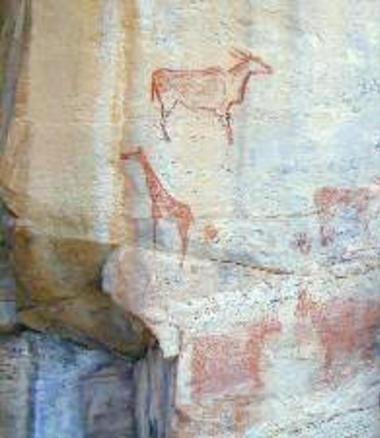
Four sacred quartzite hills rising from the Kalahari desert, bearing over 4,500 San rock paintings created across 20,000 years on surfaces still venerated today.
At a glance
In the remote northwest of Botswana, near the Namibian border, four rocky outcrops — the Male Hill (1,400 m), the Female Hill, the Child Hill, and a nameless fourth — rise dramatically from the flat Kalahari sand sheet, surrounded by desert scrub and acacia. For the San (Bushman) people, who have lived around these hills for perhaps 100,000 years, this is not a landscape: it is a living spiritual being. The Male Hill is the home of the first spirit who created all living things; the Female Hill is his wife. Offerings and prayers are still left in the cave beneath the Male Hill.
UNESCO inscribed Tsodilo in 2001, calling it a “monument of human spiritual and creative achievement.” Some 4,500 individual paintings cover the rock surfaces, painted over an unbroken span from approximately 20,000 BC to the 17th century AD. Annual visitors number only in the low thousands; reaching the site requires a 4WD vehicle and hours on sand tracks from Maun.
Key facts
- 4,500+ individual paintings recorded — the densest concentration of San rock art in the world
- Timespan: c. 20,000 BC to the 17th century AD — continuous use across 20 millennia
- Four hills: Male (1,400 m), Female, Child, and a nameless fourth outcrop
- Oldest possible ritual object: a python-shaped rock with deliberate cut grooves estimated at approximately 70,000 years old — potentially the oldest known ritual behaviour on earth
- Animals depicted: giraffe, eland, rhino, hippopotamus, and even penguin
- UNESCO World Heritage Site since 2001
- Access: 4WD only; approximately 3–4 hours on sand tracks from Maun
History and significance
Human presence at Tsodilo begins in the Middle Stone Age, perhaps 100,000 years ago. The site has been continuously significant to successive groups: Middle Stone Age foragers, Later Stone Age San communities who painted the rock panels over thousands of years, Iron Age farmers who arrived roughly 1,000 years ago, and modern San communities whose oral traditions preserve detailed interpretations of the paintings.
In 2006, archaeologist Sheila Coulson reported a chamber in a cave on the Male Hill containing a python-shaped rock — some 6 metres long — with approximately 400 deliberately cut notches and evidence of burning nearby. The team interpreted this as evidence of a ritual approximately 70,000 years old, potentially the oldest known ritual behaviour on earth, predating the cave art of Europe by 30,000 years.
The rock paintings are attributed to San artists working within a shamanic tradition. Therianthropic figures (part human, part animal) and geometric entoptic patterns represent visions experienced during trance states. The eland appears repeatedly and holds particular spiritual significance. The rhino panels are among the oldest known figurative paintings in Africa.
What you see
Tsodilo is not a single-entrance site: the hills spread across several kilometres and paintings are distributed across hundreds of panels. The Female Hill has the greatest concentration of accessible art, including the painted panels trail. The Male Hill is sacred and requires permission to ascend. The paintings are rendered in iron oxides (red, yellow, orange), white kaolin, and manganese black on quartzite surfaces, many superimposed layer upon layer across centuries.
The site has a small visitor centre and community campsite; San community members serve as mandatory guides. A small museum is housed in the visitor centre.
Practical information
- Entry fee: Yes, paid at the visitor centre; guides are mandatory
- Best time to visit: May to September (dry season); roads are impassable in wet season (November–March)
- Duration: At minimum half a day for the Female Hill trail; a full day for multiple hills
- Camping: Community campsite available on-site
- No mobile signal on-site; emergency radio contact via visitor centre
Getting there
Tsodilo is approximately 500 km northwest of Gaborone and about 70 km from the nearest town, Shakawe. Fly or drive to Maun, then drive north past Sehithwa and Tsau, turning west on a sandy track — roughly 3 to 4 hours of 4WD driving from Maun. GPS coordinates are essential; the track is unmarked in places. Small charter flights can reach the Tsodilo airstrip from Maun.
Nearby
- Okavango Delta (~250 km southeast) — UNESCO World Heritage Site and one of the greatest wildlife areas on earth
- Drotsky Caves (Gcwihaba Caverns) (~100 km east) — extensive limestone cave system associated with San mythology
- Shakawe fishing lodges (~70 km north) — on the Okavango River, popular for birdwatching and fishing
Sources
- UNESCO World Heritage: Tsodilo — World Heritage List
- Coulson, S. et al. (2011): World Oldest Ritual Site? The Snake Rock of Tsodilo Hills — Nyame Akuma
- Lewis-Williams, J.D. (2002): The Mind in the Cave — Thames & Hudson
- Wikipedia: Tsodilo
- Botswana Tourism Organisation: botswanatourism.co.bw
Find it on the map
See this place and what’s around it →📷 Become a Cultural Heritage Online photographer
Share your photos of places: they stay published under your name as the author. The more they're seen, the more you get noticed — and soon a contest will reward the most appreciated photos.
Log in or sign up free to add a photo