
A megalithic city carved entirely from living volcanic rock on a Rhodope Mountain peak, continuously occupied for 8,000 years — site of the ancient oracle of Dionysus that reportedly prophesied the destiny of Spartacus.
At a glance
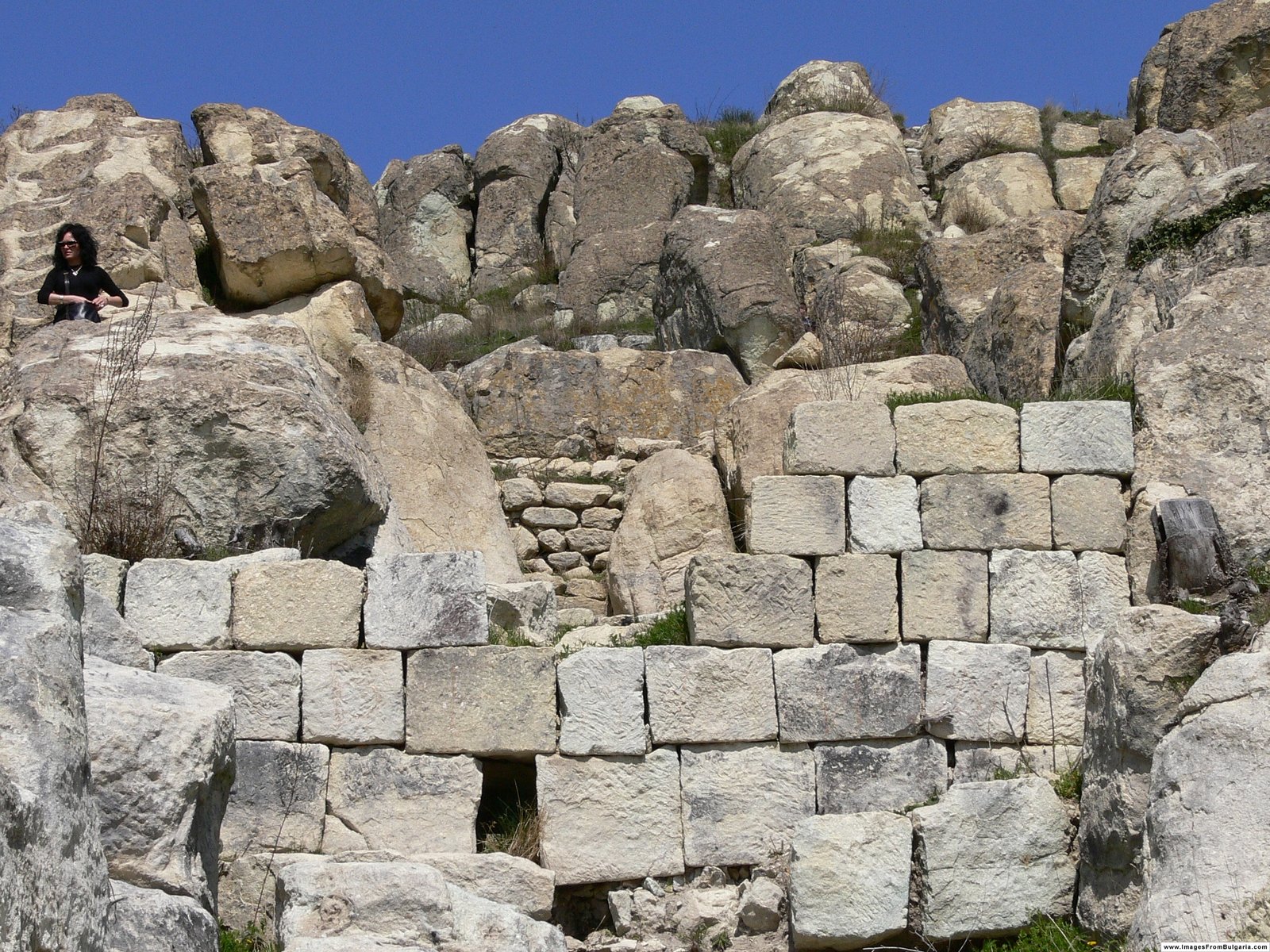
On a rocky peak 470 metres above the Rhodope Mountains of southern Bulgaria, near the town of Kardzhali, an entire city was carved from the living rhyolite rock — the orange-red volcanic stone that composes the entire hill. Rooms, courts, altars, streets, and staircases were cut directly into the rock face over thousands of years, not built on top of it, accumulating from approximately 6000 BC to the 14th century AD. Perperikon is thus one of the longest continuously occupied sites in Europe.
The most important feature is a circular ceremonial area at the summit with a large rock-cut wine vat and circular altar platform, identified by leading excavator Nikolay Ovcharov as the sanctuary of Dionysus — famous in the ancient world for an oracle that made prophecies by observing wine burning on the altar. The most celebrated prophecy attributed to this site was made for Spartacus, the Thracian rebel who would lead the greatest slave revolt in Roman history.
Key facts
- Occupation span: c. 6000 BC to 14th century AD — approximately 7,400 years of continuous habitation
- Construction method: carved entirely from living rhyolite rock, not built on top of it
- The Spartacus prophecy: ancient sources record that Dionysus priests here prophesied that Spartacus would achieve great power ending in catastrophe — confirmed by history
- Successive occupants: Thracians, Greeks, Romans, Byzantines, First and Second Bulgarian Kingdoms, medieval
- Active excavations: ongoing every summer since 2000, led by archaeologist Nikolay Ovcharov
- Elevation: 470 m above sea level in the Rhodope Mountains
- Distance from Kardzhali: approximately 15 km
History and the oracle
The earliest human activity at Perperikon dates to the Chalcolithic (Copper Age), around 6000 BC, when the distinctive rhyolite peak was already attracting settlers. Through the Bronze Age and into the Iron Age, the Thracian inhabitants developed the summit into an increasingly elaborate ceremonial complex. The circular rock-cut altar area is associated by archaeologists with the Thracian cult of Dionysus, which was fundamentally connected to wine, prophecy, and ecstatic ritual.
The oracle of Dionysus at Perperikon is mentioned by several ancient sources, including references preserved by Plutarch. The most famous story concerns Spartacus — the Thracian gladiator who escaped from a training school in Capua in 73 BC and led the Third Servile War, in which enslaved people across Italy rose in revolt against Rome. According to Plutarch, when Spartacus was in Thrace assembling his followers before the revolt, the priests of Dionysus prophesied that “great and formidable power would attend him, but would come to a sad conclusion” — a remarkably accurate summary of a war that for two years threatened Rome before ending in the crucifixion of thousands along the Appian Way.
After the Roman conquest of Thrace, the site continued as a religious and administrative centre. The Byzantines built a palace and church complex at the summit, partially reconstructed today. The site was contested between Bulgarian and Byzantine rulers through the medieval period, finally abandoned in the 14th century during the Ottoman conquest.
What you see
The summit of the hill is a extraordinary landscape of carved rock: flat surfaces, cut channels, rooms without roofs, stairways descending into the hillside, and the central circular altar area with its large wine-pressing vat (rhyton). Everything is orange-red rhyolite, carved rather than built. Walking through the complex, the absence of transported stone is striking — every feature emerged from the hill itself.
At the summit, the partially reconstructed Byzantine palace and church give a sense of the medieval phase. Ongoing excavation trenches are visible throughout; finds of ceramics, bronze objects, coins, and carved stone elements are displayed at the site museum in Kardzhali. The views across the Rhodope valleys from the peak are dramatic.
Access involves a walk from the car park up the hill; the path is uneven but manageable. The site is open year-round, though summer is when active excavations are most visible.
Practical information
- Entry fee: Yes; site museum in Kardzhali has separate admission
- Opening hours: Typically 9:00–18:00 daily in summer; reduced hours or closure in winter
- Duration: 1–2 hours at the site; add time for the Kardzhali museum
- Active excavations: visible in summer months
- Terrain: rocky and uneven; sturdy footwear recommended
Getting there
Perperikon is approximately 15 km northeast of Kardzhali in southern Bulgaria, near the village of Gorna Krepost. From Kardzhali, take the road towards Momchilgrad; signs for Perperikon are marked. The site has a car park. Kardzhali is accessible by bus from Plovdiv (approximately 2 hours) and Sofia (approximately 4 hours). There is no direct public transport to the site itself; taxis from Kardzhali are the practical option without a car.
Nearby
- Kardzhali Archaeological Museum (~15 km) — houses the main finds from Perperikon and other Rhodope sites
- Kardzhali Reservoir (~10 km) — large artificial lake in the Rhodope foothills, scenic and popular for birdwatching
- Rock Phenomenon Pobiti Kamani (~60 km northwest) — natural stone forest, one of the most photographed landscapes in Bulgaria
Sources
- Ovcharov, N. (2004 onwards): Perperikon excavation reports — National Archaeological Institute, Bulgarian Academy of Sciences
- Plutarch: Life of Crassus — ancient source on the Spartacus prophecy
- Wikipedia: Perperikon
- Kardzhali Museum: museum-kardzhali.com
- Bulgaria Travel: Bulgaria Travel — Perperikon
Find it on the map
See this place and what’s around it →📷 Become a Cultural Heritage Online photographer
Share your photos of places: they stay published under your name as the author. The more they're seen, the more you get noticed — and soon a contest will reward the most appreciated photos.
Log in or sign up free to add a photo