
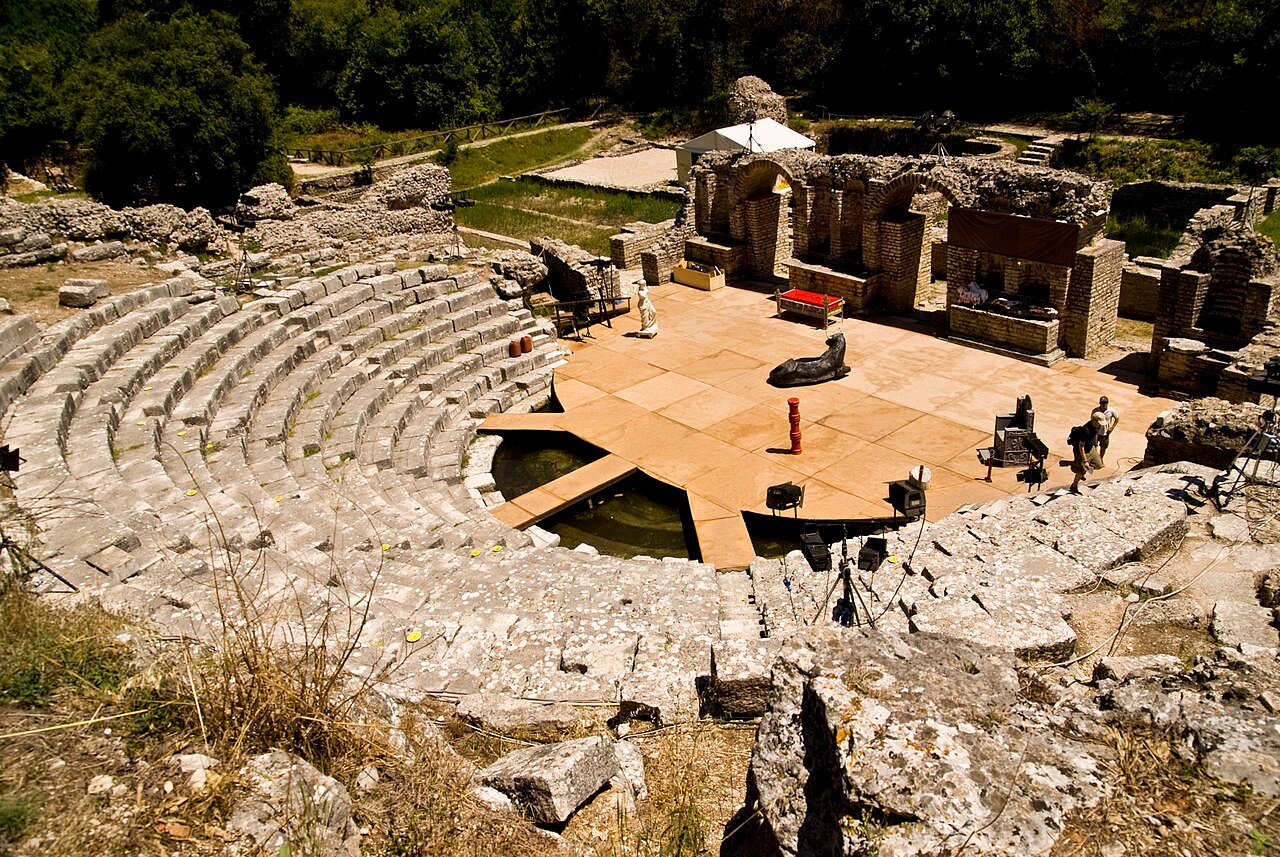
On a small peninsula in the lagoon between Albania and Corfu, the ancient city of Butrint offers the most complete stratification of Western history in a single compact site: 2,700 years of occupation, from a Greek sanctuary to a Venetian castle, every era excavated and visible.
At a glance
Butrint (Greek: Bouthroton; Roman: Buthrotum; Albanian: Butrint) is a UNESCO World Heritage Site since 1992 on the Butrint peninsula in southern Albania, separated from the Greek island of Corfu by the Vivari Channel. The site offers a vertical cross-section of Western civilisation: a 7th-century BC Greek sanctuary, a 4th-century BC theatre, Roman monumental buildings, a 5th-century Christian baptistery with an extraordinary mosaic floor, Byzantine walls, and a Venetian castle — all within a compact area of approximately 25 hectares now protected as a national park. Each era built upon or around the preceding one, creating a physical palimpsest of history unique in the Mediterranean.
Key facts
- Period: c. 7th century BC to 19th century AD (2,700 years continuous occupation)
- UNESCO WHS: inscribed 1992
- Area: approximately 25 hectares of excavated site, within a larger national park
- Key monuments: Greek theatre (4th-3rd c. BC), baptistery mosaic (5th-6th c. AD), Venetian castle (15th-16th c.)
- Excavation: Italian archaeologists from 1920s; ongoing international team
- Notable visitor: Lord Byron (1809), described view as “most beautiful in the world”
History
The earliest phase at Butrint is a sanctuary to Asclepius (the Greek god of healing) established on the hilltop in the 7th century BC, most likely by colonists from Corinth. The site grew into a substantial Greek city by the 4th-3rd centuries BC, constructing a theatre whose lower rows and orchestra survive in remarkable condition.
Roman conquest came in the 1st century BC. Both Julius Caesar and Augustus considered Butrint important: Caesar planned a veteran colony here; Augustus actually established one. The Romans added a forum, baths with polychrome mosaic floors, a triumphal arch, and an aqueduct that carried fresh water from nearby springs. The city reached its peak population of perhaps 10,000-15,000 in the 1st-2nd centuries AD.
In the 5th-6th centuries AD, Christianity transformed the site. A large basilica was built, and adjacent to it the baptistery that would become Butrint’s most famous monument: a circular building whose floor was covered with approximately 150 square metres of mosaic depicting geometric patterns and animals — birds, fish, deer, hunting scenes — executed in extraordinary detail. This is the largest surviving mosaic floor in Albania.
Byzantine towers and walls consolidated the defences through the medieval period. Venice seized Butrint in 1386 and built a castle and triangular tower that still stand above the ruins. The Ottomans took the site in 1799 and held it until Albanian independence in 1912. The population had long since moved to the opposite shore; Butrint had been abandoned to swamp and forest, which paradoxically preserved it. Italian archaeologists began excavations in the 1928 under Luigi Maria Ugolini; a Mussolini-era interest in demonstrating Roman imperial heritage funded the first major campaign.
What you see
From the entrance, a boardwalk path winds through dense forest past the key monuments in rough chronological order. The Greek theatre (4th-3rd century BC) retains its semicircular orchestra and lower seating rows; performances are still occasionally staged here. The Lion Gate, an impressive carved portal, leads toward the upper city.
The forum and Roman baths preserve mosaic floors in a modest roofed shelter. The baptistery is the emotional centrepiece: a round room whose extraordinary mosaic floor — birds, fish, hunting scenes in geometric frames — is viewed through a glass walkway that protects the surface while allowing it to be studied at close range. The adjacent basilica gives scale to the early Christian phase.
The Venetian castle (Triangular Castle) crowns the hill and gives panoramic views across the Vivari Channel toward Corfu, over the lagoon, and across the archaeological zones. The sheer density of visible strata — Greek wall beneath Roman wall beneath Byzantine tower beneath Venetian parapet — is the experience unique to Butrint.
Practical information
Butrint National Park is open year-round. Entry includes access to all excavated areas and the Venetian castle. Guided tours in English are available at the site entrance. The visit takes 2-3 hours minimum for a thorough exploration; allow a full day if using the ferry crossing to explore the lagoon side. The site involves uneven terrain and some climbing to the castle; comfortable shoes essential. A small museum near the entrance displays finds from the excavations.
Getting there
Butrint is located 18 km south of Sarande, the main city on Albania’s “Riviera” coast. From Sarande, take a taxi (approximately 20-25 minutes) or the occasional local bus toward Ksamil and Butrint. Sarande has ferry connections to Corfu (45 minutes) and bus connections to Gjirokaster (1 hour) and Tirana (5-6 hours). Many visitors combine Butrint with a day-trip from Corfu — the ferry crossing to Sarande and a taxi to Butrint can be done in a single day.
Nearby
- Ksamil — beach resort village with clear Ionian water, 4 km north of Butrint
- Sarande — the main coastal city, 18 km north, with ferry link to Corfu
- Gjirokaster — UNESCO-listed Ottoman city (the “City of Stone”) 70 km inland, birthplace of Enver Hoxha and Ismail Kadare
- Corfu (Greece) — the Greek island visible across the channel, accessible by 45-minute ferry from Sarande
Sources
- Ugolini, Luigi Maria. Albania Antica I: Ricerche Archeologiche. 1927.
- Hodges, Richard (ed.). Butrint 1: Excavations at the Triconch Palace. Oxbow Books, 1997.
- Butrint Foundation — butrintfoundation.org — ongoing excavation reports.
- UNESCO World Heritage List: “Butrint” — whc.unesco.org.
- Wikipedia: “Butrint” — sources and references.
Find it on the map
See this place and what’s around it →📷 Become a Cultural Heritage Online photographer
Share your photos of places: they stay published under your name as the author. The more they're seen, the more you get noticed — and soon a contest will reward the most appreciated photos.
Log in or sign up free to add a photo