
Tsingy de Bemaraha

Tsingy de Bemaraha Madagascar limestone needles pinnacles karst UNESCO World Heritage
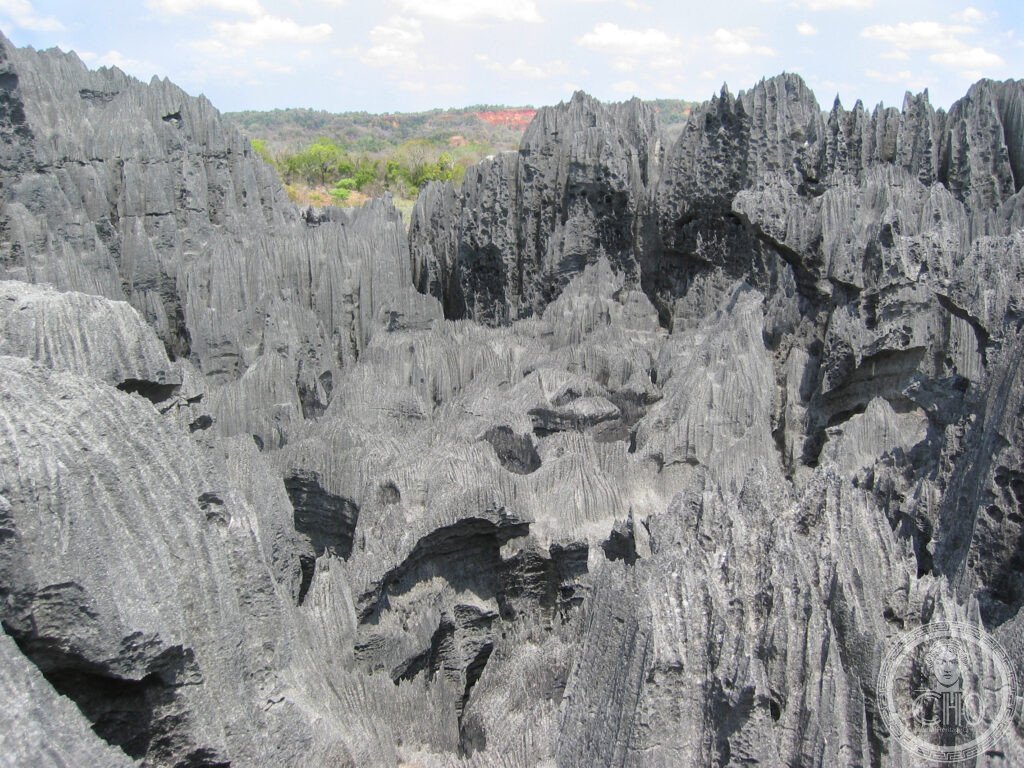
The Grand Tsingy of the Tsingy de Bemaraha Strict Nature Reserve (the razor-sharp limestone pinnacles (tsingy) of the Bemaraha plateau; the needles of grey limestone rising 30-50 metres from the karst surface; the narrow passages and canyons between the pinnacles; the aerial bridges and rope ladders of the Tsingy circuit for visitors; the white limestone against the blue sky; the dense dry deciduous forest growing in the protected depressions between the tsingy pinnacles; a Decken’s sifaka (Propithecus deckenii) visible on the limestone face), Bekopaka, Melaky Region, Madagascar. UNESCO World Heritage Site 1990. Photo via Wikimedia Commons.
Melaky Region, western Madagascar · 152,000 hectares of razor-sharp limestone pinnacles; “where one cannot walk barefoot” (Malagasy); Decken’s sifaka; UNESCO WHS 1990; the most difficult UNESCO site to reach in Africa

Tsingy de Bemaraha

The most alien-looking landscape in Africa and the most difficult UNESCO World Heritage Site to reach on the continent — the Tsingy de Bemaraha Strict Nature Reserve and National Park (Melaky Region, western Madagascar; 152,000 hectares; UNESCO WHS 1990) consists of a vast forest of razor-sharp limestone pinnacles (tsingy — the Malagasy word means “where one cannot walk barefoot”) formed over 200 million years of karst dissolution.

At a glance

Tsingy de Bemaraha (the most precisely Tsingy single 152000 hectares limestone pinnacles 30-50m karst razor-sharp Madagascar Jurassic 200 million years erosion dissolution UNESCO heritage: the formation of the tsingy: the limestone of the Bemaraha plateau was laid down during the Jurassic period (approximately 200-145 million years ago) as marine sediment; subsequent tectonic uplift raised the limestone above sea level; then the erosion process created the tsingy — the combination of rainwater (slightly acidic; dissolving the limestone along fracture lines and bedding planes) and the tropical climate (warm, seasonal rainfall; intense dry seasons) over millions of years progressively dissolved the limestone along its joints, creating the pinnacle landscape; the pinnacles of the Grand Tsingy (the northern section of the reserve; the most dramatic; the most visited) rise 30-50m above the karst floor; the edges of the pinnacles are genuinely razor-sharp — they can cut leather; the Malagasy name for the landscape (tsingy = “where one cannot walk barefoot”) is literally accurate; the pinnacles are too close together to walk between in most areas; the visitor circuits require climbing harnesses, fixed ropes, and aerial bridges — the most precisely Tsingy single 152000 hectares limestone pinnacles 30-50m karst razor-sharp Madagascar Jurassic 200 million years erosion dissolution UNESCO heritage in any UNESCO world heritage site; the endemic wildlife (the most precisely Tsingy single Decken sifaka lemur Propithecus deckenii 7 lemur species Malagasy bat cave fish cave crab UNESCO heritage: the tsingy habitat has produced extraordinary endemic wildlife: the wildlife adapted to the limestone: 7 species of lemur (including Decken’s sifaka (Propithecus deckenii) — a large, white-furred lemur with tan markings; the sifaka leaps between the tsingy pinnacles with extraordinary agility, using all four limbs to cling to the vertical limestone surfaces); endemic cave fish (fish that live only in the cave systems within the tsingy plateau; completely blind; albino; fed by organic material washed in by the seasonal rain); endemic cave crabs; 53 species of bird; the Nile crocodile in the Manambolo River gorge below the tsingy) — the most precisely Tsingy single Decken sifaka lemur Propithecus deckenii 7 lemur species Malagasy bat cave fish cave crab UNESCO heritage in any UNESCO world heritage site)).

Key facts

  • The Grand Tsingy Circuit: the most precisely Tsingy single Grand Tsingy aerial bridge rope ladder harness 200m via ferrata circuit visitor experience difficult access heritage — the visitor experience at Grand Tsingy: the only way to experience the interior of the tsingy landscape is via a series of fixed climbing circuits installed by the park authority (fixed ropes, iron rungs, and aerial suspension bridges (via ferrata-style); the visitor must rent a harness from the park entrance at Bekopaka); the main Grand Tsingy circuit (5-6 hours; approximately 4 km; involves: climbing fixed ropes up the limestone faces (20-40m vertical ascent on iron rungs fixed into the rock); traversing narrow passages between pinnacles; crossing two aerial suspension bridges over deep crevices (the bridges are 30-50m above the canyon floor; 20-30m long)); minimum fitness level recommended: comfortable with heights; ability to climb ladders; the Petit Tsingy (2-3 hours; lower and less exposed; suitable for those uncomfortable with heights or for children; the same karst geology in a smaller scale)
  • The Manambolo River Gorge: the most precisely Tsingy single Manambolo River gorge pirogue boat Bekopaka crossing crocodile canyon waterfall karst heritage — the journey to the Tsingy involves crossing the Manambolo River gorge: the access road from Morondava to Bekopaka (the base village for the Tsingy) crosses the Manambolo River by wooden pirogue ferry (the ferry is only possible in the dry season — May-November; the river rises dramatically in the wet season); the gorge is itself spectacular (the Manambolo River has carved a 30-50m deep canyon through the limestone plateau; the grey vertical limestone walls; the crocodiles (Nile crocodile) on the banks; the boat trip through the canyon (1.5-2h) is part of the Tsingy experience); in the wet season (November-April), the Tsingy is effectively inaccessible
  • GPS: 18.6000° S, 44.7700° E

History

Strict Nature Reserve status (the most precisely Tsingy single Strict Nature Reserve 1927 French colonial MNP 2007 buffer zone Bekopaka Sakalava community ecotourism conservation UNESCO heritage: the Tsingy de Bemaraha was first protected as a Strict Nature Reserve in 1927 CE by the French colonial government of Madagascar (the French established a system of strict nature reserves (réserves naturelles intégrales) in Madagascar in the 1920s specifically to protect endemic wildlife and habitats); the strict nature reserve status meant that human settlement and resource extraction were prohibited; the surrounding communities (primarily Sakalava people) were excluded from the reserve; this exclusion created ongoing tension between conservation and community needs; the area was designated a National Park (the Tsingy de Bemaraha National Park) in 2007 CE (adding a buffer zone where limited human use was permitted; the nearby communities of Bekopaka and Antsiraraka were designated as the gateway communities for ecotourism; guide services are mandatory and provided by community members) — the most precisely Tsingy single Strict Nature Reserve 1927 French colonial MNP 2007 buffer zone Bekopaka Sakalava community ecotourism conservation UNESCO heritage in any UNESCO world heritage site)).

What you see

Access and logistics (the most precisely Tsingy single Morondava 200km dirt track 4×4 3-5 days pirogue Manambolo crossing dry season May-November accommodation Bekopaka heritage: Tsingy de Bemaraha is one of the most logistically demanding UNESCO sites in Africa: the route from Morondava (the nearest city with an airport; Air Madagascar connects Morondava to Antananarivo): 200 km of dirt road (the RN35 and RN8; in the dry season (May-November) this takes 5-8 hours by 4WD; in the wet season the road is impassable; river crossings by bac (ferry) required at multiple points); the pirogue crossing of the Manambolo River gorge; the accommodation in Bekopaka (several simple lodges; the Orchidée du Bemaraha and Soleil des Tsingy are the main options; solar electricity; no running water in most rooms; meals available); the park fees and mandatory local guide; minimum 2 days at the Tsingy (Grand + Petit circuits; allow 3 days if possible) — the most precisely Tsingy single Morondava 200km dirt track 4×4 3-5 days pirogue Manambolo crossing dry season May-November accommodation Bekopaka heritage in any UNESCO world heritage site)).

Practical information

  • Getting there: Morondava Airport (MOQ; Air Madagascar connects Morondava-Antananarivo (TNR) daily (approximately 1h); the airport is small but functional); from Morondava to Bekopaka: 200 km by dirt road and river ferry (4WD mandatory; hire a 4WD with driver in Morondava for the full circuit; the cost is approximately MGA 800,000-1,200,000 per day (approximately USD 175-265) for the vehicle; budget approximately 4 days for the return trip from Morondava including 2 days at the Tsingy); the ONLY accessible season is May-November (dry season); December-April (wet season): the dirt roads are completely impassable; the river is too high to cross; the Tsingy is closed; no exceptions; the park entry fee (approximately MGA 20,000/day; USD 4.50; plus the mandatory guide fee MGA 50,000/circuit (USD 11)); the harness rental (mandatory for Grand Tsingy; MGA 10,000; USD 2.25)

Getting there

Morondava (MOQ) 200 km by 4WD dirt road (5-8h). Pirogue crossing required. Accessible ONLY May-November. Budget 4 days. Guide mandatory. GPS: -18.6000, 44.7700.

Nearby

  • Avenue of the Baobabs — 70 km southeast of Morondava; the most famous landscape in Madagascar (the Grandidier’s Baobab trees (Adansonia grandidieri) lining the dirt road; the trees are 20-25m tall with swollen trunks 3-4m in diameter; approximately 25 trees remain in the most-photographed section of the road; the best photography at sunset and sunrise when the orange light illuminates the vertical trunks; the baobabs are remnants of ancient forest that was cleared for agricultural land; the trees are sacred to local communities); the Avenue is not officially in the UNESCO inscription but is the most visited single-spot attraction in western Madagascar
  • Kirindy Forest — 60 km north of Morondava; the best dry deciduous forest for nocturnal lemur watching (the Malagasy giant jumping rat (Hypogeomys antimena — one of the world’s rarest rodents; found only in Kirindy and surrounding forests; resembles a scaled-up rabbit; monogamous; digs deep burrows in the forest floor); the fossa (Cryptoprocta ferox — Madagascar’s largest native carnivore; a cat-like predator; the top predator of the forest; nocturnal; very difficult to see; the best chance in the world is at Kirindy during the mating season (September-October) when fossas congregate at communal mating sites))

Sources

  • Wikipedia, Tsingy de Bemaraha; Decken’s sifaka; Karst, accessed June 2026
  • UNESCO, Tsingy de Bemaraha Strict Nature Reserve, WHS reference 494, inscribed 1990

Hero image: Tsingy de Bemaraha, Melaky Region, Madagascar, Wikimedia Commons. Editorial text © Cultural Heritage Online, 2026.

📷 Diventa un fotografo di Cultural Heritage Online

Condividi le tue foto dei luoghi: restano pubblicate con la tua firma come autore. Più vengono viste, più ti fai conoscere — e presto un concorso premierà le foto più apprezzate.

Accedi o registrati gratis per aggiungere una foto
📋 Copy & share on social
Scroll to Top