

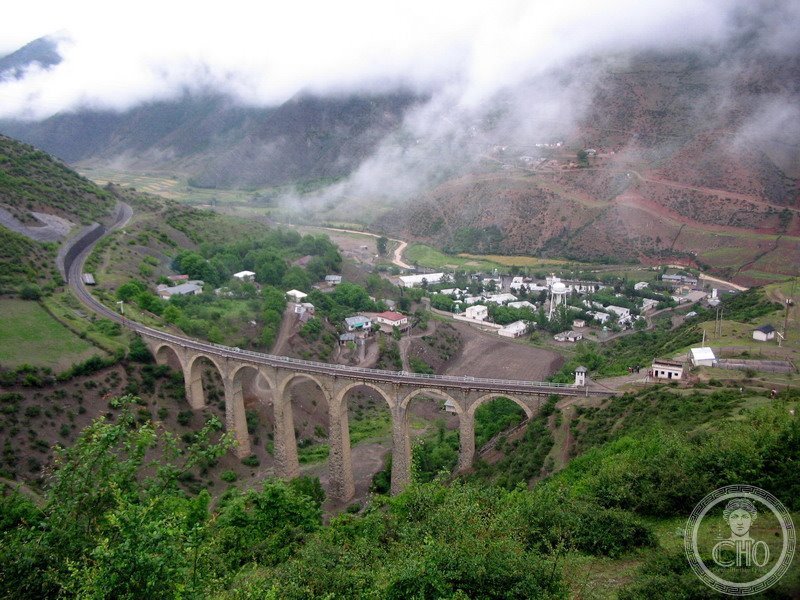
Built in just twelve years across 1,394 kilometres of mountains, deserts, and subtropical forest, the Trans-Iranian Railway stands as one of the most audacious feats of 20th-century engineering — and as a monument to a nation that paid for it entirely with its own resources, refusing foreign debt.
At a glance
The Trans-Iranian Railway connects the Caspian Sea port of Bandar-e Torkaman in the north to the Persian Gulf port of Bandar Imam Khomeini in the south, crossing four distinct climate zones along its 1,394-kilometre length. Commissioned by Shah Reza Pahlavi and built between 1927 and 1939, it traverses the Alborz and Zagros mountain ranges, the semi-arid Iranian plateau, subtropical Caspian forest, and Khuzestan desert. The railway earned UNESCO World Heritage status in 2021 as an outstanding example of 20th-century infrastructure that overcame exceptional natural obstacles through engineering innovation, while representing Iran’s deliberate assertion of economic independence.
Key facts
- UNESCO inscription: 2021, as “Trans-Iranian Railway”
- Total length: 1,394 kilometres, single track
- Construction period: 1927–1939 CE (12 years)
- Tunnels: 224, including the 2,825-metre Zagros summit tunnel cut through solid rock
- Major bridges: 235, crossing gorges, rivers, and mountain passes
- Maximum grade: 2.5% on plateau sections; steep switchbacks in the mountains
- Climate zones crossed: 4 — subtropical Caspian forest, plateau semi-arid, Zagros alpine, Khuzestan desert
- Funding method: National sugar and tea tax — no foreign loans
History
The idea of a north-south railway linking the Caspian and the Persian Gulf had been debated in Iran since the late 19th century, with foreign powers repeatedly proposing lines that would serve their strategic interests. Shah Reza Pahlavi, who came to power in 1925, rejected all foreign-financed proposals and instead levied a national tax on sugar and tea — commodities consumed by all Iranians regardless of class — to fund the project entirely from domestic resources. The symbolism was deliberate: the railway would be Iranian-owned from the first spike.
Construction began in 1927 at both ends simultaneously, with European and American engineering firms contracted to manage sections. The Kampsax consortium (a Danish company) coordinated the overall project. Workforce peaked at approximately 50,000 workers, drawn from Iran and abroad. The northern section through the Alborz Mountains presented the most severe engineering challenges: the mountain range rises steeply from the Caspian coastal plain to altitudes exceeding 2,000 metres over a horizontal distance of less than 50 kilometres, requiring the builders to achieve this climb through tunnels, viaducts, and multiple switchbacks.
The line was completed in 1939 and inaugurated with a symbolic through-journey by Reza Shah. It transformed Iranian commerce, connecting the agricultural and pastoral north with the oil-producing south and giving Iran direct access to both the Caspian trade routes and the Persian Gulf.
In 1941, the Allied powers requisitioned the railway for use as the “Persian Corridor” — the supply route through which Anglo-American war materiel reached the Soviet Union during the Second World War. The strategic importance of the line effectively determined the course of Iranian politics: fearing that Reza Shah might align Iran with Germany, the British and Soviet forces jointly occupied Iran in August 1941 and forced his abdication. The railway that was built to assert independence paradoxically triggered the loss of it, at least temporarily.
Engineering achievement
The northern climb from the Caspian to the plateau is the line’s most celebrated engineering passage. Between Bandar-e Torkaman and Garmsar (the plateau entry point), the railway ascends more than 1,500 metres using a system of horseshoe curves, spiral tunnels, and switchbacks that allow locomotives to gain altitude in terrain that offers no natural gradient. The track doubles back on itself multiple times within a few kilometres, a technique borrowed from alpine railways in Switzerland and Austria but applied here at a scale without precedent in the Middle East.
In the Zagros section, the principal obstacle was the summit tunnel — 2,825 metres of solid limestone cut without modern boring equipment, ventilated by hand-excavated shafts. The 235 major bridges include sweeping stone viaducts crossing gorges more than 100 metres deep. The largest bridge, crossing the Veresk gorge in Mazandaran Province, was singled out by Allied engineers in 1941 as the most impressive railway structure in the Middle East. Its designer, Walter Aigner, reportedly sat under the bridge as the first train crossed it as an expression of personal confidence in the structure.
The Persian Corridor in WWII
Between 1941 and 1945, the Trans-Iranian Railway carried approximately 5 million tons of Allied war supplies to the Soviet Union, including tanks, aircraft, trucks, food, and ammunition. The route, called the “Persian Corridor” by Allied planners, was preferred over the Arctic convoys (which were exposed to German attack) and the Pacific route (closed after Pearl Harbor). American engineers of the United States Army Transportation Corps operated the line from 1942, replacing the worn British locomotives with American equipment and nearly doubling the line’s cargo capacity. The volume of supplies delivered via the Persian Corridor has been credited by some historians as a significant factor in Soviet resilience on the Eastern Front.
Practical information
- Route: Bandar-e Torkaman (Caspian) to Bandar Imam Khomeini (Persian Gulf), via Tehran
- Operator: Islamic Republic of Iran Railways (RAI), operational today as Iran’s main north-south rail artery
- Passenger service: Regular trains Tehran–Mashhad, Tehran–Tabriz, Tehran–Ahvaz and other routes use sections of the line
- Most scenic section: The Alborz crossing between Firuzkuh and Garmsar — accessible by train from Tehran (approx. 3–4 hours)
- Veresk Bridge viewpoint: The Veresk Bridge in Mazandaran is a popular excursion point; accessible by car from Pol-e Sefid
- Visitor access: The line is operational infrastructure; heritage viewing is from public viewpoints along the route
Getting there
The Trans-Iranian Railway is best experienced on a working train. Tehran’s Imam Khomeini railway station serves all intercity routes. For the most dramatic scenery, take the morning train from Tehran toward Sari or Gorgan (Mazandaran Province), which crosses the Alborz section. For the Veresk Bridge specifically, take a bus or hire a car from Chalus or Pol-e Sefid — both are accessible from Tehran in about 3 hours by road. International visitors enter Iran via Tehran Imam Khomeini International Airport; visas are required for most nationalities and are obtainable on arrival for many countries.
Nearby
- Tehran — Iran’s capital; National Museum of Iran, Golestan Palace UNESCO WHS, Grand Bazaar
- Persepolis — 900 km south; UNESCO WHS, ceremonial capital of the Achaemenid Empire
- Isfahan — 450 km south; Naqsh-e Jahan Square UNESCO WHS, Safavid-era mosques and bridges
- Shushtar Historical Hydraulic System — 700 km south; UNESCO WHS, Sassanid-era water management system in Khuzestan Province, the railway’s southern terminus region
Sources
- UNESCO World Heritage Committee, Outstanding Universal Value: Trans-Iranian Railway, 2021
- H. Wulff, “The Traditional Crafts of Persia,” MIT Press, 1966 (background on Iranian infrastructure tradition)
- T.H. Vail Motter, The Persian Corridor and Aid to Russia, United States Army in World War II, Office of the Chief of Military History, 1952
- Wikipedia, “Trans-Iranian Railway” (consulted 2026)
Find it on the map
See this place and what’s around it →📷 Become a Cultural Heritage Online photographer
Share your photos of places: they stay published under your name as the author. The more they're seen, the more you get noticed — and soon a contest will reward the most appreciated photos.
Log in or sign up free to add a photo