

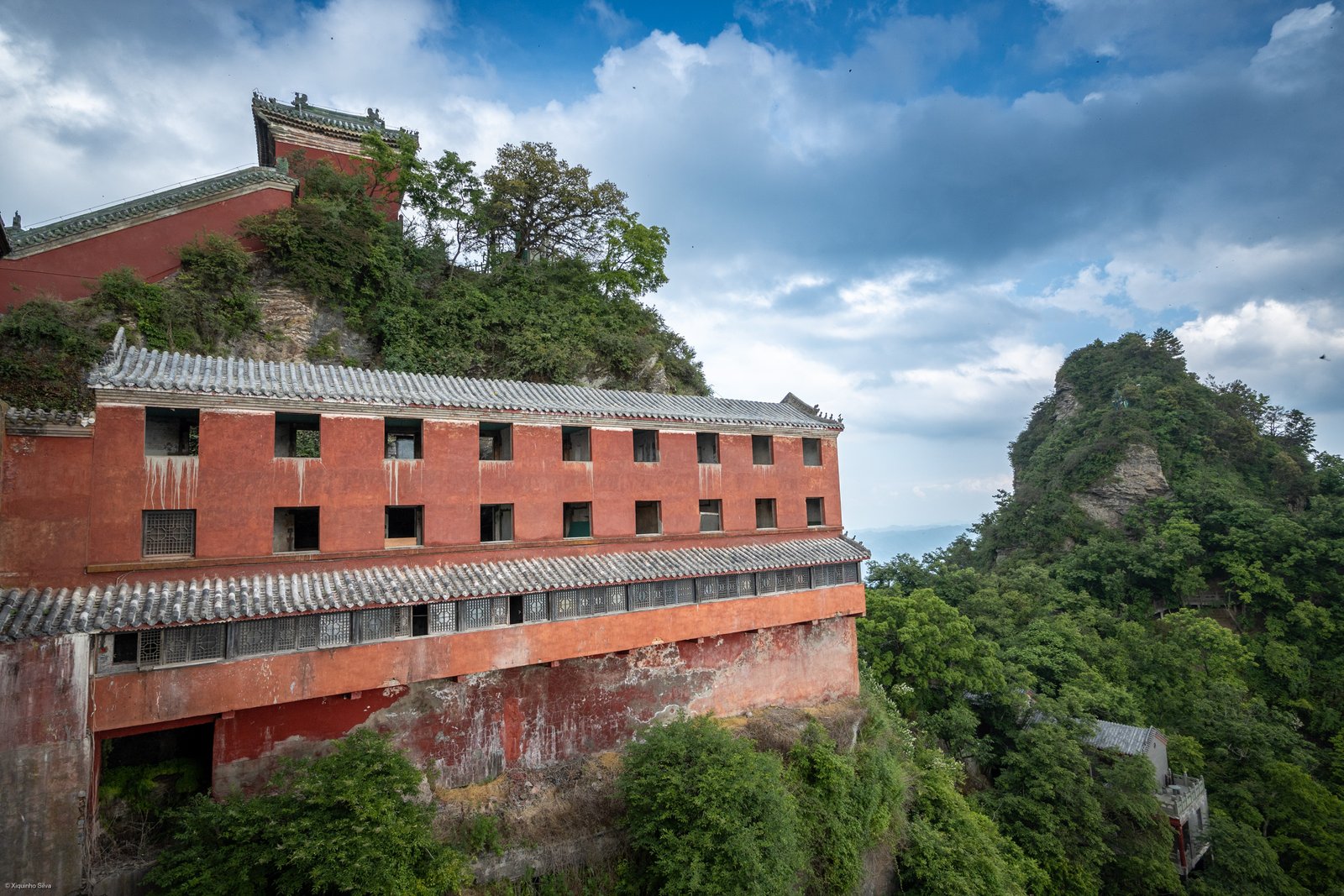
A UNESCO World Heritage Site in Hubei Province, China: a network of Taoist palaces, cliff-face temples, and monastery clusters built across the peaks and ridges of China’s holiest Taoist mountain — including a bronze-gilded summit hall erected in 1416 CE by the Yongle Emperor using 300,000 workers over twelve years.
At a glance
The Wudang Mountains (Wudangshan) in northwestern Hubei Province have been China’s most sacred Taoist site for over a thousand years. The complex of religious buildings inscribed by UNESCO in 1994 encompasses 8 palaces (gong), 2 temples (miao), 36 monastery clusters (an), and 72 cliff-face shrines, connected by a network of ancient stone-paved paths that ascend through dense forest to the mountain summits. The highest peak, Tianzhu Feng, rises to 1,612 metres above sea level.
The buildings were constructed over several centuries, beginning with early Taoist hermitages in the Tang Dynasty (7th century CE), expanding significantly under Song and Yuan patronage, and reaching their definitive monumental form during the Ming Dynasty (1368–1644 CE) — particularly during the reign of the Yongle Emperor, who ordered the largest single construction project in the mountains’ history. The result is one of the most architecturally coherent sacred landscapes in China: buildings designed to be seen from the valleys below, their rooflines punctuating the ridgeline at precisely calculated intervals.
Key facts
- UNESCO status: World Heritage Site (cultural), inscribed 1994.
- Location: Wudang Mountains, Shiyan City, Hubei Province, central China.
- Highest peak: Tianzhu Feng (Heavenly Pillar Peak), 1,612 m above sea level.
- Complex composition: 8 palaces, 2 temples, 36 monastery clusters, 72 cliff shrines.
- Key structure: Golden Hall (Jinding) at the summit, bronze-gilded, erected 1416 CE; Yongle Emperor’s commission.
- Construction scale: Yongle project (1412–1424 CE) involved an estimated 300,000 workers over 12 years.
- Religious tradition: Centre of Chinese Taoism; associated with the Zhenwu (Perfect Warrior) deity cult.
- Martial arts: Legendary birthplace of Wudang-style internal martial arts (neijia), including precursor traditions to Tai Chi.
History
Taoist hermits are recorded in the Wudang Mountains as early as the Eastern Han Dynasty (1st–3rd century CE), drawn by the mountain’s reputation for spiritual power. The formal religious development of the site began under Tang Dynasty patronage in the 7th century CE, when the first permanent structures were built. The mountains’ association with the deity Zhenwu (the Perfected Warrior, later identified with the north and with water) deepened through the Song (960–1279 CE) and Yuan (1271–1368 CE) dynasties, with each new court adding patronage and buildings.
The decisive transformation came under the Ming Dynasty’s Yongle Emperor (r. 1402–1424 CE), who had a personal connection to the Wudang cult: he attributed his successful seizure of the imperial throne in the Jingnan campaign (1399–1402 CE) to the divine intervention of Zhenwu. In gratitude — and to legitimise his rule — he ordered a comprehensive construction project beginning in 1412 CE. The scale was extraordinary: approximately 300,000 workers (including soldiers, craftsmen, and labourers) were mobilised for 12 years to build or rebuild the major palace complexes, lay stone-paved paths, and erect the bronze Golden Hall at the summit of Tianzhu Peak.
The 14th-century legend that the sage Zhang Sanfeng achieved enlightenment in the Wudang Mountains — and in doing so developed the principles of what would become internal (neijia) martial arts — cannot be historically verified, but it cemented the mountains’ status as the spiritual home of a distinctive martial tradition that emphasised internal cultivation over external strength. Wudang-style martial arts are still taught and practiced at the monasteries today.
The buildings survived the disruptions of the Qing Dynasty (1644–1912 CE) largely intact. Several structures were damaged or destroyed during 20th-century political upheavals, particularly during the Cultural Revolution (1966–1976 CE), and have since been restored. The filling of the Danjiangkou Reservoir in the 1970s submerged the historic town of Jinyuan Zhen in the valley below the mountains, displacing the traditional gateway community to the site.
What you see
The summit structure, the Golden Hall (Jinding), is the defining image of Wudang. It is a small bronze-gilded building, approximately 5.5 metres wide and 4 metres deep, erected on a square stone platform at the very tip of Tianzhu Peak. The hall was prefabricated in Beijing, transported piece by piece to the mountain, and assembled at the summit in 1416 CE. Despite its modest dimensions it dominates the skyline and reflects light that is visible from the valleys far below. Inside stands a bronze statue of the enthroned Zhenwu deity.
The Taihe Palace complex immediately below the summit is the most complete major building group. Its red-walled enclosures, tiled gate towers, and subsidiary shrine halls step down the steep peak in a series of terraces. The south gate, approached via a steep stone staircase flanked by incense burners, follows the classic Ming palace ceremonial axis.
The Purple Cloud Palace (Zixiao Gong) is the largest surviving complete palace complex in the mountains, located on a plateau approximately halfway up the main ascent route. Its Great Hall, auxiliary buildings, and surrounding walls date primarily from the Yongle construction campaign. The roof tiles — glazed in turquoise and green — remain intact and are characteristic of the Wudang building tradition. The complex is still an active Taoist monastery.
Why this place matters
The Wudang complex is one of the most complete surviving examples of Ming-Dynasty sacred architecture in China. Unlike the Forbidden City in Beijing — which has been heavily restored and is now a museum — the Wudang buildings remain functioning religious sites, giving the landscape an authenticity of use that reinforces its physical authenticity. Taoist rituals, seasonal festivals, and daily practice continue in the palaces and monasteries.
The site is also a living cultural phenomenon: the martial arts schools that have operated here for centuries still train students in Wudang-style neijia practice. The connection between a sacred mountain landscape and a transmitted physical discipline — where the landscape itself is understood as a teacher — is a form of intangible heritage inseparable from the built complex.
Practical information
- Open: Year-round; scenic area open daily 07:30–18:00 (hours vary by season).
- Entry fee: Scenic area ticket approximately 260 CNY (includes cable car); separate ticket for Jinding summit area approximately 27 CNY.
- Cable cars: Three cable car lines serve different sections; recommended for the upper sections given the steep terrain.
- Summit weather: Temperatures at Tianzhu Peak are significantly lower than the valley; bring a layer even in summer; cloud cover frequently obscures views in July-August.
- Time needed: A full day minimum for the main route; two days allows coverage of the main complexes without rushing.
- Martial arts: Several schools within the scenic area offer short courses and demonstrations for visitors; advance booking required for multi-day programmes.
Getting there
The Wudang Mountains are accessed from Shiyan City in northwestern Hubei. High-speed rail (CRH) serves Wudangshan Station directly, with connections from Wuhan (approximately 2.5 hours), Xi’an (approximately 2 hours), and Zhengzhou. Shiyan is also served by Shiyan Wudangshan Airport with domestic flights from major Chinese cities. From Wudangshan station, shuttle buses and taxis cover the 15 km to the scenic area entrance.
Nearby
- Danjiangkou Reservoir — The largest artificial lake in Asia by surface area, 30 km south; the northern source of China’s South-to-North Water Diversion Project; scenic lakeside landscape.
- Shennongjia Nature Reserve — UNESCO Biosphere Reserve, approximately 150 km southeast; remote forested mountain wilderness in western Hubei, associated with Chinese legends of the Yeren (wildman).
- Ancient City of Xiangyang — A historically significant Ming-Qing walled city on the Han River, approximately 180 km east; one of the best-preserved historic city walls in central China.
Sources
- UNESCO World Heritage Centre. Ancient Building Complex in the Wudang Mountains. whc.unesco.org/en/list/705.
- Wikipedia contributors. Wudang Mountains. en.wikipedia.org/wiki/Wudang_Mountains.
- Wikipedia contributors. Golden Hall (Wudang Mountains). en.wikipedia.org/wiki/Golden_Hall_(Wudang_Mountains).
Find it on the map
See this place and what’s around it →📷 Become a Cultural Heritage Online photographer
Share your photos of places: they stay published under your name as the author. The more they're seen, the more you get noticed — and soon a contest will reward the most appreciated photos.
Log in or sign up free to add a photo